Monday, June 8, 2009

The Spy is In Your Hands

Don't talk: your cell phone may be eavesdropping. Thanks to recent developments in "spy phone" software, a do-it-yourself spook can now wirelessly transfer a wiretapping program to any mobile phone. The programs are inexpensive, and the transfer requires no special skill. The would-be spy needs to get his hands on your phone to press keys authorizing the download, but it takes just a few minutes—about the time needed to download a ringtone.

This new generation of -user-friendly spy-phone software has become widely available in the last year—and it confers stunning powers. The latest programs can silently turn on handset microphones even when no call is being made, allowing a spy to listen to voices in a room halfway around the world. Targets are none the wiser: neither call logs nor phone bills show records of the secretly transmitted data.

More than 200 companies sell spy-phone software online, at prices as low as $50 (a few programs cost more than $300). Vendors are loath to release sales figures. But some experts—private investigators and consultants in counter-wiretapping, computer-security software and telecommunications market research—claim that a surprising number of people carry a mobile that has been compromised, usually by a spouse, lover, parent or co-worker. Many employees, experts say, hope to discover a supervisor's dishonest dealings and tip off the top boss anonymously. Max Maiellaro, head of Agata Christie Investigation, a private-investigation firm in Milan, estimates that 3 percent of mobiles in France and Germany are tapped, and about 5 percent or so in Greece, Italy, Romania and Spain. James Atkinson, a spy-phone expert at Granite Island Group, a security consultancy in Gloucester, Massachusetts, puts the number of tapped phones in the U.S. at 3 percent. (These approximations do not take into account government wiretapping.) Even if these numbers are inflated, clearly many otherwise law-abiding citizens are willing to break wiretapping laws.

Spyware thrives on iPhones, BlackBerrys and other smart phones because they have ample processing power. In the United States, the spread of GSM networks, which are more vulnerable than older technologies, has also enlarged the pool of potential victims. Spyware being developed for law-enforcement agencies will accompany a text message and automatically install itself in the victim's phone when the message is opened, according to an Italian developer who declined to be identified. One worry is that the software will find its way into the hands of criminals.

The current predicament is partly the result of decisions by Apple, Microsoft and Research In Motion (producer of the BlackBerry) to open their phones to outside application-software developers, which created the opening for spyware. Antivirus and security programs developed for computers require too much processing power, even for smart phones. Although security programs are available for phones, by and large users haven't given the threat much thought. If the spying keeps spreading, that may change soon. -- Newsweek

Friday, June 5, 2009

Obama speech in Cairo confirms that his war in Afghanistan-Pakistan is to help build the TAPI pipeline


The planned route of the TAPI pipeline Obama is sending 17000 troops to die for TAPI.... in Afghanistan


'All tyranny needs to gain a foothold is for people of good conscience to remain silent'. - Thomas Jefferson

President Barack Obama's speech in Cairo on June 4 was a carefully prepared speech meant to explain the administration's policies in the Middle East to the people of the region. I listened to see how he would explain his controversial decision to increase the number of U.S. troops and military activity in Afghanistan and Pakistan, a decision I strongly oppose. What I heard in Obama's speech about Afghanistan was very discouraging in that it revealed the appalling continuation of the blatant 9-11 deception by the new administration.

Here is the essence of what Obama said about 9-11 and the war in Afghanistan and Pakistan:
The first issue that we have to confront is violent extremism in all its forms. In Ankara, I made clear that America is not and never will be at war with Islam. We will, however, relentlessly confront violent extremists who pose a grave threat to our security because we reject the same thing that people of all faiths reject, the killing of innocent men, women, and children. And it is my first duty as president to protect the American people.

The situation in Afghanistan demonstrates America's goals and our need to work together. Over seven years ago, the United States pursued Al Qaida and the Taliban with broad international support. We did not go by choice. We went because of necessity. I'm aware that there's still some who would question or even justify the offense of 9/11. But let us be clear. Al Qaida killed nearly 3,000 people on that day.

The victims were innocent men, women, and children from America and many other nations who had done nothing to harm anybody. And yet Al Qaida chose to ruthlessly murder these people, claimed credit for the attack, and even now states their determination to kill on a massive scale. They have affiliates in many countries and are trying to expand their reach.

These are not opinions to be debated. These are facts to be dealt with. Make no mistake, we do not want to keep our troops in Afghanistan. We see no military -- we seek no military bases there. It is agonizing for America to lose our young men and women. It is costly and politically difficult to continue this conflict.

We would gladly bring every single one of our troops home if we could be confident that there were not violent extremists in Afghanistan and now Pakistan determined to kill as many Americans as they possibly can. But that is not yet the case.

And that's why we're partnering with a coalition of 46 countries. And despite the costs involved, America's commitment will not weaken…

This is how Obama explained the U.S. war effort in Afghanistan and Pakistan: As a necessary confrontation with 45 nations against the violent extremists behind the attacks of 9-11. We would bring our troops home, he said, if there were no "violent extremists" in those countries "determined to kill as many Americans as they possibly can."

What is the real reason behind Obama's war in Afghanistan?

THE 9-11 DECEPTION

Al Qaida was behind the mass murder of thousands of people on 9-11, Obama said. This is not an opinion to be debated, he added. "These are facts to be dealt with."

If the Obama administration were truly concerned about facts, he might take note of the disturbing fact that not a single 9-11 victim's case has gone to trial after nearly 8 years. If the legal case were so solid that Osama Bin Laden and his agents committed 9-11, why has the evidence not been presented in an open trial in a U.S. court? The military is supposedly holding Khalid Sheikh Mohammed, the person who is the "confessed" mastermind of 9-11, in Guantanamo. Why is he not put on trial in an open court? Why have the surviving airplane parts not been identified? Why has the evidence of thermite in the collapsed towers not been addressed?

One of the 9-11 facts the Obama administration will have to deal with is the evidence of super-thermite in the dust of the World Trade Center. This thin layer of super-thermite was evidently used to pulverize the concrete in the twin towers on 9-11. The people who applied tens of tons of thermite to the interiors of the twin towers are, in fact, directly responsible for the murder of 3,000 people on 9-11. If Al Qaida had teams of men spraying super-thermite and placing explosive charges in the buildings leased and owned by Larry Silverstein and the Israeli commando Frank Lowy, let's see the evidence. Otherwise, let's find out who really put the super-thermite in the twin towers.

The United States went to war in Afghanistan out of "necessity," Obama said, yet the American public has not been given any solid evidence to prove that the Taliban of Afghanistan had anything to do with 9-11. Why then is the Zionist-run Obama administration sending more troops to Afghanistan? And why have they expanded the war into Pakistan?

I have discussed in several articles the powerful Zionists behind the Obama White House. Obama was sponsored and molded since 1992 to be the first black president of the United States by the daughter of Philip Morris Klutznick, the former president of the B'nai B'rith and mega Zionist from Chicago. The chief of staff of the White House is Rahm Emanuel, an Israeli national whose father was a member of a Zionist terrorist organization in Palestine that was allied with Nazi Germany. These are a few real facts, not opinions, that need to be dealt with.

Understanding the Zionist nature of the Obama administration, the question that must be asked is why is the administration expanding the war in Afghanistan and Pakistan? The American people certainly have no real interest in Afghanistan or Pakistan and the Afghans and Pakistanis have no real interest in America. There must be a Zionist strategic goal in controlling these two Central Asian nations, but what is it?

As I pointed out in my article from 2001, "The Great Game: The War for Caspian Oil and Gas," the Israelis are deeply engaged in the region:

Turkmenistan and Azerbijan are also both closely allied with Israeli commercial interests and Israeli military intelligence. In Turkmenistan, a former Israeli intelligence agent, Yosef A. Maiman, president of Merhav Group of Israel, is the official negotiator and policy maker responsible for developing the energy resources of Turkmenistan.

"This is the Great Game all over," Maiman told the Wall Street Journal about his role in furthering the "geopolitical goals of both the U.S. and Israel in Central Asia. "We are doing what U.S. and Israeli policy could not achieve," he said, "Controlling the transport route is controlling the product."

"Those that control the oil routes out of Central Asia will impact all future direction and quantities of flow and the distribution of revenues from new production," said energy expert James Dorian recently in Oil & Gas Journal on September 10, 2001.

Foreign business in Turkmenistan is dominated by Maiman's Merhav Group, according to the Washington Report on Middle East Affairs (WRMEA). Maiman, who was made a citizen of Turkmenistan by presidential decree, serves as Turkmenistan's official negotiator for its gas pipeline, special ambassador, and right-hand man for the authoritarian President Saparmurad Atayevich Niyazov, a former Politburo member of the Central Committee of the Communist Party of the Soviet Union.

The Merhav Group of Israel officially represents the Turkmen government and has brokered all of the energy projects in Turkmenistan, contracts worth many billions of dollars.

ISRAEL & THE TAPI PIPELINE

The main Zionist goal in Afghanistan and Pakistan is to "pacify" these nations to allow the Turkmenistan-Afghanistan-Pakistan-India (TAPI) gas pipeline to be built. This line, once completed, could be extended to China. This project is the pipe dream of Joseph A. Maiman (a.k.a. Josef, Yosef, Yossi), one of the most powerful men in Israel.

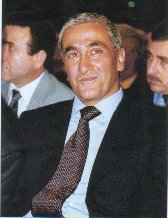
Yosef A. Maiman

The Jerusalem Post of 23 July 2004, described Maiman as one of the leading miners of the gas of Central Asia, specifically Turkmenistan:

Though his sprawling multi-billion-dollar empire stretches from Channel 10 TV, where he is a partner, to Central Asian gas fields, where he is a leading miner, Maiman was born humbly, in a displaced persons camp in Germany, and grew up in Peru.

Maiman's Merhav Group started off in 1976 with Third World debt-financing, but later diversified into agriculture, energy solutions and telecoms. Today, it is the Republic of Turkmenistan's single largest foreign partner.

Just two weeks ago, the Israeli foreign ministry announced it would open a new embassy in Ashgabat, Turkmenistan, "saying it was a natural step in burgeoning bilateral ties, and reflected a new momentum in Israel's overall ties with the Central Asian countries," according to the Jerusalem Post of 21 May 2009.

Turkmenistan is reported to be "the second largest holder of gas reserves in the world, with some 28 trillion cubic meters of proven gas reserves," second only to Russia. The "former" Israeli Mossad agent Joseph A. Maiman is reportedly the owner or co-owner of much of that gas and has been the key person managing the development of Turkmenistan's gas fields. If the TAPI pipeline were to be completed, the Israelis connected with Maiman and Merhav would collect tens of billions of dollars by selling the gas of Turkmenistan to Pakistan, India, and China. This is certainly one of the key Israeli strategic goals in Afghanistan and Pakistan. The pipeline is meant to pass through Kandahar, the area where Canadians are serving and which Canada is obliged to defend until 2012.

The planned route of the TAPI pipeline

Mr. Maiman is also a business partner of Rupert Murdoch and Ronald Lauder. In November 2002, Yossi Maiman and the former head of the Mossad, Shabtai Shavit, launched a new political party with the former head of the Shin Bet, Ya'acov Perry. These people are all closely tied to the false-flag terror attacks of 9-11. Their roles are described in my chapter entitled, "The Architecture of Terror."

To really understand why the Obama administration is sending more troops to Afghanistan and waging war in Pakistan it is essential to understand what is at stake and who will benefit from the TAPI pipeline. Obama's speech in Cairo today was a blatant deception about the real purposes of the war in Central Asia.

OBAMA IN DRESDEN

Obama flew to Germany after speaking in Cairo and landed in Dresden, the Saxon capital city on the Elbe. Dresden was completely obliterated in a Allied fire-bombing attack on Valentines Day and Ash Wednesday 1945. Eyewitnesses to the holocaust of Dresden estimate that more than 500,000 people were killed in the attack in which the entire inner city was incinerated. Obama will visit the Buchenwald concentration camp in the outskirts of Weimar. I spent a month in Dresden and visited Buchenwald. I discovered that the death rate for German prisoners held in Buchenwald during the Soviet occupation was much higher than the death rate in the camp during the war.

Here are a few extracts from my Letter from Buchenwald:

According to a U.S. Army report dated May 25, 1945, a total of 238,980 prisoners had been held at Buchenwald in the period from July 1937 to April 1945. Of this number 34,375 died. This report, which shows a mortality rate of some 14 percent, was based on camp records confiscated by the U.S. Army.

Shortly after the U.S. Army "liberated" Buchenwald, it was turned over to the Soviet Union and became the so-called Special Camp No. 2 from 1945 to 1950. As the guide book, written by Sabine and Harry Stein says, "Prisoners moved into the barracks again hardly four weeks after the last survivors had left the National Socialist concentration camp in Buchenwald. Buchenwald became a place of isolation and death for another four and a half years...."Hunger and isolation seriously affected everyday life.

Hunger was almost omnipresent. Mass deaths ensued when the restricted rations were cut temporarily."More than one third of the total number of 122,671 prisoners died in the course of being there," the guide says about the post-war Soviet prison camp. "The victims of Buchenwald Special Camp were buried in mass graves. Their relatives did not receive any official notification."The history of Special Camp No. 2 and the existence of mass graves was subject to taboo in the German Democratic Republic," the guide says.The official mortality rate in the Soviet camps during the post-war period was more than twice that of Buchenwald during the war. According to camp records kept by the Soviet Union, the Soviet prison camp system in Germany held 122,671 prisoners between 1945 and 1950 of which 42,889 died. This is a death rate of nearly 35 percent. In addition, 756 persons were executed.

To understand what really happened in both of these places, I recommend reading my articles from Buchenwald and Dresden.

Sources and Recommended ReadingAbout Buchenwald and Dresden:Bollyn, Christopher, "Letter from Buchenwald," November 12, 2005
Bollyn, "Letter from Slaughterhouse Five," February 19, 2004
About Afghanistan and the Deception of 9-11:"Active Thermitic Material Discovered in Dust from the 9/11 World Trade Center Catastrophe," Steven E. Jones et al, The Open Chemical Physics Journal, March 2009

Bollyn, Christopher, "The Great Game: The War for Caspian Oil And Gas," September 25, 2001

Wednesday, June 3, 2009

Traitors, Paid agents and creeps for hire.....لو كان سمير قصير حيا لإعتقله الجيش اللبناني بتهمة التجسس لمصلحة إسرائيل


Traitors, Paid agents and creeps for hire.....

http://filkkaisrael.blogspot.com/2009/06/blog-post_03.html

لو كان سمير قصير حيا لإعتقله الجيش اللبناني بتهمة التجسس لمصلحة إسرائيل


ما هي الصفات التي جعلت من سمير قصير نجما في حياته القصيرة ونجما بعد موته ؟
الإجابة سهلة ومتعددة الإتجاهات.
على سعيد النجومية في حياته ، فقد لعب كون سمير قصير من أصل فلسطيني مسيحي دورا في تربيته داخل المناطق الإنعزالية المسيحية خلال الحرب اللبنانية. هذه المخالطة للكتائبيين بقيادة بشير الجميل جعلت منه مكسبا للمسيحيين ضد منظمة التحريري الفلسطينية فحضنوه إلى أن سافر إلى فرنسا .
في لبنان وقبل سفره إلى فرنسا كتب الصبي في صحف إنعزالية مثل اللوريان لوجور وفي صحيفة الحزب الشيوعي التي كان إسمها النداء .
في فرنسا التي وصلها مطلع الثمانينات ، وكفلسطيني إستقبلته سفارة منظمة التحرير عبر ناشطيها بالترحيب حين تواصل معهم . ومن خلال لغته الفرنسية الجيدة التي كسبها من خلال تربيته المنزلية كمسيحي من عائلة متفرنسة ناكر لأصلها الفلسطيني فقد فتحت له منظمة التحرير علاقات كثيرة مع معارفها ومع مساندي القضية الفلسطينية.
في تلك المرحلة كان هناك عقيد في الإستخبارات الفرنسية الخارجية إسمه ميشال سورا يعمل من خلف الستار كباحث في شؤون الشرق.
معارف ميشال سورا كانوا كثرا بين الفلسطينيين ومن خلالهم تعرف على سمير قصير .
لفت سمير نظر ميشال سورا إلى ثلاث صفات فيه:
أنه مسيحي فلسطيني
أنه إنعزالي مسيحي على الطريقة الكائبية البشيرية .
أنه يتحدث العربية والفرنسية بطلاقة متقابلة.
كان سمير وقتها يدرس ويبحث عن عمل فتعرف عن طريق منظمة التحرير على الصحافي اللبناني جوزيف سماحة رئيس تحرير اليوم السابع في باريس وهي مجلة لبنانية بنفس قومي عربي.
وظف سماحة الشاب سمير قصير الذي كان في ذلك الوقت قد تجند مع الإستخبارات الفرنسية بواسطة صديقه الحميم ميشال سورا رجل الإستخبارات الفرنسية.
كان سورا يعمل على مشروع موسوعة إستعلامية إستخبارية تطلب منه مسحا شاملا لمجتمع لبنان وكان سوريا يعرف بأن النجم الصاعد في لبنان لن يكون نموذج اللبناني التاجر بل اللبناني المقاوم لإسرائيل ولأميركا.
من مهام سمير قصير كانت مراجعة لترجمة الأبحاث التي كانت تصل إلى ميشال سورا من مراسليه وعملائه في لبنان لكي يفهم ميشال سورا فهما أعمق ما يحصل عليه من معلومات عن المجتمع اللبناني.
وخلال سنوات من عمل سمير قصير مع المخابرات الفرنسية إقتصر عمله على مساعدة سورا في تحليل المعلومات التي كان يحصل عليها أو تصل إليه .
وفي نفس الوقت إجتهد سمير في مراقبة الفلسطينيين المصنفين خطرين في باريس من قبل الفرنسيين فكتب فيهم التقارير الأمنية كمخبر وضيع لا أكثر ولا أقل .
أحد العاملين في اليوم السابع أمسك بسمير وهو يكتب تقريرا في مكتبه عن جوزيف سماحة نفسه بهدف رفعه إلى الإستخبارات الفرنسية فجرى طرده من اليوم السابع فإنتقل للعمل في مركز فلسطيني للدراسات وهو ما أعطاه أهمية أكبر لدى الفرنسيين الذين لاحظوا وسامة في وجهه وطلاقة في لسانه وقدرة على الحوار وعلى العلاقات العامة وهي صفات الجاسوس الناجح .
رسموا له مخططا لحياته ولعمله معهم تقوم على التالي :
عليه أن يلعب دور المناضل الفلسطيني المطالب بالسلام مع الصهيونية وبتناسي حق العودة
عليه العمل إنطلاقا من الثقافة على الدخول إلى السياسة وحيث أنه لم يدرس الصحافة فقد سهلوا له الحصول على الدكتوراة في التاريخ وقد تبين فشله على لسانه حيث يقول بأن كتابه عن بيروت تطلب منه ثلاث سنوات من العمل ولو راجعتم الكتاب فهو نسخ عن كتب فرنسية منها الموسوعة الفرنسية المسماة تاريخ العالم الصادرة عنمجموعة علماء في تاريخ العالم من باريس . 5

أما كتابه عن الحرب اللبنانية فهو تفاهة بكل معنى الكلمة ولو عاش أي فرنسي في لبنان بمقدار ما عاش سمير في بيروت وقت الحرب لعرف كيف يشرح خلفياتها بطريقة أفضل وهو أيضا كتاب فاشل ويظهر بأن سمير لم يتقن إلا فن كتابة التقارير التجسسية على أصدقائه.
بالطبع كان للرجل شخصية محببة ، والشيطان نفسه بحسب الإيمان المسيحي سيظهر في نهاية الزمن بشكل المسيحي نفسه وهو المدعو مسيحا كذابا.
سمير قصير أيها السادة كان يهوذا الإسخريوطي ومسيحا كذابا لكل من عرفه ، لأن ما من شخص جلس معه إلا وكتب كل ما تباحثا فيه في تقرير وأرسله إلى المخابرات الفرنسية.
وهناك علامة فارقة في علاقة هذا الشاب بالصهيوينة، فيساريته هي نفسها يسارية الهستدروت وحزب العمل الإسرائيل ولهذا كان له علاقات قوية جدا مع الصهاينة الفرنسييين بحجة أنه فلسطيني يحاور لأجل السلام .
العمالة للفرنسيين ومن خلالهم كانت على ما يبدوا تدريبا على العمالة لإسرائيل التي فتح خطا مباشرا مع إستخباراتها مقابل المال وبراتب شهري كبير نظير تقاريره عن الفلسطينيين والعرب المقيمين في باريس .
وكان أول ظهور علني له في موقف مساند لإسرائيل هو حين طلبه اللوبي الصهيوني الفرنسي للشهادة ضد الكاتب الفرنسي الشهير روجيه جارودي والذي كان يحاكم بتهمة معاداة السامية بسبب كتابه " الأساطير المؤسسة للكيان الصهيوني"
الرجل في كتابه تحدث عن التلمود كأساس للعنصرية الإسرائيلية ضد الأغيار وكان غارودي في موقف قوي جدا في المحكمة لأنه لم يتحدث بشيء إلا وورد في التلمود ولم يخترع أي شيء من عنده .
لكن القضاء الفرنسي قبل بشاهد طلبه اللوبي الصهيوني في فرنسا وفوجيء القاضي وغارودي نفسه بالشاهد الذي لم يكن إلا اللبناني الجنسية الفلسطيني الأب السوري الأم المسيحي الإنعزالي النازي سمير قصير .
صعق وجود الشاب وقتها روجيه غارودي خصوصا حين عرف أنه يعمل في مركز الداراسات الفلسطينية التابع لمنظمة التحرير .
شهادة سمير قصير كعربي فلسطيني بأن كتاب غارودي هو وثيقة يتداولها المتطرفون المسلمين في العالم العربي لتشريع قتل كل اليهود هو ما أدى إلى إدانة روجيه غارودي الذي لم يضف كتابه أي شيء إلى تطرف المتطرفين ولا إلى عقائد الكارهين.
حينها ولأن المنظمة يومها لم تكن بعد قد باعت فلسطين لأجل مبنى حكومي وحرس رئاسي في رام الله فقد طردوه من مركز الدراسات الفلسطيني ورموا بأشيائه إلى الشارع مثلما يرمى رسن الكلب الأجرب.
منذ تلك اللحظة فهم الفلسطينيون والعرب في باريس بأن سمير قصير ليس إلا مخبر للإسرائيليين عليهم فأنكروا عليه معرفتهم به وتجنبوه وقاطعوه.
الإستخبارات الفرنسية لم تكن لتترك عمل كبير قام به ميشال سورا في لبنان بلا متابعة ، وكان ذاك قبل موته مقتولا في بيروت ومرمى به تحت تراب طريق مطار بيروت ، كان قد أنجز وضع خريطة طائفية للبنان فأثمرت تلك عبر المخابرات الدولية ومنها الفرنسية قلاقل طائفية في لبنان وبين الطوائف نفسها.
وكان على هذا العمل الموسوعي أن يستكمله أحد ما يفهم فيما كان ميشال سورا يعمل عليه .
هنا أتى دور سمير قصير في بيروت وغدا نروي لكم الحلقة الثانية عن المخبر الذي أصبح بطلا .
عفوا أليست بيروت تعج بأسماء الطرقات المسماة على أسماء الخونة والمستعمرين والعملاء ؟

Wednesday, May 13, 2009

SPECIAL REPORT. The history of the synthetic H1N1 flu virus and a not-so-rosy future


May 13-14, 2009 -- SPECIAL REPORT. The history of the synthetic H1N1 flu virus and a not-so-rosy future

The history of the extraction of the genetic material from the corpses of victims of the 1918 Spanish influenza virus who were buried in Arctic permafrost is part "X-Files" and part "Jurassic Park." After an unsuccessful 1951 mission, that involved U.S. biological warfare specialists, to extract 1918 Spanish flu genetic material in 1951 from a cemetery in the Inupiat Eskimo village of Brevig Mission, Alaska, scientists made another attempt, a successful one it turns out, in 1997. Dr. Johan Hultin, from the State University of Iowa, successfully extracted genetic material from the corpse of an obese thirty-something female who died from the Spanish flu in 1918, along with 85 percent of Brevig Mission's (called Teller Mission in 1918) villagers in a single week. The pandemic killed at least 50 million people around the world.

Once the Spanish flu genetic material was obtained from the lungs, spleen, liver, and heart of the Eskimo woman's corpse, scientists, in a scene reminiscent of the fictional movie "Jurassic Park," in which genetic material from extinct dinosaurs is used to bring the creatures back to life, recreated the long-since dead 1918 Spanish flu in a U.S.-government funded laboratory. The woman's organs were cut into one-inch cubes and shipped to the Armed Forces Institute of Pathology in Rockville, Maryland where the virus's genetic RNA material was identified and the 1918 Spanish flu was successfully brought back to life.

The search for the frozen bodies of 1918 flu victims was not limited to Alaska. Another team of scientists, acting like Dr. Frankenstein's "Igor," set out to dig up the graves of miners who died from the flu in the remote Norwegian mining village of Longyearbyen in Spitsbergen, which lies north of the Arctic Circle.

WMR has learned from a research scientist who has been working on the recreation of the 1918 flu that the genetic material has been re-engineered to synthetically create what is now known as the A/H1N1 virus, or as the Centers for Disease Control (CDC) calls it, the "novel flu."

The A/H1N1 influenza, which contains genetic material from two strains of swine flu, two strains of human flu, and a single strain of avian flu, has, according to the World Health Organization (WHO), infected a total of 4880 people in North America: 2,059 in Mexico; 2,535 in the United States, and 286 in Canada. There have been 56 reported deaths from the flu in Mexico, three in the United States, and one in Canada.

WMR has learned from an A/H1N1 researcher that the current "novel" flu strain is mutating rapidly in humans but no animals have contracted the virus. The enzyme in A/H1N1, as with all influenza A viruses, is called a polymerase. Scientists have calculated the molecular clock of A/H1N1 form the virus's polymerase rate. Because of the rapid mutation of the virus and the fact that, unlike 1918, rapid global transportation is now the norm, scientists are predicting that the molecular clock of the A/H1N1 virus, coupled with modern transportation, means that almost all the countries of the world will experience an A/H1N1 outbreak within the next few months.

What is different about A/H1N1 is that, unlike other new strains of viruses that rapidly mutate upon emerging and then slow down mutation and then stop entirely, the "novel" or incorrectly-named "swine flu" is showing no signs yet of slowing down its mutation rate and that, according to scientists who worry about A/H1N1 being synthetically-generated, does not happen in nature.

In 2006, at a summit meeting in Cancun, Mexico, President George W. Bush, Canadian Prime Minister Stephen Harper, and Mexican President Vicente Fox agreed for their nations to coordinate their response to avian flu, which was spreading in Asia. National Public Radio, on April 2, 2006, ran a segment on how bird flu wreaked havoc in 1918 in Brevig Mission. NPR's Weekend Edition ran a report from Brevig Mission by Lori Townsend of Alaska Public Radio:

"The grave has been opened twice by the same pathologist. In 1951, Johann Hultin convinced village elders to allow him to take tissue samples from bodies buried in permafrost. His lab attempts to map the virus were unsuccessful, but he returned in 1997, and when he did, he was once again given permission to re-open the grave."

WMR has learned from a journalist from Anchorage who covered the 1997 grave exhumation that there was CIA personnel with the team of scientists. Inuit elders of Brevig Mission argued against digging up the graves of the flu victims would release evil spirits. However, money allegedly changed hands between the U.S. government research team and some of the elders, so permission to dig up the graves was granted.

NPR and Alaska Public Radio was reporting what was extracted from the 1918 flu victim's corpse was the H5N1 avian flu virus, but that was erroneous. Or was it? If what was extracted from the dead woman's body in Brevig Mission was used to synthetically create the current A/H1N1 virus, there is a strain of avian flu in the virus. But the current A/H1N1 virus also contains swine and human flu strains.

What has been relayed by the researcher is that the original 1918 virus was the H1N1 virus. In Bio-safety level 3 (BSL-s) laboratory work that was largely classified, the virus was artifically combined with common H3N2 and a minor gene splice from the H5N1 Eurasian avian flu strain.

The avian flu or H5N1 virus that struck Asia in 2006 contained some genetic mutations of the 1918 virus. And scientists researching pandemic flu strains have, since the recreation of the 1918 flu, been playing fast and loose with flu samples. On April, 17, 2005, The Washington Post reported that Meridian Bioscience, which was under contract to the College of American Pathologists, accidentally distributed the pandemic H2N2/Japan flu strain, as part of a flu testing kit, to influenza laboratories around the world. WHO ordered the labs to immediately destroy the flu sample because it was worried about an accidental release of the pandemic virus, resulting in a global health crisis. In 1957, H2N2 killed a million people around the world.

The Post'sarticle, by Wendy Orent, states that scientists were working to create an artificial strain of the 1918 virus: "[Scientists] can combine some 1918 genes either with laboratory strains that have been adapted to grow in mice, which don't normally catch human flu, or with ordinary human flu strains to yield new artificial strains. Then the researcher infects mice with his new strain. Strains using three of the 1918 genes are already known to kill mice."

The same Postarticle quotes Peter B. Jahrling, the chief scientist at the National Institute of Allergy and Infectious Diseases, about the danger of the virus recreation research. Jahrling stated the research was like "looking for a gas leak with a lighted match." The article continues: "What concerns Jahrling and Brown, among others, is that experiments involving 1918 genes are not being carried out under the highest biosafety level, BSL-4. While most of the scientists use what is known as BSL-3 plus, or enhanced, conditions, they do not use space suits, chemical showers or gas-tight cabinets in their work."

Lastly, the article has a stark warning regarding the 1918 flu reconstruction at the military laboratory in Rockville, research led by Dr. Jeffery Taubenberger. The article states: "Even more disturbing is what may happen when Taubenberger publishes the remaining three gene sequences. Then the entire 1918 flu could be built from scratch by anyone, anywhere, who has sufficient resources and skill. It is quite conceivable that resurrected 1918 flu could someday be used as a bioterrorist agent."

In a January 29, 2006, New York Times article by Jamie Shreeve, titled "Why Revive a Deadly Flu Virus?," it is reported that the 1918 flu had been successfully revived. The article states: "In October, a team of scientists, [CDC's Terrence] Tumpey among them, announced that they had recreated the extinct organism from its genetic code -- essentially the scenario played out in the movie ''Jurassic Park,'' albeit on a microbial scale. In the movie, the scientists' self-serving revivification of dinosaurs leads to mayhem and death . . . . How dangerous is the 1918 virus to today's population? Its genetic code is now in public databases, where other researchers can download it to conduct experiments. Scientists from the University of Wisconsin and the National Microbiology Laboratory in Canada have already collaborated to reconstruct the virus from the publicly available sequence. How easy would it be for a bioterrorist to exploit the same information for malevolent ends?"

The article details how the 1918 genetic material was extracted and who worked on the project: "The resurrection of the 1918 influenzavirus was a team effort engaging the resources of the C.D.C. in Atlanta, an obscure military pathology lab outside Washington, D.C., an esteemed group of influenza experts at Mount Sinai School of Medicine in New York and one elderly Swede. Though the story has been told before, it is impossible not to begin with the Swede. In 1950, Johan Hultin, then a 25-year-old graduate student at the University of Iowa, was searching for a Ph.D. topic when he heard a visiting virologist say that the only way to solve the mystery of the 1918 pandemic would be to recover the virus from a victim who had been buried in permafrost."

There has been yet another secretive U.S. government group involved in researching bio-warfare agents like influenza. Known simply as JASON, the group consists of civilian scientists, the top experts in their fields and a number of Nobel laureates, who meet periodically and issue reports, many of which are classified. JASON has been in existence for 40 years and is thought to be a follow-on to the Manhattan Project, the top secret scientific group that created the atomic bomb during World War II. In fact, some of JASON's earliest members helped to design both the atomic and hydrogen bombs. Its first three members were scientists at Los Alamos National Laboratory, the home of the Manhattan Project.

Operating under the aegis of the MITRE Corporation, a federally-funded contracting entity, JASON scientists primarily met in the highly-secured Building 29 at 3550 General Atomics Court in San Diego. The location is the address of the Torrey Pines Institute. Funded by the Defense Advanced Research Projects Agency (DARPA), JASON also has links, according to distribution lists on JASON reports, to the CIA. The CIA maintains an element called the IC [Intelligence Community] JASON Program under the Chief Technical Officer. Traditionally, JASON self-selects its members from a number of academic disciplines. However, JASON almost lost its funding a few years ago, when, after issuing a report critical of the Bush administration's ballistic missile defense program, DARPA attempted to force three new members, obviously political overseers, on to the JASON membership rolls. DARPA's chief Tony Tether pulled funding for JASON, forcing the group for the first time since its inception in 1959 to look for another Pentagon sponsor. The ballistic missile defense program, also called Star Wars II, was a personal pet project of Secretary of Defense Donald Rumsfeld.

JASON survived when DARPA's parent orgzniation, the Pentagon's Directorate for Defense Research and Engineering (DDR&E), provided JASON with direct funding, an indication of the power enjoyed by the secretive JASON organization. JASON also has other federal government sponsors, including the Department of Energy.

JASON is also very much involved in issues of biological warfare. JASON produced a report on Civilian Biodefense in January 2000, which was highly-redacted when released. Even the names of the report's authors and the information on four bio-warfare scenarios is completely blacked out, except for a discussion of a 1947 smallpox incident in Scenario Two. The report also states that the CIA's Clandestine Measurement and Signatures Intelligence (MASINT) Operations Center and Counter-Proliferation Center were interested in biological weapons intelligence collection and signatures. A section of the report on "Managing Civilian Response" to a bio-war attack is also completely redacted, as is a section on domestic intelligence. A page on the anthrax threat references "psychological BW [biological weapons] warfare." The JASON report was completed almost two years before anthrax attacks all but suspended the work of Congress after 9/11 and saw the quick passage of the US Patriot Act.

The JASON report also discusses the mining of medical data, including patient billing records, to find out if a disease outbreak has occurred and how far and what direction it is spreading by examining "spatiotemporal patterns," including "averaging statistics for humans traveling globally."

In fact, the JASON Civilian Biodefense report mirrors, in many respects, the analysis being currently conducted by medical intelligence (MEDINT) agencies around the world on the outbreak and spread of A/H1N1. And that begs the question: is A/H1N1, artificially-developed by U.S. government scientists, the real thing or a test run for something much worse?

---

SIDEBAR:

The Jason report on bio-war discusses "managing civilian response." That also appears be a major concern of the CDC on A/H1N1 at the present time judging from the following internal CDC memo obtained by WMR (note that "swine flu" is being referred to as the "novel H1N1 flu"):

From: CDC Announcements
Sent: Monday, May 11, 2009 10:31 AM
To: CDC All - [REDACTED]
Subject: Public Inquires Regarding Novel H1N1 Flu – CDC-INFO
Public Inquires Regarding Novel H1N1 Flu – CDC-INFO

The CDC National Contact Center, CDC-INFO, is available to assist CDC programs in responding to calls and emails related to the novel H1N1 flu. CDC-INFO maintains current content for phone and email responses; maintains records of calls/emails; collects and analyzes quality assurance and customer satisfaction data; and provides on-demand reports for program partners.

If the general public is contacting you with questions related to the novel H1N1 outbreak, we encourage you to direct those inquires you receive to CDC-INFO. CDC-INFO representatives are available to respond to inquiries 24 hours, 7 days a week via email and phone, in English and Spanish. Emails should be forwarded to cdcinfo@cdc.gov. Telephone inquiries may be routed to 1-800-CDC-INFO (1-800-232-4636).

If you have any questions regarding this email, or for assistance in routing public inquiries, please contact eocjiccdcinfo@cdc.gov.

CDC-INFO’s Novel H1N1 Flu Response

Since April 22, 2009, CDC-INFO has answered more than 29,000 phone and email inquiries from the general public and health care professionals in support of CDC’s novel H1N1 flu response. As of Friday, May 8, 2009, the average hold time for phone calls related to novel H1N1 flu was less than 5 seconds. To date, the states with the highest number of phone inquiries are: California, Texas, New York, Florida, and Georgia.

On Thursday, April 30, 2009, CDC-INFO answered the highest number of inquiries on a single topic in its 4-year history, with 3,127 calls and emails answered related to the novel H1N1 outbreak.

As of May 5, 2009, 75 percent of survey respondents gave CDC-INFO their highest satisfaction rating for the novel H1N1 flu-related services they received.

Supporting CDC’s Mission

The CDC-INFO National Contact Center (1800-CDC-INFO or cdcinfo@cdc.gov) supports CDC’s mission by providing a single trusted source of accurate, timely, consistent, and science-based information for the general public, healthcare providers and public health partners. Information is available on more than 400 CDC health and safety topics, disease prevention, and health promotion information through phone, TTY, and email. CDC-INFO provides critical health information to vulnerable populations, including those without access to CDC’s internet resources or those with low health literacy.

Sunday, May 10, 2009

Do The Jews Own Hollywood And The Media?


Do The Jews Own Hollywood And The Media?


Do the Zionist Jews own Hollywood and the media? Are they using the
media to mold and shape American opinion by constantly injecting Zionist
propaganda and bias into news programs, movies, television shows, even
children's cartoons and entertainment?

The answer is so blatantly "Yes!" that you wouldn't think these
questions are even worth pursuing. But recently, the untoward comments
of a patriot talk show host made me stop and rethink it. Are there
people out there-even in the Patriot Movement-who really are that much
in the dark, who deny Jewish influence in the media?

Recently, when a caller to a talk show on the Genesis Radio Network
suggested that the Jews control the media, the host went wild. He raged
on and on, playing the race card. He branded the surprised caller and
others like him who are weary of Zionist influence "Nazis" and
"anti-Semites." Angrily, he denied Jewish involvement in any
conspiracies and ridiculed those who had the audacity to suggest that
Jews run Hollywood or the media. Then, in a real fit of spewed venom,
the talk show host demanded that the caller and all others who believe
like him should go out and hang themselves to promote population reduction.

As if that wasn't hateful enough, the pro-Zionist host then stated that
all the "Nazis and Anti-Semites" who opposed Zionism and the Jews should
plug in an electric toaster, hold it to their naked bodies, jump into a
bathtub filled with water, and have a party." In other words, kill
themselves.

Quite a rampage by the supposedly "patriot" talk show host. And all
because the poor caller had dared to propose undue Jewish influence over
the media.

Hearing the actual taped broadcast of this unbelievable tirade by a
pro-Zionist advocate confirmed my resolve to inform good folks once
again of the truly dictatorial grip that Zionist Jews have on the media.
The best way to do this is not to rage and spew venom, but simply to
present the facts, to document the truth of Jewish control of the media.

What Do Knowledgeable Jews Say?

How about going to top Jews in the media themselves and see what they
say? Take Joel Stein, for example, columnist for the Los Angeles Times
newspaper and regular contributor to Time magazine. In his column in the
LA Times (Dec. 19, 2008), Stein says that Americans who think the Jews
do not control Hollywood and the media are just plain "dumb."

"Jews totally run Hollywood." Stein proudly admits. He then goes on to
provide a long, long list of Hollywood/media chieftains-all Jews!-to
prove his point. On his list: Fox News President Peter Chernin;
Paramount Pictures Chairman Brad Grey; Walt Disney CEO Robert Igor; Sony
Pictures Chairman Michael Lynton; Warner Brothers Chairman Barry Meyer;
CBS CEO Leslie Moonves; MGM Chairman Harry Sloan; and NBC/Universal
Studios CEO Jeff Zucker.

That's just the top brass at the studios. Then there are the actors and
entertainers-predominantly Jews, from Barbara Streisand and Gwyneth
Paltrow to Tom Hanks and Ben Afleck. JewJewand Jew again. As Stein wryly
remarks, even the head of the Actors' Union, the Screen Actors Guild,
Alan Rosenberg, is a Jew.

"The Jews are so dominant," writes Stein, "I had to scour the trades to
come up with six Gentiles in high positions at entertainment companies."
"But lo and behold," Stein says, "even one of that six, AMC President
Charles Collier, turned out to be a Jew!"

"As a proud Jew," says Joel Stein, "I want America to know of our
accomplishment. Yes, we control Hollywood."

ADL's Foxman Admits Jewish Control

Stein says he then called Abe Foxman, Chairman of the Jewish ADL, to ask
him, why don't more Jews just come out and boast at this great
accomplishment? Foxman responded by admitting that yes, it's true that
most of the top execs "happen to be Jewish." In fact, Foxman told Stein,
"all eight major film studios are run by men who happen to be Jewish."

Ben Stein (no relation to Joel), the well-known Jewish actor, economic
commentator and writer, when asked "Do Jews run Hollywood?" stared
blankly at the questioner, then retorted, "You bet they do-and what of
it?" Shahar Ilan, writing in haaretz.com, the internet division of
Israel's top daily newspaper, commented, "The Jews do control the
American media. This is very clear, and claiming otherwise is an insult
to common knowledge."

Neal Gabler, also a Jew and a noted media researcher, wrote an entire
book outlining Jewish control of Hollywood. It was entitled, An Empire
of Their Own: How the Jews Invented Hollywood. But to really see how the
Jews, in their own publications and press, view the reality of Jewish
control of the media, all one has to do is take a look at a recent issue
of the Jewish Daily Forward, which featured an article entitled,
"Billionaire Boychiks Battle for Media Empire."

Billionaire Jews Battle for Media

This fascinating, look-see article discussed how the Jews had for
decades owned the media and now were competing; that is, vying, to buy
one of America's most powerful media companies, Tribune Company, which
owns 23 television stations, a baseball team, and many major newspapers,
including the Chicago Tribune and the Los Angeles Times.

"However, it turns out," gloated the Jewish mag, "we'll have a Jew in
charge of the (LA) Times, which was once one of old Los Angeles' most
famous WASP (White Anglo Saxon Protestant) institutions. What a great
day for old LA Jews"

The publication noted that among the Jewish billionaires ("boychiks")
vying for the Tribune media empire is "Liberal, Jewish, media mogul
David Geffen."

And who, pray tell, is the current owner of the Tribune Company? Why,
that would be Jewish billionaire Sam Zell. Zell is a major donor to
Israeli, Zionist and Jewish causes. His own rabbi proudly reports that
Zell is "a committed Zionist, a generous supporter of Israel, and a
member in good standing of the synagogue."

Asked who his own favorite newspaper columnists were, Zell quickly
answered, "Charles Krauthammer, Thomas Friedman, and David Brooks."
Surprise! The trio are all ardent Zionist whack-jobs who clamor over
each other demanding the U.S. attack Iran, provide billions more in
foreign aid to favored nation Israel, and so forth.

Local Newspapers Owned by Foreign Agents

So powerful is the Jewish control over the media that Nathanael Kapner,
a rare Jew who converted to Christianity and now is adept at reporting
these things, asserts that no longer can we trust our local daily
newspaper. "Zionist Jews have taken over the 'local newspaper' in
America," Kapner writes. Indeed he explains that there basically is no
local newspaper anymore, because, "Most local newspapers are owned by
companies controlled by Zionists whose offices are hundreds of miles away."

Kapner provides manifold evidence of Zionists' dominating control of the
media at all levels. The Newhouse Empire of the Jewish brothers Samuel,
Donald, and Theodore Newhouse, Kapner says, "illustrates the insatiable
appetite for opinion control:"

"Today, the Newhouse Empire owns 40 local newspapers across the U.S.A.
These include the Newark Star Ledger, the Cleveland Plain Dealer, the
Portland Oregonian, and the St. Louis Globe-Democrat."

Then, there are the vast array of magazines run by the Jewish Newhouse
family-including the New Yorker, Vogue, Golf Digest, Glamour,
Gentleman's Quarterly (GQ), and the massively circulated newspaper
insert, Parade magazine.

Jewish Media Spew Out Pro-Zionist Propaganda

The fact that Zionists control virtually every media outlet in America
is no doubt why the American citizenry hears only one version of events
in the Middle East-the pro-Jew, pro-Israeli side. This led Dr. Kevin
MacDonald, professor at California State University, to write:

"In the contemporary world, organized American Jewish lobbying groups
and deeply committed Jews in the media are behind the pro-Israel U.S.
foreign policy that is leading to war against virtually the entire Arab
world."

This Zionist bias and propaganda spin by the Jewish-owned American media
is not new. As far back as 1978, the noted Jewish political writer
Alfred Lillienthal, in his revealing book, The Zionist Connection, stated:

"The most effective component of Jewish connection is probably that of
media control. It is well known that American opinion molders have long
been largely influenced by a handful of powerful newspapers, including
the New York Times, the Washington Post, and the St. Louis-Post Dispatch
(All Jewish Families)."

To further illustrate the breadth of Jewish media control, we note that
Jewish magnate Arthur Sulzberger's media empire today includes not only
the New York Times (which, in Stalin's day, systematically covered up
the genocidal crimes of Jewish commissars in Communist U.S.S.R), but
also the Boston Globe, the Lexington Dispatch (NC), the Gainesville Sun
(FL), the Ocala Star Banner (FL), the Tuscaloosa News (AL), the
Spartansburg Herald Journal (SC), and the Santa Barbara News Press (CA).
Each of the newspapers Lillienthal mentioned back in 1978, in turn,
owned and still owns dozens of others. So tainted is the news because of
this that almost every newspaper in America endorsed President George
Bush's radically pro-Israel policies in the Middle East, including
Israel's savage butchery of Lebanon and Palestine.

There can be no doubt. It is easy for us to document the massive
dominance over the media by evil Jewish shills who are continually
hostile to pure American interests while, everyday, unabashedly spewing
out reams of misleading Zionist propaganda. Time magazine, Newsweek,
NBC, ABC, CBS, CNN, FOX-and many, many more are all owned or run by Jews
and operated solely to further the aims of the traitorous,
anti-American, ever-growing Zionist World Empire.

All America is in the Grip of the Hidden, Red Iron Fist of Zionism

Of course, the media, even as important as it is to our culture, is only
a bit piece of the whole that is now, regrettably, under the big thumbs
of the Jewish Zionist elite. Our educational establishment, Wall Street,
the banks, the Federal Reserve, our Congress, the White House (just
consider Rahm Emanuel, the Zionist Israeli freak who is Obama's White
House Chief of Staff), and our judiciary-each and every one is
infiltrated by Zionist radicals who put Israel and their own "Chosen
People" first, to the detriment of everything sacred to honest,
God-fearing, hard-working Americans.

So, the next time you hear some ignorant rube on talk radio or elsewhere
shoving the race card in your face and ranting and raving about "Nazis"
and "anti-Semites" who "claim" the Jews control the media, why don't you
just reach out and turn that radio dial to another place. And please,
don't forget to also let the radio network and station manager know of
your displeasure.

The fact is that the dishonest Zionist shills out there promoting
Zionist lies, drivel, and nonsense truly deserve our contempt.

The Truth is Precious

As for Texe Marrs and Power of Prophecy, we have long pledged ourselves
to telling you the truth, the whole truth, and nothing but the truth.
And part of that truth, simply put, is this: That yes, absolutely,
Zionist Jews do own and control Hollywood and the media. So beware of
their lies and deceit. The truth is precious. Let us work together to
protect and nurture it.

(Texe Marrs, Author and Researcher may be contacted at
www.powerofprophecy.com)

Saturday, May 2, 2009

يا كلّ الامم كفّوا أيديكم عن لبنان


يا كلّ الامم كفّوا أيديكم عن لبنان

لن يُدفنَ الحلم
مهما قتلوا
لن يترمّل الأمل
مهما فعلوا!

فنحن شعب الحلم والأمل.
أجدادنا الفينيقيون شقّوا طريقهم في البحار والمحيطات لتزهوَ الدنيا بالارجوان،
نحن شعب يريد السلام ويريد أن يعود الأرجوان.
نحن شعب الحرية، شعبٌ جُبل بنار القضية.
نحن شعب علّم الحرف ونشر الديمقراطية منذ فجر الانسانية.
نحن شعب يعيش في نقطة صغيرة في هذا العالم الواسع،
وهذه النقطة ألهبت مشاعركم منذ ستة آلاف عام.
ابحثوا غير ههنا.

أيها الأمم،
يا كلّ الامم،
كفوا أيديكم عن لبنان
دعونا نعيش بسلام،
ألا يكفي وطننا الحبيب لبنان.

وطننا كطائر الفينيق، تنبعث من رماده الحياة.
والحياة تعلّمنا أنّ الانتقام من شيمنا فقد ربّتنا المبادئ وأطعمنا القانون
وسقانا الاستشهاد ونمنا في ظلّ سماء الحرية.
نحن لبنانيّون.

Was The "Spanish Flu" Epidemic Man-made? (Flashback)


http://www.savethemales.ca/001836.html

Was The "Spanish Flu" Epidemic Man-made? (Flashback)

flu.jpg

By Henry Makow Ph.D.


In 1948 Heinrich Mueller, the former head of the Gestapo, told his CIA
Interrogator that the most devastating plague in human history was man-
made.

He was referring to the influenza pandemic of 1918-1919 that infected
20% of the world's population and killed between 60 and 100 million
people. This is roughly three times as many as were killed and wounded
in World War One, and is comparable to WWII losses, yet this modern
plague has slipped down the memory hole.

Mueller said the flu started as a US army bacteriological warfare weapon
that somehow infected US army ranks at Camp Riley KS in March 1918, and
spread around the world. He says that it "got out of control" but we
cannot discount the horrible possibility that the "Spanish Flu" was a
deliberate elite depopulation measure, and that it could be used again.
Researchers have found connections between it and the "Bird Flu."

There was nothing "Spanish" about this flu. According to Wikipedia: "In
the U.S., about 28% of the population suffered, and 500,000 to 675,000
died. In Britain 200,000 died; in France more than 400,000. Entire
villages perished in Alaska and southern Africa. In Australia an
estimated 10,000 people died and in the Fiji Islands, 14% of the
population died during only two weeks, and in Western Samoa 22%. An
estimated 17 million died in India, about 5% of India's population at
the time. In the Indian Army, almost 22% of troops who caught the
disease died of it."

"Indeed, symptoms in 1918 were so unusual that initially influenza was
misdiagnosed as dengue, cholera, or typhoid. One observer wrote, "One of
the most striking of the complications was hemorrhage from mucous
membranes, especially from the nose, stomach, and intestine. Bleeding
from the ears and petechial hemorrhages in the skin also occurred.
...Another unusual feature of this pandemic was that it mostly killed
young adults, with 99% of pandemic influenza deaths occurring in people
under 65 and more than half in young adults 20 to 40 years old. This is
unusual since influenza is normally most deadly to the very young (under
age 2) and the very old (over age 70). "


MUELLER'S SOURCE

At a 1944 Nazi bacteriological warfare conference in Berlin, General
Walter Schreiber, Chief of the Medical Corps of the German Army told
Mueller that he had spent two months in the US in 1927 conferring with
his counterparts. They told him that the "so-called double blow virus"
(i.e. Spanish Flu) was developed and used during the 1914 war.

"But," according to Mueller, "it got out of control and instead of
killing the Germans who had surrendered by then, it turned back on you,
and nearly everybody else." ("Gestapo Chief: The 1948 CIA Interrogation
of Heinrich Mueller" Vol. 2 by Gregory Douglas, p. 106) Actually the
Armistice took place Aug 11, 1918.

The interrogator, James Kronthal, the CIA Bern Station Chief asked
Mueller to explain "double blow virus." It reminds me of AIDS.

Mueller: "I am not a doctor, you understand, but the 'double-blow'
referred to a virus, or actually a pair of them that worked like a prize
fighter. The first blow attacked the immune system and made the victim
susceptible, fatally so, to the second blow which was a form of
pneumonia...[Schreiber told me] a British scientist actually developed
it...Now you see why such things are insanity. These things can alter
themselves and what starts out as a limited thing can change into
something really terrible."

The subject of the Spanish Flu arose in the context of a discussion of
typhus.
The Nazis deliberately introduced typhus into Russian POW camps and,
along with starvation, killed about three million men. The typhus spread
to Auschwitz and other concentration camps with Russian and Polish POWS.

In the context of the Cold War, Mueller says: "If Stalin invades
Europe...a little disease here and there would wipe out Stalin's hoards
and leave everything intact. Besides, a small bottle of germs is so much
cheaper than an atom bomb, isn't it? Why you could hold more soldiers in
your hand than Stalin could possibly command and you don't have to feed
them clothes them or supply them with munitions. On the other hand, the
threat of war...does wonders... for the economy." (108)

Is Mueller credible? In my opinion he is. Gregory Douglas apparently is
a pseudonym for his nephew with whom he left his papers. Normally a hoax
would not run to thousands of pages. The Interrogation is 800 pages. The
Memoirs are 250 pages. The microfilmed Archive apparently covers 850,000
pages. Finally, the material I have read is incredibly well informed,
consistent and full of plausible revelations .

CONCLUSION

The "Elite" cult has made no secret of its desire to decrease the world
population. (See Alan Stang, Population Extermination: How Will it be
Done? )

It's possible that World War One was a disappointment to the Elite in
terms of the numbers killed. Whether the "Spanish Flu" was deliberate or
not, we cannot say. But apparently the US Army has a record of
experimenting with drugs/chemicals/bacteria on unwary soldiers. Did such
an experiment get "out of control" at Fort Riley?

So far the Bird Flu has only killed 160 people since 2003. Is it a
harbinger of something more deadly? Hopefully it isn't but we should be
mindful of the shocking precedent set by the 1918 Influenza Pandemic.


-----

See Youtube- Dr. Len Horowitz "Swine Flu Engineered for Profit"

http://www.youtube.com/watch?v=GBeKB7aKzOs

See also "Hitler's Gestapo Chief Became Top Truman Advisor"

See also "The Influenza Pandemic of 1918"

Another view-- Vaccines Responsible for Swine Flu


Comments for "Was The "Spanish Flu" Epidemic Man-made? (Flashback)"

David S, MD said (December 14, 2006):

Your article claiming Spanish Flu was manmade seems implausible to me
for the following reasons:

The very existance of viruses as separate entities from bacteria wasn't
proven until 1898.

The first human virus wasn't identified until 1901.

Viruses could not be seen until the 1940s.

The physical structure of DNA was not understood until the 1960s.

Creation of a new viral strain about 15 years after the discovery of
viruses as an entity, and many years before each of the subsequent
critical events identified above, isn't impossible. But it would be
implausible in the extreme, IMHO.

Arn said (December 8, 2006):

Sir, I love/hate your site. There is so much to to be learned from it
and yhat I enjoy. I send others to visit it. I just wish the news wasn't
so dark, but that's life. I do not visit as much as I want to but when I
am here I go from link to link and forget where I started from.
------

Arn,

Good to hear from you. Remember knowledge is power. Even if you feel
powerless to change external things, you can steer your own course in a
new direction.

H

Lisa said (December 6, 2006):


I don't doubt it for a minute... Actually, I think most of our disease
are man-made these days. I have worked as a medical transcriptionist for
the last seven years, and I can tell you for an absolute fact that the
pharmaceutical companies create most of the diseases... take one for one
thing, and bam, you have three more problems pop up. I kept noticing a
trend; either a patient is healthy and on no meds or is sickly and on a
long list. Oncology (cancer medicine) was the WORST, and I was relieved
to wash the blood off of my hands from that account after only one year.
Talk about hell on earth!

All of this probably won't do any good for your article, but on a more
personal level -- just because the bird flu & disease topic came up --
wanted to pass onto you some info about Olive Leaf Extract. My husband &
I have been taking it for maybe 6-8 months now and I have to say that we
have not been sick, not even a cold or flu, since we started taking it.
I didn't really look into it that much, just took a friend's advice and
started taking it, but really the results have been quite amazing. IF
those ever-elusive "powers that be" are up to something, why not prepare
early? A little "preventive medicine?"

BIRD FLU IS FOR THE BIRDS said (December 5, 2006):

Hello, This was not a FLU, it was made man by the doctors who were
bored. Only people who got the vaccines got sick, they had to make up
a name for it so they named it the Spanish Flu. Eleanor McBean was a
young girl at the time, I suggest that you put her name in your search
and she wrote a few books about it. The scientists are PAID by the GOV
to lie and say it was the bird flu, The Bird flu is a hoax and it can
not be transmitted to people, it is in the bird population like
chickens.

THE WHO the world health organization is so phony and work with the gov
to say all this lies that it can spread. I suggest that
you go to http://www.nomorefakenews.com click on and scroll down to
searchable archives, and look for this 2005-10-10 It will Jon
tells about the fake bird flu and then go to 2005-10-13 This tells you
more how the chicken are raised in dirty conditions, and are
subjected to vaccine all the time, this weakens their IMMUNE SYSTEM....
they eventually die from all the vaccines they get. No one
person has ever died from bird blu, because it is only in the chicken
family. NOT one document is out there, sure they are going to lie that
someone has these people were sick prior with upper respiratory or some
other illness. But to make it sound that it can transfer to people
THEY LIE that these people died from bird flu... this is all about
propaganda. I suggest that you all read this one written by a doctor
who is not afraid to tell the truth and for goodness sake sent this
message to others. THE GOV will lie about anything to make money from
that bloody toxic chemical poisoned TAMIFLU who knows what aids virsu is
packed in there and vaccines are loaded with toxic chemicals that
eroded the myelin shealth causes brain injuries, seizures, destroys the
central nervous system. ANd they said if you get sick from the TAMIFLU
SHOT too bad they cant help you, HINT HINT it tells you already how
toxic they are, don t be a stupid fool, THEY LIE the gov LIES all
the time and yes, they think we are all so stupid. THIS IS ALL ABOUT
CRAP AND PROPOGRANDA LIES and LIES believe their bloody lies???
http://www.goodnewsaboutgod.com/studies/birdflu.htm this is very long
and it shows you how phony the bird flu is going to people, WAKE UP
AMERICA THIS BIRD FLU IS JUST FOR THE BIRDS

Nate said (December 5, 2006):

Well done sir.

I am curious as to why you did not raise the rhetorically pregnant
question ... "And exactly why did certain governments dig up dead bodies
and recreate the Spanish Flu?"

http://www.google.com/search?
hl=en&lr=&q=Recreating+the+Spanish+Flu+&btnG=Search


Security fears as flu virus that killed 50 million is recreated ...
Scientists have recreated the 1918 Spanish flu virus, ... any molecular
biologist with sufficient knowledge could recreate this virus," said Dr
John Wood, ...
www.guardian.co.uk/science/story/0,3605,1585977,00.html - 38k - Cached -
Similar pages

Ray said (December 5, 2006):

I thought I would add a bit to your article on the Spanish Flu of 1918.

In Pasteur Plagiarist Impostor! ? The Germ Theory Exploded!, R.B.
Pearson states on page 85; [Quoting]

?In the pamphlets ?Germ Mutation? and ?Immunity, Artificial vs. Natural?
I give some important evidence indicating that the 1918 influenza
epidemic was caused by mutation in vaccines used to ?prevent? typhoid in
the armies in Europe.
?When they inoculated against typhoid, they soon found that they had a
PARA-typhoid on their hands, and the percentage of paratyphoid in those
inoculated WAS IDENTICAL TO THE SECOND DECIMAL PLACE, with the
percentage of TYPHOID in those NOT inoculated.(60)
?And when they gave two ?shots,? one for each of these, they discovered
a second paratyphoid, so to be scientific, they called them ?A? and ?B?.
?And, as ?scientists? must always be ?scientific,? they then gave the
boys three ?shots?, one for each of the above diseases, whereupon they
found a fourth ?disease??INFLUENZA?and the world?s highest recorded
death rate in that! The Surgeon General of the A.E.F. said of this ?
Influenza?:
?The ordinary clinical picture of typhoid paratyphoid is very frequently
profoundly modified in vaccinated individuals? . . . ?intestinal types
of supposed influenza should always be considered as possible typhoid
until proven otherwise.? . . . ?vaccination is a partial protection only
and must be reinforced by sanitary measures.?(61)" [End Quoting]

Thank you for all your work Mr.Makow.

Jean from Hungary said (December 5, 2006):

Once again you pointed out something real big. We know that the NWO
"elites" are openly supporting a massive depopulation agenda and, thus,
something is certainly being cooked on that purpose. Everybody fears
that it could be the "bird flu" and is surprised that it did not "work"
until today. Personally, I`m afraid the next "Spanish flu" virus is
ready to be unleashed but wasn`t yet.

Could it be that the "bird flu" is only a preparatory phase in that it
is going to justify massive vaccinations which would protect or, on the
contrary, sensibilise selected populations to a still secret and
unleashed WMD virus? Such a selective targeting could be necessary
considering that the physically deficient urbanised western populations`
immune system is certainly weaker than that of the Arab or Asian
populations whom the global "elites" want probably to get rid of in
particular.

This didn`t appear in the international medias but, a few months ago,
the current Hungarian government was bragging about funding a miracle
vaccine against the "bird flu ". Some of the ministers of this
government have even "tested" it in front of the TV cameras (?!).

Strangely, this miracle vaccine never appeared on the international
market and went unnoticed by the World Health Organisation. Even
stranger is that, when some journalists asked the government about the
destiny of this miracle vaccine likely to save mankind from a "bird
flu" plague, they were answered that it was not the business of the
government to bring it to the populations and that of an obscure private
company was charged to sell it at the best price and... that an Iraqi
billionaire bought it already for use in the Middle East. Sure, I`m a
conspiracy nut...

PS ...And do not forget the depleted uranium everlasting dust clouds
offered to the Middle East in the "anti-terrorist" Gulf war packages.
Many million Arab and Iranian people will probably die of it in the
coming years. Many Israeli people too, of course, since the zionist wall
cannot filtrate the DU dust... Are the Israelis a sacrificial lamb to
the NWO? I mean those many who are too poor to ever leave the region.

Jennifer said (December 4, 2006):

Look up the herb "Boneset", it was used by locals to survive the Spanish
Flu. I tell people to go buy Boneset, St.John'sWort and Goldenseal at a
reliable health food store,which will protect them from the man-made
bird flu shortly coming to devastate most of mankinds' indigenoius/poor
people world-wide. I'm Shawnee, many of us know what's to come.

Bob said (December 4, 2006):

Superb essay, Henry. A whole book could be written about elite
depopulation measures, perhaps by you. Even the deliberate delay in
responding to the New Orleans Katrina calamity serves as an example.
It's a bad time to be a "useless eater".

The most outrageous case, I believe, was the development of the AIDs
virus, as endorsed by Richard Nixon, at Fort Deitrick, Maryland. While
much material on this is to be found, considerable effort is necessary.
Surely, the elites found the widespread deaths of black Africans to be a
bonus.

Jocelyn said (December 3, 2006):

I think that Heinrich Mueller is very credible, and accurately reported
what he had heard at the 1944 conference. But I do not think that his
source, General Schreiber, is credible. First of all, the context of the
comment: it was made at a bacterial warfare conference. The Nazis had
every reason to lie, if that might help to convince anyone in the room
who might be squeamish about what they themselves were doing. Secondly,
Schreiber?s description of the ?double blow? was all wrong. He says the
first blow attacked the immune system. In actual fact, it was people
with STRONG, not weak immune systems, who died of the Spanish Flu.
Thirdly, Schreiber says that a British scientist developed that flu. So
how did the Flu get out of control in the US? Here I am looking at
motive and opportunity. The United States was not in WW1 until 1917.
Germany, Britain and the rest of the combatants had been at war since
1914. If the British had developed the Flu as a weapon, it makes more
sense that they would have tested it in Canada or France, because if
they killed a few colonials or Frenchmen, so what? I can?t see the
British taking the chance of offending the Americans.

My feeling about Spanish Flu as a weapon of war, is that it was most
likely a natural flu, and if used as a weapon, it was AFTER it had
become epidemic, to kill selected high-level enemy targets. If the
British used it, it?s too bad they didn?t get the Kaiser with it. I
think it?s more likely that the Germans themselves used it. Kaiser Bill
was a very nasty piece of work, and his own grandmother, Queen Victoria,
had not been able to tolerate him. The Kaiser did not hesitate to use
mustard gas, chlorine gas, and other chemical weapons, so why not
bacteriological weapons? I can imagine it being approved for use after
the US joined in 1917, and the tide of war turned against Germany.

By the way, I do not think that the Spanish Flu recombined at any point,
with Sin Nombre or other hantaviruses, although that was what the writer
of the book thought. Recent research has shown that the Flu was a nasty
killer all by itself, like the current deadly bird flu. The SARS flu of
a couple years ago, is similar in that it was also hemorrhagic. Dr.
Patricia Doyle got it, and survived. I recommend her Emerging Diseases
Message Board at www.emergingdisease.org/phpbb/index.php. She also has a
number of excellent articles archived at www.rense.com, which can be
searched for under ?Patricia Doyle?.

In the meantime, if you want to know more about recombination of
viruses,
check out the website, www.recombinomics.com.

Tim said (December 3, 2006):

Interesting article but from what I've seen so far a lot of Heinrich
Mueller's information is second hand (hearsay). Until we find out what
the first hand witnesses & participants said it is very much
speculation. Interesting and it fits a lot of other circumstantial
information but still in the speculation category.

I remember a story on Nova a couple of years ago where they were looking
at the 1917/18 epidemic and there was an allied camp (in Belgium I
believe) where the British had setup a farm to feed the troops. Lots of
pigs, chickens and humans living in close quarters.

They showed doctors reports from late 1915 and early 1916 that showed
the same symptoms and pathologies as the later world wide outbreaks.

A more likely scenario is that some "genius" in the military thought it
would be great to weaponize it and took samples back to the US
where it broke out of confinement.

A secondary scenario is that it was developed earlier and then they just
needed the right cover to release it. Intentionally released to
thin out the herds in a place that could have given rise to it naturally
(great cover for diabolical work!). Like a densely packed farm.

It doesn't matter if it hits your troops first because it will infect
all quick enough. Especially in a war where territory and animals
change hands frequently. That and the fact that the western front wasn't
really that important. It was the east and destroying ruling
imperial families of Russia and Germany that was the real agenda.
---

Tim,

Thanks. Funny how you accept PBS (NOVA) which is funded by the elite but
not Mueller which is suppressed by them.

Henry

Bob said (December 3, 2006):

Just saw your piece on the "Spanish" Flu, and agree with ALL of your
conclusions. But I doubt that very many people in this day and age will
"see" the hands of the NWO behind something that happened so "long" ago.
What is needed are constant reminders that people with strong immune
systems need no other defenses against the latest NWO "threat", whether
the strains are man-made, weaponized, or natural.

Darleen said (December 2, 2006):

There is absolutely NO DOUBT in my mind that viruses, such as AIDS, are
created in THEIR laboratories, by THEIR scientists and introduced into
society as a means to control the population. Targeting the ethnic
groups which they consider expendible and "useless eaters" such as the
"towelheads" they are killing in
Iraq and the "darkies" they starve and plaque with
diseases in Africa.

Is it merely "luck" that those whom WE SERVE never
seem to succumb to the diseases that they spread? Is it merely "good
fortune" that they escape the horrible suffering of diseases such as
cancer for which they will never find a cure, but continue to milk us of
donations for research. I'm sure the heads of many of these
organizations skim from the top, line their pockets with our gifts and,
if drugs and pornography aren't bringing in enough "dough" to fund their
black
operations, they have another resource at their
fingertips.

Ed said (December 2, 2006):

There is an article in "The Lancet", published in the 80's, which
accuses the USSR of developing Aids.
A month later a medical journal in the USSR published an article stating
that Aids was developed from a pneumonia virus in a laboratory in
Maryland.
I was told this by a retired blood specialist.
He was an expert witness at a case in California during which he was
approached by two former CIA employees who had taken infected blood to
Africa to spread the disease. With the lack of hygiene in Africa the
disease spread very rapidly. They were deeply ashamed of what they had
done. Although they wanted to "come clean", no one would publish the
story.
The doctor told me that he only dare talk about it, and question the
party line that aids came from monkeys, because he was retired.
Aids was introduced into the UK from the US by Terence Higgins. His
"partner" was the son of a virologist(!) who also died. The virologist
put up the money to start the Terence Higgins Trust.
I do not know if all of this is true or not, it is only what I have been
told, but it certainly agrees with what you say in your article.

David said (December 2, 2006):

Well done here Henry; although, despite the overwhelming body of
incontrovertible evidence to the contrary: by & large -- the great
majority of people out there still believe in the good tooth fairy.

Quite frankly, I am convinced that the vast majority of the world's
population will only wake-up to what is really going on here on planet
Earth, is once the flames of hell are liking at their feet.

Tony said (December 2, 2006):

I don't believe anything that has Gregory Douglas's name attached to it.
The man, to my knowledge, has no credibility whatsoever.

I don't know about the flu but I do know that it is flat not true that
the Germans in W2 "deliberately introduced typhus into Russian POW
camps." When the hordes flooded into eastern Europe from the Soviet they
brought typhus with them which had originated in the Asian part of
the Soviet, spreading it everywhere. It was in the German POW camps that
typhus killed many inmates, including the girl with the diary -
forget her name. Typhus ran wild because all the people, those in camps
and those not, were already half starved and weak due to allied bombing
of the railroads which prevented food from being shipped to them. This
was common knowledge after the war, even in the U.S.

---
Thanks Tony,

Your reaction is generally typical of people who have not bothered to
read Mueller's Diary and Interrogation. Generally hoaxes don;t run to
thousands of pages of consistent, witty and incredibly informed
material. As for the typhus, In your view, the Nazis were incapable of
anything unethical. Then you might be happy to learn that Mueller claims
less than a half million died in the camps, only half Jews and those by
typhus, an assertion I challenge.

Henry

Howard said (December 2, 2006):

George Bush has dumped 4.5 Billion grams of Radioactive waste all over
Iraq. Yes, American weapons are tipped with Uranium a deadly radioactive
poisonous material in defiance of the Geneva Convention. The usage of
poisoned bullets and bombs is a direct violation of the Geneva
Convention and is a WAR CRIME. 350,000 or almost 3 out of every 5
soldiers that served in the first Bush Iraq War is now out on DISABILITY
because of Gulf War syndrome. During that First Gulf War Only one tenth
of the poisonous and deadly radioactive Uranium 238 laced with Uranium
235, Uranium 236 and Plutonium was spread in Iraq as in the Current Bush
Iraq War. This Time a Bush has spread 10 times as much destruction.
Thanks to George W Bush If you serve in Iraq you will breathe, eat,
drink and absorb thru your skin radioactive waste since Uranium Bullets
and bombs burn and become a fine dust which is spread everywhere. And
Courtesy of George Bush In the next 14 years 3 out of 5 of you will have
cancers and other disabilites that will plague you for the rest of your
lives.

Thursday, March 26, 2009

Jewincidences all around, the Siamese twins CIA/MOSSAD and the New World Order


Sunday, March 15, 2009

Does Barack Obama Offer Hope for New Mideast Dynamic?


Does Barack Obama Offer Hope for New Mideast Dynamic?


Those familiar with the pro-Zionist politics of John McCain breathed a sigh of relief at his defeat. With Barack Obama there’s a possibility of change where change is most needed: in U.S.-Israeli relations. The prospects, however, are not bright for several reasons.

First, he faces major hurdles in Congress where pro-Israelis chair key committees and subcommittees. Obama hails from Chicago, a major node in the node-and network system of organized crime. His senior in the Illinois delegation is Richard Durbin, a lawyer recruited by the Israeli lobby in 1982 to oppose 11-term Rep. Paul Findley who challenged the Israelification of U.S. foreign policy. First elected to the Senate in 1996, Durbin serves as assistant majority leader.

Durbin shares a house in Washington with Charles Schumer, a pro-Israeli senator from New York and third ranking in the Senate leadership. Both men are junior to Senate Majority Leader Harry Reid of mobbed-up Nevada.

Reid is a Zionist-inclined Mormon (aka the Lost Tribe of Israel). His assessment of the Israel lobby: “I can’t think of a policy organization in the country as well organized and respected.”

Obama proved on the campaign trail how readily he could yield to pressure from pro-Israelis. Malcolm Hoenlein, head of the Conference of Presidents of Major American Jewish Organizations, cited Obama’s promise of change as “an opening for all kind of mischief.”

To please and appease, Obama delivered a series of pro-Israel speeches. Though it was U.S. national security that was put at risk in pursuit of Israel’s agenda in the Middle East, Obama spent much of his spring campaign pledging his allegiance to Israel and portraying its security as “sacrosanct.”

Obama takes office in the midst of a perfect storm raging in a nation targeted by those skilled at waging war “by way of deception,” the Israeli Mossad’s operating motto. Those complicit are skilled at displacing facts with what people can be deceived to believe—whether a false belief in Iraqi WMD and mobile biological weapons laboratories, or a misplaced faith in the infallible wisdom of unfettered financial markets.

Though Americans know they were deceived, they do not yet know how, by whom or to what purpose. Those anticipating change need only watch who staffs an Obama administration.

When he convened his foreign advisory team, he placed pro-Israeli Madeleine Albright at the head of the table. She was secretary of state for President Bill Clinton.

When he convened his economic policy team, Lawrence Summers took
the lead. Recently forced out as president of Harvard University, former Treasury Secretary Summers handpicked the pro-Israeli advisory team that oversaw the oligarchization of Russia. The largest fraud in history, Mikhail Gorbachev estimated that the financial pillage exceeded $1 trillion. Eight of the top nine oligarchs qualify for Israeli citizenship.

Obama will be sworn in on the 100th anniversary of the founding of the National Association for the Advancement of Colored People. The NAACP was established six months after the Springfield race riot of 1908 that resulted in seven deaths in Abraham Lincoln’s hometown. From its outset, the NAACP leadership was dominated not by African-Americans but by Jewish-Americans. Not until 1975 did it have a black president.

By allying with those genuinely oppressed, the Jewish-American community enjoyed extraordinary economic and social progress, particularly when compared to blacks. Advancement in the financial arena was especially pronounced where 25 percent of the Forbes 400 richest Americans are now Jewish, compared to 1.7% of the U.S. population. Blacks, on the other hand, continue their disproportionate representation in the lower tiers of both wealth and income.

The subprime mortgage meltdown is the third financial “pump and dump” over just the past two decades. The savings and loan fraud of the late 1980s cost taxpayers $124 billion. The far more expensive “dotcom” bust of 2000 will be dwarfed by this latest financial fraud. Those who skimmed the financial cream as markets rose have routinely been well placed to buy assets at reduced prices as markets fell.

With foreign policy and economic policy the key challenges, watch who Obama picks for those areas. In this handoff from one party to another, the same pro-Israeli bias appears likely to remain intact. Unable to manipulate him with sex (as with Clinton) or beliefs (as with Bush), race may well come into play.

As the U.S. enters the most challenging period in its 232-year history, this president could determine whether freedom survives or oppression triumphs. If President Obama grasps the all-pervasive influence of the U.S.-Israeli relationship, he could become a transformational leader—by transforming that relationship. Should he continue on the course set by previous leaders of both parties, it would be wrong to charge “the fix is in” when the facts confirm that the fix never left....


Saturday, March 14, 2009

Israel is nothing but a failed Ponzi scheme....


Israel is nothing but a failed Ponzi scheme....

CIA report: Israel will fall in 20 years

A study conducted by the Central Intelligence Agency (CIA) has cast
doubt over Israel's survival beyond the next 20 years.

The CIA report predicts "an inexorable movement away from a
two-state to a one-state solution, as the most viable model based on
democratic principles of full equality that sheds the looming
specter of colonial Apartheid while allowing for the return of the
1947/1948 and 1967 refugees. The latter being the precondition for
sustainable peace in the region."

The study, which has been made available only to a certain number of
individuals, further forecasts the return of all Palestinian
refugees to the occupied territories, and the exodus of two million
Israeli - who would move to the US in the next fifteen years.

"There is over 500,000 Israelis with American passports and more
than 300,000 living in the area of just California," International
lawyer Frances Kyle said in an interview with the Press on Friday,
adding that those who do not have American or western passports, have
already applied for them.

"So I think the handwriting at least among the public in Israel is
on the wall...[which] suggests history will reject the colonial
enterprise sooner or later," Kyle stressed.

He said CIA, in its report, alludes to the unexpectedly quick fall
of the apartheid government in South Africa and recalls the
disintegration of the Soviet Union in the early 1990s, suggesting
the end to the dream of an 'Israeli land' would happen 'way sooner'
than later.

The study further predicts the return of over one and a half million
Israelis to Russia and other parts of Europe, and denotes a decline
in Israeli births whereas a rise in the Palestinian population...

Kyle said given the Israeli conduct toward the Lebanon and the
Gaza strip as of late..., the American public -- which has been
voicing its protest against Tel Aviv's wars and massacres against all
peoples of the Lebanon and Palestinians in the last 55 years
-- will 'not take it anymore'...

Some members of the US Senate Intelligence Committee have been
informed of the report....

Israeli President Shimon Peres has participated in shaping the policies of Israel for most of its existence. His Washington Post op-ed last week billed as “a peacepartners prod” to the Obama administration, evidences a major disconnect within the government of Israel concerning what is urgently required for that country’s increasingly unlikely long-term survival.

According to a CIA Study currently being shown to selected staff members on the US Senate Intelligence Committee and the House Permanent Select Committee on Intelligence, Israel’s survival in its present form beyond the next 20 years is doubtful.

The Report predicts “an inexorable movement away from a two-state to a one-state solution, as the most viable model based on democratic principles of full equality that sheds the looming specter of colonial Apartheid while allowing for the return of the 1947/1948 and 1967 refugees. The latter being the precondition for sustainable peace in the region.”

To President Peres’ chagrin, the Executive Summary states that “during the next fifteen years more than two million Israelis, including some 500,000 Israeli citizens who currently hold US green cards or passports, will move to the United States. Most Israelis not in possession of these documents will receive ‘expedited waivers.’ The Report claims that, “Alongside a decline in Jewish births and a rise in Palestinian fertility, approximately 1.6 million Israelis are likely to return to their forefather’s lands in Russia and Eastern and Western Europe with scores of thousands electing to stay, depending on the nature of the transition.”

In his Washington Post piece President Peres desperately attempts to salvage a two-state solution from a one, a three- or even a four-state arrangement. He appears to realize that a two-state solution is seriously jeopardized unless Israel dramatically and quickly changes course. With the tacking to the right in Israel and the likely make up of the next government once Peres selects Livni or Netanyahu in the next few days, and given the swelling mood among the occupied in favor of another Intifada, Peres plaintively asserts to the Obama administration that “two states is the only realistic solution.”

Peres instructed the American people and their government three times in his op-ed brief for a two-state solution, and that Israel is “the land of my forefathers.” He laments that the CIA-predicted one-state solution would, “Undermine Israel’s legitimacy and the internationally recognized right to exist as a sovereign Jewish state in the land of my forefathers.”

Peres knows that his forefathers had no connection whatsoever to Palestine, as is the case with more than 95% of the Zionists who swept into the area over the past century and demolished close to 600 villages while expelling a majority of the native population. Historians have established that most arriving Jews were in fact Slavic converts to Judaism without any historical or genealogical nexus to Palestine or Hebrew tribes in the area.

Against the historical backdrop of the past century of nearly global rejection of colonialism, his claim of settled international acceptance of “Israel’s legitimacy” is a major stretch. “Legitimacy” is what the conflict continues to be about — whether a 19th Century colonial enterprise can violently uproot and massacre an indigenous population taking over a land declaring God promised it to them, as they terrorize and expel the local inhabitants. Contrary to Peres’ claim of Israel as a “legitimate State,” there is no internationally recognized right for Israel to exist on stolen land without the consent of the dispossessed. Peres assures his American benefactors that Israel’s legitimacy is based “in international law or morality.” In point of fact, both International law and morality require the right of return of those whose lands were taken and lifting the brutal occupation. Surely Peres is aware, as the CIA Report asserts, that a majority of the 192 countries which make up the membership of the United Nations would vote this evening to establish one State of Palestine if given the chance.

The Report concludes that what went wrong will be debated for many years. In essence the problem was the premise that a “chosen people” with no link or rights to a land could impose a state by force. Many Middle East observers believe that the two-state solution is essentially over, but for the packing, finger-pointing and assuredly more violence.

Increasingly repelled by Israeli crimes, the international community is moving toward the majority position of Palestinians, and is coming to believe that the realistic solution to the Middle East conflict is one state — secular, multicultural, democratic, and based on one person one vote.

Peres is loath to accept one state and claims, in promoting a two-state solution, that he has “personally witnessed the remarkable progress we have made with the Palestinian Authority in recent years.”

Does he have in mind the increasing bantustanization (what Noam Chomsky calls “unviable fragments”), the ever-snaking apartheid wall and other barriers, the illegal outposts which increased yet again last year? The blockade of and depraved slaughter in Gaza?

Or does President Peres have in mind this week’s announcement by outgoing Prime Minister Olmert that Israel has the right to keep building in large West Bank settlement blocs, including Efrat, by adding 423 acres so that 21,000 more residents can join the current 9,000, according to Efrat mayor Oded Revivi? Olmert claims its part of the annexation that will be considered in a future final peace deal with the Palestinians.

President Peres has passed nearly a lifetime devoted to undermining prospects for a viable Palestinian state and offering a wink and nod to the building of more than 430 colonies while offering lip service to the “peace process.” His “Message to the American People” fails to communicate what the Israeli and Palestinian public knows well about the real nature of the two-state option he has in mind and which he considers to be “the best resolution to this age-old conflict.” Both populations know that the two-state option that long time politician Peres has consistently run on, is the Yigal Allon Plan.

The Allon scheme to expel the Arab population from Palestine has been Peres’ electoral platform during his campaigns in 1974, 1977, 1981, 1984, and 1987 and it shaped Israel’s settlement policies from 1967-1977. Peres worked to make the Allon Plan part of the 1978 Camp David agreement and 1993 Oslo Accords.

As the American public begins to stir from its long slumber on the Question of Palestine and hopefully dramatically changes American Middle East policy, it should consider that the Peres favored “moderate” Allon Plan continues to be Israeli policy. As formulated by its author and adhered to by successive Israel governments, it contains the following “moderate” elements:

* Seeking “maximum land with minimum Arabs”

* Annexes approximately 40% of the West Bank and Gaza, taking the choicest parts

* Dispossess Palestinians from land Israel wants for Jews

After Israel’s attack in 1967, Yigal Allon presented to the cabinet a solution to the Arab problem. The Allon Plan called for annexing the following areas: “a strip of land ten to fifteen kilometers wide along the Jordan River; most of the Judean desert along the Dead Sea; and a substantial area around Greater Jerusalem, including the Latrun salient.” The plan was crafted to include as few Arabs as possible in the area claimed for Israel and included building permanent colonies and army bases in these areas.

The two-state solution that Peres is trying to sell the American public and administration is a Palestinian “state” in 76.6% of the West Bank, carved up into sealed enclaves, with the largest of the 430 plus settlements/colonies remaining in place under Israeli sovereignty. Israel would take another 13.3% outright and continue to occupy the remaining 10.1% for a period of up to thirty years. During this period Israel would continue building new and expanding current settlement/colonies. The above percentages do not include the subtracted East Jerusalem and the territorial waters of the Dead Sea. In point of fact the 76% offer is based not on 100% of the occupied territories, but merely those parts that Israel was willing to discuss. Consequently, the “just and moral solution” President Peres favors would amount to slightly less than 16% of historic Palestine being given to those driven from their homes and land.

Peres claims Israel has worked tirelessly for peace. Yet the record is clear that Israel has only worked tirelessly for expansion at the expense of the indigenous Arab population while obstructing more than two-dozen “peace initiatives” over six decades, while targeting the Palestinian people, culture, and economy.

Peres claims in his op-ed that Libyan leader Muammar Qadaffi agrees that Israel deserves Palestine and that “this is salient in his fundamental and central premise that the Jewish people want and deserve their homeland.” Peres takes Qadaffi’s words out of context and misrepresents his thesis, which in fact calls for one state shared by both peoples. Qadaffi insists that the Middle East welcomes Judaism but not racist Zionism. It is the latter which underpins the founding of Israel and which has led to history’s condemnation.

As the President of Israel seeks yet more indulgence and largesse from the American taxpayers and the Obama administration, there is something he can do to shore up waning trust and waxing disillusionment with the two-state option. He can announce immediately that he fully accepts UN Security Council Resolution 242 and advocates the removal of all settlements and the total withdrawal of the Israeli military from the West Bank and Gaza.

Israel’s President urges the American people and government to, “commit our most concerted effort to allow two states to flourish.” Unless he and his fellow leaders of Israel are prepared, without further delay, to commit to a complete withdrawal to the June 4, 1967 armistice line, in a serious effort at peace, Israel will continue to lose American and international support and one state is the likely future for Palestine.

Israeli President Peres can avert his eyes from reality, but the Obama administration and the American people cannot afford this fatal delusion.

Thursday, March 5, 2009

Icons and geo-politics or must Russia bail out Ukraine?


Icons and geo-politics or must Russia bail out Ukraine?

By Gaither Stewart


Mar 4, 2009,


ROME -- Even though Russian icons have little meaning in the USA, religious icons lie at the roots of pictorial art in Slavic East Europe. For the 700 years from the 11th century until the time of Peter the Great, the icon practically was the only indigenous pictorial art of the vast territories of the Eastern Slavs, which later, in fact, coincided with the former USSR.

Though a mysterious object, the icon, that is, the sacred image, or the sacred representation that the museum visitor easily passes up for more conventional art, is nonetheless both pure art . . . and at the same time sacred art.

Like all culture, the icon can also become a defensive arm.

But why speak of icons here? In these critical times, what do Russian icons have to do with anything but art? Now don’t back off, and I will explain. If we for a moment consider icons as the powerful emblems they are for Russia, we can get another view of some of history’s misunderstandings, tensions, and prejudices. For example, we find that Churchill’s enigmatic Russians are not a threat to mankind at all. For the sake of this article about a current major European issue, however, I would add that one might also consider today the content of the painted icon as emblematic of the tensions between powerful Russia and its neighbor and little brother, the ambitious Ukraine.

For above all, the icon has mysterious powers: art connoisseurs tell us that at the very base of the icon lies a light. Yes, a light! The gold background of the Russian icon represents that light. A light of hope? A light of understanding? In any case, the icon has always been a symbol of something great, something arcane and mystical. Few persons are able to penetrate the conundrum and the real significance of the icons that for hundreds of years were produced by illiterate monks in remote monasteries in Slavic-Byzantine lands.

It is a mystery that iconographic art reigned supreme in those East European territories right up until the arrival there of Western art. Yet, soon after Western art spread eastwards, the icon in Russia, too, was officially reduced to a secondary art related to liturgical exigencies, if not to folklore. From the act of the degrading of the art of the icon derives our powerful international word, iconoclast (and the adjective iconoclastic), i.e., the destroyer of icons or images, and by extension the wrecker of “cherished traditions.” (Webster’s dictionary) Yet, despite modernity and the changes in Russia, the icon did not die.

The early icon painter, the secluded ascetic monk, like Andrey Rublev, was not trying to transmit a realistic impression. Not at first. He simply wanted to convey in color on a flat wooden surface the very essence of life, its spiritual basis, and its characteristic features. Yet, in a way, it was impressionism. That is what I see in the reproduction of a fifteenth century icon I am now examining: impressionism.

Moreover, if icon painting began in Byzantium, the icon is very Russian art, emblematic of the Russian mind, of the Russian religious mind. The iconographic art reached its zenith in Slavic lands; when we think of icons, we tend to think in terms of Russian icons. The icon projects the Christ image to center stage. Christ, surrounded by Madonnas and unsmiling saints, is the protagonist. Christ, redeemer and saviour of mankind. Above all, Christ, the regenerator of the Russian people. The very idea of Russia is identified with that iconographic Christ. The rebirth of the world the icon painters showed in their art must begin with the liberation and purification of the Russian people, the people destined to save all mankind.

When German armies invaded Russia in 1941, Russia had no imaginary Maginot Line or Great Wall to block the invader. Stalin, the Generalissimo, had instead Russian space and vastness and the mystique of a Russia destined to save the world. Precisely in that concept lies the role of the icon, a symbol of Russia’s destiny. Traditionally every Russian home once had its Icon Corner or Beautiful (Krasny) Corner and people carried their icons with them when they moved. Miracles and healings and military victories have been attributed to their icons. Russian soldiers have worn iconographic images on their chests into battle. Their icons played the role of flags in the West.

Now stay with me. We’re nearly there.

Russian icons differ from earlier Byzantine icons, more massive and marked by powerful colors. Slavic icons were influenced by the directions the three chief East Slavic peoples -- Russians, Ukrainians and Byelorussians -- took under foreign domination: Byelorussia under Lithuania, Ukraine under Poland, and Russia under the Tartars. The Russian icon then spread unchecked over vast territories to the north and east and came to dominate the others, emblematic of constantly expanding Russian political-cultural domination. In that sense the Russian icon became emblematic of the idea of Russia itself. Names like Theophanes the Greek and, above all, Andrey Rublev are familiar to every Russian, as are the most famous cities of the icon, such as Pskov, Suzdal and Vladimir.

Fifteenth century Moscow was the center of Russian icon painting, giving its name to the Moscow School. In the eyes of Russian spiritual thinkers, the destiny of Moscow was to become the new Jerusalem. That was the same message of Russia’s great 19th century writers: purification of the Russian people in order to be able to fulfill its destiny of salvation of the world.

This age-old conviction was not greatly different from the Russian Communist view of Russia and of Moscow as the center of a new civilization. The regeneration of Russia, then the world, was the guiding light for Lenin’s revolutionaries. Even for the revolution’s early poets, like Mayakovsky, the Christ figure led the way. But always a Russian Christ. The same Christ of the icons.

Emblems and symbols and the icon story

Icon painters of western Ukraine, on the other hand, soon fell under the influence of a more sophisticated Western church art, more sober, more Polish Catholic in tone and purpose, more removed from the people than the vigorous Russian icon created by the monks, working according to Marx’s economic definition in a “semi-Asiatic mode of production.”

While people and icon painters of eastern areas of Ukraine followed the development of their big brothers the Great Russians, West Ukraine remained under Polish and Western influence. That cultural difference, of which icon painting is emblematic, created an abyss between East and West Ukraine. For Ukraine today is a country split down the middle. Its two cultures, one of its eastern part close to Russia and a western part looking toward Europe, are the source of the often unbridgeable divisions within Ukraine itself but especially in its relationships with Russia.

Western emotions about the new-old country of Ukraine are no less confused than those of the Ukrainian people themselves. Ukraine is a big nation, the France of Eastern Europe, with a desire to decide its own fate, a fate, however, that has led them down disastrous paths in the past. A major problem is its two souls. Its Eastern soul has held Ukrainians close to the Great Russians in language and culture; its Western soul led its rabid nationalists to collaboration with Nazi Germany against Soviet Russia. Ukraine’s Western soul aspires to become part of Western Europe; its Eastern soul prefers a privileged relationship with Russia.

One used to speak of a geographic Europe extending to the Ural Mountains in Russia, with part of Russia in Europe and part in Asia. However, the border between today’s United Europe (EU) and Russia -- straddled by Ukraine -- is a geopolitical affair, a question of power and influence.

Here I want to interject a reminder from a Russian friend of how nationalistic Great Russians today view (the) Ukraine. Until the collapse of the USSR, one generally spoke of “The Ukraine” in English and other Western languages. My friend objects to the omission of the article “the” before Ukraine. He recalls that the word Ukraine in most Slavic languages bears the sense of “borderland.” There are a lot of “borderlands” or “ukraines” in the world, he insists, but only one of them has become an independent state. Many if not most Russians still consider “the Ukraine” a borderland part of Russia. To many the separation from Russia seems artificial and the result of NATO-USA infringements in Russia.

Western Ukraine nonetheless insists on its historical ties with Poland and Western Europe. Both Orthodoxy and the Uniate faith (Greek Catholic) have followers there. Ukrainian nationalist sentiment is strongest in the westernmost parts of the country, which became part of Ukraine when the Soviet Union expanded after World War II.

East Ukraine is a different story. Ukraine was once the center of the first Slavic state, the Russian state, known as Kievan Rus. It is the cradle of Russia as the phony state of Kosovo is of Serbia. During the 10th and 11th centuries, Kievan Russia was the largest state in Europe, until it disappeared during the Mongol invasions. The cultural and religious legacy of Kievan Rus laid the foundations of both Russian and Ukrainian nationalism. A Ukrainian state was established during the mid-17th century that remained autonomous for 100 years until Russia assimilated Ukrainian ethnographic territory. Following the collapse of czarist Russia, Ukraine again had a short-lived period of independence (1917-20), before it was absorbed into the Soviet Union, as the Ukrainian Soviet Socialist Republic.

A significant minority of the population of Ukraine are Russians or use Russian as their first language. Russian influence is overwhelming in the industrialized east of the country, where the Orthodox religion and its iconography are predominant. After Russia, the Ukrainian Republic was the most important economic component of the former Soviet Union. Although Ukraine became independent after the dissolution of the USSR, democracy there has remained elusive. Its ancient divisions have stalled efforts at the formation of a unified nation. In the final months of 2004, the Western supported “Orange Revolution” overturned a presidential election controlled by pro-Russia exponents. An internationally monitored vote then swept into power a coalition of pro-Western reformists. Yet, the run-off presidential vote of 52 percent for pro-Western Viktor Yushchenko and 44 percent for pro-Russian Viktor Yanukovich again reflected the divisions in Ukraine between east and west. Those divisions are part of the tremendous economic-financial crisis there today, a huge threat to Western Europe and the USA which have financed it.

Though the post-Communist era in Ukraine seemed closed and its option for the West certain, the change was illusory. Its coalition government collapsed over disastrous economic policies, corruption and a dramatic gas war with Russia. The government also dissolved abecause the east and south of the nation prefer Russia and Ukraine’s past. Although the amount of trade with EU countries exceeds commerce with Russia, Russia remains Ukraine’s major single trading partner. Not only is Ukraine dependent on Russia for gas, it also forms an important link on the pipeline transit route for Russian gas exports to Europe. Today, Russia’s retreat from the West has ended. Since much of Europe’s economic future depends on Russia’s gas, European efforts at democratizing Russia have stopped. Europe no longer pushes hard for Ukrainian democracy.

Pravda reports that Ukraine’s coffers are empty and that Western bankers are turning their backs on Ukraine. A Rome banker told me that Western banks are terrified of Ukraine’s financial situation and that no one will lend it more money. Anyway, in the long run Russia itself cannot permit US economic-military presence (the two go hand in hand!) in its borderland and the cradle of Russia, the land of the Little Russians. While Ukrainians of east and west bicker among themselves, the reality is that only Russia can save Ukraine from itself.

Epilogue

Besides being divided internally between east and west, (the) Ukraine is crushed between pressures from its eastern and western borders. Since the end of the USSR, the major pressure from the West has been a question of USA meddling. As did Nazi Germany, the USA has taken advantage of the east-west division of (the) the Ukraine, wooing West Ukraine at the expense of its eastern soul and Russia.

In reality, the European Union desires association with Ukraine. The EU Parliament favors “full respect for the democratic choice of the Ukrainian people and opposes pressures to change the political and economic status of Ukraine. This rings friendly and cooperative -- to Western-oriented Ukrainians. To Russia and eastward-looking Ukrainians, any interference at all by the West in Ukraine rings threatening.

The reality is that the tide in Ukraine has now turned eastwards. The impulse toward the West of the last 15 years has stopped. Though Ukraine must have good relations with both East and West, in any economic contest between Russia on one hand and Europe-USA on the other, Moscow in a fair battle will always win. For Russia, a Ukraine in the camp of the USA would be like Canada suddenly taking control of New England, or Mexico taking over Texas.

The question of where the West ends and Russia begins is not unimportant. Russia is again a global actor. Much of the empire is gone but Russia’s aspirations remain. Today, Russia is showing its muscles in a game of hazards and risks. Alongside India and China, Russia has assumed a protagonist role, which the America of Bush and now Obama do not seem to comprehend, no more than they are even aware of this icon story and of Russia’s world outlook.

Geography and history, the flow of time and peoples over many centuries, war and peace, economics, religion, philosophy, and culture -- including those enigmatic but eloquent icons -- combine to make the Russia-Ukraine borderland a special European story. Most certainly Europeans of both East and West would agree, this is not an accessible space for American imperialist intervention.

Since the collapse of the USSR, we have seen that a weak Russia is a danger for world balance of power. A strong Russia worries Washington, less so Europe. A strong Russia to counter uncontrollable American unilateralism appeals to much of the world. Cold war at low risk is better than hot war anywhere. The disappearance of the USSR paved the way for “preemptive war America,” its hands free to strike where it likes. America is never friendlier with Russia than when it is divided, poor, its economy in shambles, its empire dismantled. Washington cannot control China or India. Nor in the end can it contain Russia.

Gaither Stewart, Senior Editor and European Correspondent for Cyrano’s Journal Online, is a novelist and journalist based in Italy. His stories, essays and dispatches are read widely throughout the Internet on many leading venues. His recent novel, Asheville, is published by Wastelandrunes,

Monday, March 2, 2009

OUR HEAVENLY FATHER COMFORTS US DAILY THROUGH JESUS CHRIST


OUR HEAVENLY FATHER COMFORTS US DAILY THROUGH JESUS CHRIST:


Praise be to the God and Father of our Lord Jesus Christ, the
everlasting Father of compassion and of our comfort in heaven and on
earth that truly comforts us in all our troubles continuously, so that
we can comfort those in any trouble that they may be going through
with the same comfort we ourselves receive from heaven. “Our heavenly
Father is pure love, comfort, compassion” in his heart, soul and
everlasting holy life; He loves to bless his creatures, whether they
are powerful faithful angel from heaven or men, women and children
from all the families of the nations of the entire world.

Our heavenly Father wants to display His wonderful and glorious powers
to bless and thus set his angels and peoples free from the powers of
the deep darkness of Satan and his wicked fallen angels that have not
stopped defying Him and his Son Jesus Christ ever since the first
universal angelic-rebellion in heaven. Indeed, Satan is still the same
wicked devil from the ancient days of the angelic Kingdom of God,
total rebellious against our heavenly Father and the wonderful words
and works of His tree of life, our Lord Jesus Christ; likewise, Satan
still wants to have things done his way in heaven and on earth in our
days.

Nowadays, since Satan so far cannot have things done his wicked way
then he feels very uncomfortable wherever he goes in the heavens and
on earth as well, thus “making people” feel his uncomfortable ness
within their wicked and Christ less lives and all-around them all over
the earth; and people never know why they feel uncomfortable all the
time. Indeed, Satan’s spirit of error works around them to make their
hearts think his wickedness and thus say his evil words making their
lives unpleasant and at times unbearable as well for others; this is
why of the problems, difficulties, infirmities, wars, destructions and
deaths for many people all over the nations of the world, for
example.

However, it is the holy faithfulness of His tree of life, our Lord
Jesus Christ, that stopped dead on his tracks not only Satan but every
wicked follower of sin, lies and evil works of death and destruction
in the heavens with the angels and on earth with humankind as a whole.
Therefore, our heavenly Father did not stay back, but He responded to
the enemies’ attacks with the wonderful wonder-working powers of the
Holy Spirit of the blood and glorious life of his dear Son Jesus
Christ, so Satan will never sing victory over Him much less over any
of his loved ones, as you and me today or ever.

In other words, our heavenly Father knows exactly where Satan is and
what he is doing to carry out his wicked schemes against people, and
so, He sends His Holy Spirit and His Son Jesus Christ ahead of Satan,
therefore, He may stop his wicked words and works with the power of
His Gospel of everlasting Salvation and Restoration. And our heavenly
Father always “moves in our favor” but with the supernatural powers
and presence of His Holy Spirit, His Son Jesus Christ and His host of
angels as well, so Satan’s will against us may never fulfill in our
lives, therefore, our heavenly Fathers shows us compassion and
everlasting comfort to our hearts, souls and minds because He cares.

In truth, we are the apple of the eye of our heavenly Father, because
we not only love His dear Son Jesus Christ, with all his truth,
righteousness, holiness, perfection, sanctity and eternal gracious all
forgiving blood but because we ourselves have come out from Him one by
one beginning with Adam and Eve in paradise, for example. Consequently
it is His wonderful and glorious ancient love for the Spirit of the
atoning blood and life of His Son Jesus Christ that moves Him to fight
against Satan and every one of his followers, so we may walk
victoriously against all evils with his holy name living within our
hearts today and forevermore in eternity.

In truth, we do not have any problems much less any infirmities or a
place in the graveyard or in hell, if our heavenly Father lives today
within our hearts through the wonderful gracious power of the Spirit
of his glorified eternal blood and miracle working power ancient name,
our Lord Jesus Christ! That is to say, as well, that we live
victoriously over Satan’s sins, lies, crimes, deceitfulness, death and
destruction on earth and in hell; what is more, with Jesus Christ
living within our hearts each day, Satan knows no victories over us
but only total defeat on earth, in hell and in the lake of fire,
forever and ever.

However, because Jesus Christ lives within our hearts then the Holy
Spirit that is the Comforter (or the Spirit of Truth) comforts us
around the clock, whether we are experiencing terrible problems,
difficulties, infirmities or death in our lives or of our loved ones,
for example, truly, our heavenly Father is the God of our comfort,
thanks to Jesus Christ! Beyond doubt, we know no defeat with our
heavenly Father living within our hearts, souls, minds, bodies and
human spirit, thanks to the wonderful and glorious presence of Jesus
Christ in our lives, therefore we will know only continuous victories
against the words and works from Satan and his wicked followers on
earth and in paradise, today and in eternity.

Until now, we can “sing victory at all hours over Satan”, because our
heavenly Father commanded (programmed) us from the beginning of time
to be always victorious against all the lies and wicked works from
Satan and his fallen angels in paradise, on earth and in the brand-new
Jerusalem from heaven above in eternity. Today, he that knows our
heavenly Father through the wonderful and glorious Spirit of His Son
Jesus Christ knows no defeat but only victory after victory over Satan
and each one of his wicked follower on earth and in the after life,
for example.

Nowadays, God set us to defeat spiritually Satan whenever or wherever
he may come against us with his wicked and double-cross lies thus to
try to defeat our heavenly Father, his Son Jesus Christ and His Holy
Spirit within our hearts—something that is impossible for him to do
but nonetheless he tries—knowing that he lives lost already in
eternity. Truthfully, this is only possible today within our hearts,
minds, souls, bodies and human spirit by eating from the tree of life,
his ancient dearly beloved Son Jesus Christ; otherwise, we can never
be victorious over Satan’s lies and wicked schemes of his followers
such as his ever faithful fallen angels and evil doers around the
world.

This is something that Adam and Eve did not understand in paradise
when they approached the tree of life not to eat from it for their
well-being but, unfortunately, they ate from the tree of knowledge of
good and evil for the beginning of their sin and the sins of every
man, woman and child on earth. In truth, Adam and Eve were the first
ones to feel the uncomfortable ness of Satan within their hearts and
lives when they ate rebelliously from the forbidden fruit instead of
eating obediently from the fruit of life, our Lord Jesus Christ, the
Son of David, so they may live and never die in eternity.

That is why our heavenly Father gave us initially His glorious Holy
Spirit along with each one of His spiritual gifts, so we may not only
be victorious over Satan and his followers, but we may be able to
“sing songs of victories and words of worship”, thanks giving of
glories and honors on earth and in heaven to Him. And this is why
today we can sing songs of joy, healing, prosperity, victories,
worship and of thanks giving to Him and His glorious name through the
faith of our hearts and invocation of our lips of the fruit of life,
His Son Jesus Christ!

In truth, we posses tremendous overwhelming powers with our heavenly
Father and His Holy Spirit, that is, if Jesus Christ lives within our
hearts and professed with our lips today and forevermore in eternity
thus we may live a comfortable life just our heavenly Father and his
angels do in heaven, for instance. Because, for us not only to be
faithful to Him and to the name of His Son Jesus Christ but also to
sing songs of worship, glories of honor and thanks giving to Him and
His wonderful work of His Gospel of Salvation, then we need the power
of His Holy Spirit, the Comforter, living within our hearts each day.

Yes, we need the Holy Spirit of our heavenly Father today more than
ever, so we can live a peaceful and harmonious life with Him, his host
of angels and His tree of life, our Lord Jesus Christ, the Son of
David and only possible savior of Israel and of mankind as well! That
is to say, also that without the comfort of His Holy Spirit living
within our hearts, souls, minds, bodies and human spirit, we cannot
only serve our Heavenly Father constantly, but also we will never be
able to be faithful to the fruit of life, which is the precious name
of His tree of life, our Lord Jesus Christ!

That is why that our Lord Jesus Christ taught to the crows of Israel
on and on by affirming to them that no one can come to him unless
personally sent by His heavenly Father, our everlasting and all-
powerful Holy Spirit! And so, our heavenly Father gave us His precious
Holy Spirit from the beginning of time by letting Him descend from
heaven and enter into the earth thus to subdue all the power of Satan
and his fallen angels, so we may be liberated today to receive His Son
Jesus Christ within our lives as “our only possible eternal savior”.

Meaning that the Holy Spirit comes to us incessantly thus to take us
to the Lord Jesus Christ today, so he can see and bless us by
forgiving our sins by the wonderful atoning working powers of his holy
blood and sacrificed life over the crossed dead trees of Adam and Eve
over the holy hill outside Jerusalem, in Israel. For this site is also
a holy place for our heavenly Father in Israel, where He did not only
did away with our sins but also blessed us mightily until the point
not only to write our name with the blood of His Son in the book of
life, but secured for us eternal life on earth and in heaven.

Moreover, this eternal life exists today in heaven above not only in
paradise or in His old angelic Kingdom but in the brand-new holy and
faithful Jerusalem from heaven above where all human life thrives
daily liberated from Satan and his lies forever and ever. Moreover,
this supernatural work that Jesus Christ did for Israel over the holy
hill of Jerusalem and shed his life to the ground not only cleanses us
from the powers of sin and death, but also fills us with the wonderful
resurrected brand-new life of the never-ending third day, so we may
live and never die again because of sin.

With Jesus Christ living within our hearts, we do not only please
righteousness, holiness, justice, perfection, love, truth for our
heavenly Father and His Holy Spirit but really makes each one of us
that wonderful person that came out of His holy heart and molds us
with His glorious hands. This is why that today you cannot only
believe within your heart in the name of Jesus Christ but also “you
can invoke him with your lips” without Satan and his wicked devils
opposing or stopping you from fulfilling the holy will of our heavenly
Father within your life, so you may live liberated from Satan today
and forevermore in eternity.

Truly, Satan ceases to have any power (if any) within your life the
moment you are born again of the Spirit of the blood, flesh, bones,
nature and life of the tree of life, the Son of God, our Lord Jesus
Christ, and this implies that Satan, sin and death cannot touch you
ever again in paradise and eternity forever. As it happens, our
heavenly Father comforts you day by day not only with His holy heart
every time He thinks of you, but also “He makes his comfort perfect”
with the Holy Spirit of the expiatory blood and victorious life of His
tree of life, our Lord Jesus Christ.

In addition, our Heavenly Father blesses you each day by forgiving
your sins in Jesus’ name and holy life, because He feels eternal
compassion for you and for your loved ones, so you may live blessed
continuously and never die by the lies, sin, death and destruction of
the spirit of error from Satan and his fallen angels. Therefore, our
heavenly Father set us free from Satan and his lies since the
beginning of things in heaven when He commanded His Holy Spirit to
descend to earth with great powers and authorities thus to destroy the
chain of the deep darkness holding us, so we may be free to love and
live for His tree of life forever.

In reality, our heavenly Father created each one of us within the deep
and powerful unfailing love of His holy heart, beginning with Adam, so
we may be brothers to his Son Jesus Christ in paradise and in the
brand-new Jerusalem from heaven above, where there is no more Satan,
lies or sin forever and ever but only eternal pure-love and comfort.
That is why that our heavenly Father made Jesus Christ important in
our daily lives, by default, that without him we cannot truly serve
and love Him as He ought to be loved by each one us every day on earth
and in heaven; therefore, our Jesus Christ resurrected to be our daily
true haven, shelter and worship to God.

Moreover, those that live without loving our heavenly Father through
Jesus Christ, then they live a life lacking all the good blessing,
health, joy, wealth and prosperity from heaven and from earth as well
until they finally realize that without Jesus Christ they cannot truly
live and see life as they ought to. Today as each day, Jesus Christ is
our awaking to our brand-new life of the never-ending third day of the
resurrection that our heavenly Father gave us in the day of our
creation in heaven but, unfortunately, we lost it to Satan because of
Adam’s and Eve’s personal rebellions against the fruit of life in
paradise, our Lord Jesus Christ!

Therefore, Jesus Christ is important and our constant comfort in
heaven, on earth and in the brand-new glorious life from The Jerusalem
from heaven above where our heavenly Father’s will flourishes
perfectly well within our hearts day and night and forevermore in
eternity. Our heavenly Father called us citizens of His brand-new life
to come in the glorious and spectacular New Jerusalem from heaven
above where He and His King Messiah wait on patiently for each one of
us with great love in their hearts and mansions with streets paved
with old, so we may live in eternal peace and happiness ever after.

That is to say, also that Jesus Christ is our celestial comfort that
Adam and Eve lost in paradise and the Hebrews in the land of Israel
when they refuse to eat from him as he said, I am the bread of life,
whoever eats from me shall never hunger again. That is to say, also
that whosoever drinks from me then he shall never thirst again in this
life or in the next life to come from our heavenly Father and his
faithful host of holy angels in eternity.

Therefore the comfort and the compassion that our heavenly Father
provides not only to Israel but to all those that love Him throughout
the human life of the nations of the world, then they live in peace
and in perfect happiness with Him on earth and in paradise forever;
from then on, our heavenly Father comforts us daily with His Spirit.
Since then, our heavenly Father comforts each one of us with His
precious and glorious Holy Spirit every hour of our entire lives on
earth, just as He comforted his Son Jesus Christ while he carries out
His will in Israel and in the midst of not only his elected-people but
the peoples of the nations of the world also.

Then, Jesus Christ is the comfort that God granted initially in
paradise by offering us His best, “His Son”, so we may live for Him
today, fill with righteousness, perfection, power, wisdom,
understanding and everlasting-life of the heart, soul, mind and Spirit
of His Son Jesus Christ; therefore, we live eternally as angels for
God, but only with Jesus Christ. In truth, with Jesus Christ living
within our hearts thus to fulfill our heavenly Father’s will then we
live for Him, just as His Holy Angel lived for Him in heaven and in
Israel thus to continue to do His perfect will each day for the glory
and honor of His eternally loved name in the hearts of His people.

That is to say, also that today our heavenly Father watches each one
of us just as He watched after his angels and His Son Jesus Christ in
the heavens and on earth, so we may live a blessed and glorious life
each day of our entire life forever in eternity, for the glory and
glory of His name. Now, if the faithful angels served and adored our
heavenly Father each day, then they lived blessed continuously,
comforted eternally, and the same takes places with each one of us
when we serve and honor Him within our hearts, in the glorious name of
His cherished Son Jesus Christ; that is why Satan flees from us
constantly, Jesus is here!

That is to say, also that when Satan sees us, in truth, he sees Jesus
Christ displaying power from his holy body, blood and victorious life
thus to put him down and cast him out from our lives and the lives of
our loved ones and friends as well, for example, all over the earth.
Jesus Christ comforts us with the words, miracles, marvelous signs in
the heavens and on earth but Satan, however, afflicts us by opposing
us each day with the wicked intent to steal, kill and destroy us every
day of our entire lives on earth.

Truthfully, this is something that Satan does against us in secret and
from a distance, just as he would love to attack and destroy our
heavenly Father and His Son Jesus Christ in the heavens, so he may
exalt his wicked name in the hearts of angels and of mankind also
above the name of our Lord Jesus Christ. For Satan knows very well
that Jesus Christ is our true love and comfort in paradise, on earth
today and in the brand-new celestial Jerusalem, so he does whatever he
can to steal, kill and destroy this heavenly comfort within our
hearts, souls, minds, bodies and human spirit without us knowing
anything about his move against us all the time.

For this reason, people suffer problems, difficulties, infirmities and
even death as well every hour, because the comfort of our Lord Jesus
Christ, which is, in reality, the Spirit of God (or the Spirit of
truth) is not living within their hearts and lives, as our heavenly
Father requires them to have Jesus Christ present within them each
day. Furthermore, with Jesus Christ living within our hearts, then we
enjoy perfect blessings of peace, happiness, wealth, power, wisdom,
intelligence and more heavenly and earthly blessings of those we can
see and those that we cannot (see), because we thrive daily in the
perfect will of our heavenly Father, just as He intended to do with
Adam and Eve in paradise.

Then, since Jesus Christ lives within our hearts subsequently the
unfailing love of our Father fills our daily lives with His holy
presence and His angels thus to see that we enjoy the blessed life of
His Son Jesus Christ by meeting each one of our needs, then with Jesus
Christ in our lives, God sees us as faithful angels always. Truly,
every one in heaven is like Jesus Christ whether they are lesser
angels or powerful archangels, seraphim, cherub and other holy
creatures of indescribable glories from the Kingdom of heaven and from
the brand-new Jerusalem from heaven above, as well, as men, women and
children like you and me today, for instance.

That is why that our heavenly Father when He created us, indeed, He
implanted His Image and the likeness of His Son Jesus Christ in us, so
we may be like him today, in our new-spiritual birth of His Holy
Spirit and glorious name, on earth and in the new eternal life from
His everlasting brand-new Jerusalem from heaven above. Truly, the
image and likeness of our heavenly Father comfort us each day on earth
and in paradise as well, but only with Jesus Christ living within our
hearts and confessed with the lips of our mouths, for the comfort,
glory and honor of his all-powerful mysterious holy name.

That is why that our heavenly Father made not only Jesus Christ to be
the solution to all our problems and difficulties, the wonder-working
medicine for our infirmities, the everlasting salvation of our hearts,
souls, minds, bodies and human spirit but also our heavenly Father
made His Son Jesus Christ our daily peace, joy, happiness, justice and
perfect everlasting comfort. And because our heavenly Father is the
God of our daily compassion from heaven, then He made His Son Jesus
Christ our daily comfort as well, so we may comfort others with the
same heavenly comfort when they suffer the afflictions of the usual
unwelcome enemies show up in their lives, such as Satan and his fallen
angels, for example.

Consequently, with Jesus Christ living within our hearts then our
heavenly Father displays daily His perfect compassion for each one of
us, so we may live not only according to His perfect will, as the
angels do in heaven, but fill as well with His unfailing love thus to
manifest His powerful miracles and great-works within our lives
continually. For this way, truth and life of Jesus Christ is, indeed,
our true daily walk of miracles and marvelous works in the heavens and
on earth thus for each one of us to attain not only many glorious
spiritual blessings of life, health, prosperity and happiness but we
may be able to see our heavenly Father face-to-face soon, very soon.

In other words, our heavenly Father comforts each one of us with
compassion, without distinction of persons, with His Holy Spirit (the
Comforter), because He wants to be always the One that solves your
problems and difficulties, heals you and renews you from your terminal
sickness and diseases, so He may exalt His holy name on earth
powerfully. That is why that our heavenly Father gave us His Spirit
without measure from the beginning of things in the heavens and on
earth, for example, and the same is true with His Son Jesus Christ,
our comfort, so He may perform the miracles and great-works necessary
within our lives thus to exalt His name and make us happy forever.

Because, our heavenly Father needs to display his compassion, mercy,
love and the grace of His Son Jesus Christ not so much as for the
angels in heaven as if they need it, but with every man, woman and
child from all the families of the nations of the world, for the glory
and honor of his holy name. So, we praise our heavenly Father and God
of our Lord Jesus Christ, for He along is our Father of compassion and
love for each one of us throughout the earth, therefore, he comforts
us in our troubles and infirmities, so we may comfort others each day
in the same comfort that we have faithfully received from Him.

Our heavenly Father is our true medicine for our infirmities and
diseases, thus the only possible solution to our problems and
difficulties in our lives throughout the earth but only with His Son
Jesus Christ living within our hearts, in a moment of prayer and of
faith, in His holy presence. For that reason, our praises of glories
and honors to His holy name belongs to Him today and throughout the
endless ages of eternity, so we may cherish His holy presence every
moment of our brand-life that we received through the gracious Spirit
of the resurrected blood and victorious life of His Son Jesus Christ
over evil and death perpetually.

We are indebt to our heavenly Father for the wonderful things that He
does for each one of us every day of our entire life, so we may never
lack the powerful protection of His everlasting love and mighty name;
and since we owe Him so much, then we should leastwise show
thankfulness to Him frequently by invoking His name. Unbelievably, our
heavenly Father waits for you each day since old days, so you may
receive His Son Jesus Christ within your heart and begin to praise
Him, as angels do in heaven, today on earth and well into the fabulous
New Jerusalem from heaven above, where the Spirit of our eternal
comfort will never end.

That is why our heavenly Father gave us a soul, mind and heart thus to
worship and honor Him and His holy name with our lips, so darkness may
die and the light of His Son Jesus Christ may prevail against darkness
and live always within us on earth and in eternity as well, forever
and ever. For our heavenly Father placed all his power and authority
within the Holy Spirit of the glorious name of His beloved Son Jesus
Christ, so he may not only forgive our sins instantly, but protect us
from every wild attack from Satan and his wicked follower, such as
fallen angels of deep darkness, problems, infirmities and death from
Satan.

That is why, our Lord Jesus Christ openly declared himself the door
that opens in heaven daily, so every one that loves our heavenly
Father through the mighty Holy Spirit of his atoning blood and
victorious life from paradise, Jesus Christ, and then he or she may
enter trough him to see the Father face-to-face soon, very soon. For
this reason many powers from heaven operate within and around us,
whether we know it or not, because of what our heavenly Father did
with the life and blood of His Jesus Christ nailed to the trees-
crossed-to-each-other of Adam and Eve over the holy mountaintop of
Jerusalem; and this mighty work of God works for us today without-
ceasing.

Likewise protect us by the overwhelming powers of His Holy Spirit from
the power of Satan and his wicked people as well, because Satan does
have followers doing his uncomfortable will on earth, whether you know
it or not, so he may attack not only those that serve our heavenly
Father but every family of the nations of the world. Believe it or
not, after all these generations, since the first great angelic-
rebellion against the tree of life, our Lord Jesus Christ, Satan still
hates our heavenly Father and his Son just the same from day one, and
this is why he attacks men, women and children thus to hurt, offend
our heavenly Father and His Holy Spirit again.

That is why that you feel uncomfortable at times with problems and
infirmities developing around you or your loved ones, for example,
because your soul (or human spirit) senses the evil and uncomfortable
presence of Satan and his fallen angels trying to approach and attack
you just as they approached and attacked initially our heavenly Father
and His tree of life. However, when Jesus Christ enters into your life
then you will begin to experience peace, joy, happiness and the
glorious blessing of the presence of our heavenly Father and of His
Holy Spirit, meaning that your problems and infirmities “left your
heart, mind, soul, body and human spirit” with Satan, the moment he
fled from you in a big hurry.

That is to say, also that if Satan stays in your life or around you
with his fallen angels and usual evildoers, then he will attack you
and your family thus to affect the Spirit of the unfailing love of our
heavenly Father and of His Son Jesus Christ in your life and of your
loved ones as well. Because, the truth is that Satan hates the union
of the family, therefore he does everything he can within his powers
of darkness to attack and destroy the union of the Spirit of the
family, which is, in truth, the Spirit of God; that is to say that
when Satan attacks any family, indeed, attacks the Holy Spirit of
God.

Moreover, the wrath of our God boils hot in heaven and ready to
downpour over the wicked of the earth, so He may wipe them out from
His presence and restore the holiness of the Spirit of the family (or
families) for the service and glories of his tree of life, our Lord
Jesus Christ, the Son of David! Inasmuch, the power of our heavenly
Father within the nations of the entire world is, truly, as in
paradise, the union of the holiness of the family, but only within the
Spirit of the resurrected blood, flesh, bones and messianic life of
His dear Son Jesus Christ, that is why Jesus is our redeemer on earth
and in paradise forever.

That is to say, also that if Satan can destroy the Spirit of the
families of the nations, then he would really upset our heavenly
Father so much that He would begin to overflow with wrath, so He may
destroy the world as He once did in the days of Noah, for example; and
this is very bad, indeed. We certainly do not want to see the world
with the human race ruined, as it happened once in Noah’s days,
because people became wicked against our heavenly Father and His Son
Jesus Christ thus destroying the union of the Spirit of the family
everywhere; then it is the family with Jesus Christ that keeps the
world alive nowadays and eternally.

Thus far, our heavenly Father comforts us each day, so he may keep and
build the Spirit of the families of the nations, but Satan, however,
acts differently, and this is to separate the fathers from their sons,
and the mothers from their daughters, so the Spirit of the family may
die according to Satan’s wicked plans of old. When the truth is that
our heavenly Father daily manifests His compassion over the peoples of
the nations of the world through His word, so He may edify the Spirit
of the families with the wonderful working powers of the Comforter, so
the Holy Spirit of His unfailing love may dwell within them, as He
does within Jesus Christ constantly.

That is why our heavenly Father promised in the book of Malachi, for
example, to send the Spirit of the prophet Elijah to the earth again
before His great and terrible day arrives on earth, so through his
preaching the hearts of the parents may return to the children, and
the hearts of the children may return to the parents. However, if not,
then I will send a curse over the earth to destroy it completely from
the holy presence of the tree of life, our Lord Jesus Christ, forever,
our heavenly Father promised to Israel and the entire human race in
the days of old and for today as well, because His love for the family
lives on undyingly.

Therefore, the only One that can really stop our heavenly Father from
destroying all life from the face of the earth, as He once did in
Noah’s days, because the hearts of the parents were against the
children, and the hearts of the children against their parents, is
Jesus Christ, the Son of David, and none other today and forevermore.
Truly, Jesus Christ is in our days as Moses was for the Hebrews in the
land of Goshen, Egypt, thus to take them to the Promised Land where
our heavenly Father’s families would thrive in the power of his
unfailing Spirit of love, peace, mercy and the overwhelming grace of
His tree of life, our Lord King Messiah, Jesus Christ!

That is why Jesus Christ is more important than ever before not only
for the Israelis’ families but for each family from the nations, so
the Holy Spirit of the families’ comfort, compassion, love, peace,
health, happiness, prosperity and many more blessings from the tree of
life may flourish constantly within them until they return to heaven
sinless, alive and saved. Therefore, when we praise and honor our
heavenly Father through the Spirit of the atoning blood and sacrifice
life of His dear Son Jesus Christ, then He not only recognizes each
one of us immediately as one of His own but “He immediately begins to
bless and heal us” from problems, difficulties, infirmities and even
the threat of death also.

Then, today our Lord Jesus Christ is with us just as he was with Moses
to lead his people to The New Celestial Jerusalem, so they can become
families that love our Father but with His unfailing Spirit of love
that began to form the first family in paradise Adam, Eve and their
descendants by the millions throughout the earth. Today, our heavenly
Father will do this for each one of us every time just as He did it
for His prophets, apostles, disciples and even Jesus Christ himself in
Israel, because, Jesus Christ whenever he said or did anything in
Israel or for any one at all, in truth, he spoke and did the works of
our heavenly Father.

Divinely, this was done just as the Holy Spirit led him throughout the
land of Israel to execute our heavenly Father’s will of forgiveness of
sin, healing, restoration, reconciliation, blessing of miracles and
marvelous works, resurrecting of the dead from their graves, for
example, and the eternal final salvation of the human race, as well.
That is to say, also that every word and work that manifested our Lord
Jesus Christ, truly, it was our heavenly Father speaking and blessing
us at the same time with His glorious and powerful miracles, wonders
and marvelous works on earth and in heaven; Like this, our heavenly
Father told the world: Jesus Christ is My Only Son!

Truthfully, since those ancient days our heavenly Father “continues to
tell Israel and the nations of the world” that Jesus Christ is the Son
of David, His beloved Eternal Son, for the forgiveness of sin, the
comfort of the hearts and souls, the wonder-working compassion for
their souls, bodies and human spirit day by day and well into all
eternity. Beyond doubt, our heavenly Father did all these great works
and signs not only for people to see His glory and many wonders as a
sign of the end of times in Israel and humankind, for example, but
thus to glorify His holy name within our hearts forever and ever all
over the earth and even beyond eternity, as well.

That is why that today we can very well perform great miracles and
great wonders in the heavens and on earth, because the Holy Spirit of
the Ten Commandments and the Son of David exist within and all-around
us today and forevermore in eternity thus to bless us as always, for
the glory and honor of our heavenly Father. And this is something that
we can very well see His holy and mighty name being exalted powerfully
just about everywhere by the preaching and teaching of the Holy Gospel
of Salvation of our Lord Jesus Christ, for example, and thus defeating
Satan in his lies and terrible sin and crimes against every man, woman
and child from humankind.

This is the power of the Gospel of our Lord Jesus Christ where he
commanded us to go into all the nations of the world to preach and
teach to every man, woman and child his salvation, and thus, whoever
believes and submerges underwater in Jesus’ name will be saved, and
whoever refuses to believe His truth is already condemned. Moreover,
whoever believes then receives the Holy Spirit of God, so he may pray
for the sick and heal them in the name of the Lord Jesus Christ, for
the glory and honor of our heavenly Father that is in heaven.

Thus, great signs will follow the believers wherever they may go thus
to bless them with the Gospel of Salvation, and they will speak in new
tongues before our heavenly Father, so He may hear their prayers and
answer them according to His holy will with them and the families of
the nations of the entire world. Therefore, with Jesus Christ within
our hearts, then “our heavenly Father comforts us continually” thus to
bless and forgive our sins and the sins of many as well throughout the
earth, for this is the power of the preaching of the ancient Gospel of
Salvation, the Son of David, the everlasting tree of life and health
for men and angels alike!

For our heavenly Father made it His personal duty since even the
beginning of all things to forgive, bless, protect, heal all those
that dare to love Him within the wonderful and everlasting powers of
the precious name of His dear Son Jesus Christ, so we may live today
liberated from Satan, sin, curses, problems, difficulties, infirmities
and death forever. That is to say, also that we may live protected and
comforted by His Holy Spirit thus to enjoy His wonderful and glorious
presence every day of our entire lives on earth, full of His blessings
of miracles and great wonders, manifested within our lives and the
lives of our loved ones as well today and forevermore in eternity.

Today, we praise our God and Father of our Lord Jesus Christ who
comforts us with His Holy Spirit, for He along is the Father of our
compassion and the God of all comfort in the hearts, souls, minds,
lives, bodies and human spirit of every man, woman and child from the
families of the nations of the entire world. May our heavenly Father
bless you richly today and forevermore, in the holy and all-powerful
name of His Son Jesus Christ! Amen!

Culture and peace for every one today and always!

Cordially yours,

The Bible says there EXIST only one way to heaven!

JESUS said, "I am the way, the truth, and the life, no man comes unto
the heavenly Father, but by me" John, 14:6

Nobody else can save you. Trust JESUS today!

Michel CIA2 SULEIMANN

{{Country
|name =''الجمهورية اللبنانية''
''Al-Jumhūrīyyah al-Lubnānīyyah''
|map =Lebanon rel 2002.jpg
|flag =Flag of Lebanon.png
|arms =Arms of Lebanon.png
|capital =Beirut
|capital-raw =
|government =Republic
|government-raw =
|language =Arabic
|king =
|queen =
|monarch-raw =
|president =Michel CIA2 SULEIMANN
|president-raw =
|chancellor =
|chancellor-raw =
|pm =Fouad Siniora
|pm-raw =
|area =4,015 sq mi
|pop =3,874,050
|pop-basis =2006
|gdp =$21.5 billion
|gdp-year =2006
|gdp-pc =$5,500
|currency =Lebanese pound
|idd =
|tld =
}}
The '''Republic of Lebanon''', also called the '''Lebanese Republic''' or simply '''Lebanon''', is a country in the Middle East which borders [[Syria]], [[Israel]], and the eastern shore of the [[Mediteranean Sea]]. Once known as the "Pearl of the Middle East" with historical ties to the [[Bible]], Lebanon has seen a period of civil war and partial invasion/occupation by its two immediate neighbors; Hamas, Hezbollah, and other terrorist organizations hamper efforts at rebuilding.
==Etymology==
The name dates to the Akkadian invasion of the 23rd century BC, The [[Akkadians]] referred to the Snow Capped mountains as "Lobnan" (meaning White), the name was exclusive to the biblical mountain region until the 20th century when the French created "Greater Lebanon" to include the Phoenicia, Mount Lebanon and the Western Beqa'a.
==In the Bible==
Lebanon appears seventy times in the Bible, starting with the wanderings of the Israelites during the forty years in the wilderness as recorded in [[Deuteronomy]], through their conquer in [[Joshua]].
One of the most famous references is to the "cedars of Lebanon", which were used to build the First Temple of Solomon, as written:

And, behold, I purpose to build an house unto the name of the LORD my God, as the LORD spake unto David my father, saying, Thy son, whom I will set upon thy throne in thy room, he shall build an house unto my name. Now therefore command thou that they hew me cedar trees out of Lebanon; and my servants shall be with thy servants: and unto thee will I give hire for thy servants according to all that thou shalt appoint: for thou knowest that there is not among us any that can skill to hew timber like unto the Sidonians.
And it came to pass, when Hiram heard the words of Solomon, that he rejoiced greatly, and said, Blessed be the LORD this day, which hath given unto David a wise son over this great people.
And Hiram sent to Solomon, saying, I have considered the things which thou sentest to me for: and I will do all thy desire concerning timber of cedar, and concerning timber of fir. My servants shall bring them down from Lebanon unto the sea: and I will convey them by sea in floats unto the place that thou shalt appoint me, and will cause them to be discharged there, and thou shalt receive them: and thou shalt accomplish my desire, in giving food for my household. So Hiram gave Solomon cedar trees and fir trees according to all his desire. And Solomon gave Hiram twenty thousand measures of wheat for food to his household, and twenty measures of pure oil: thus gave Solomon to Hiram year by year.I Kings 5:5-11
==Geography==
*Area: 10,400 sq. km. (4,015 sq. km.) about 0.7 times the size of Connecticut.
*Cities: Capital--Beirut (pop. 1.5 million). Other cities--Tripoli/Trablus (210,000), Zahle (60,000),
Sidon/Sayda (50,000), Tyre/Sur (20,000), Byblos/Jbail (10,000).
*Terrain: Narrow coastal plain; El Beqaa (Bekaa Valley) separates Lebanon and Anti-Lebanon Mountains.
*Climate: Mediterranean; mild to cool, wet winters with hot, dry summers; Lebanon mountains experience heavy winter snows.
==People==
[[Image:Restaurants Beirut.gif|340px|right]]
The population of Lebanon comprises various Christian and Muslim sects as well as Druze. No official census has been taken since 1932, reflecting the political sensitivity in Lebanon over confessional (religious) balance. While there is no consensus over the confessional breakdown of the population for this reason, it is safe to say that the Muslim sects as a whole make up a majority, and that Shi'ites, Sunnis, and Maronites are the three largest groups.
About 400,000 Palestinian refugees, some in Lebanon since 1948, are registered with the United Nations Relief and Works Agency (UNRWA). They are not accorded the legal rights enjoyed by the rest of the population.
With no official figures available, it is estimated that 600,000-900,000 persons fled the country during the initial years of civil war (1975-76). Although some returned, continuing conflict through 1990 as well as after the 2006 war sparked further waves of emigration, casting even more doubt on population figures. As much as 7% of the population was killed during the civil war between 1975 and 1990. Approximately 17,000-20,000 people are still "missing" or unaccounted for from the civil war period.
Many Lebanese still derive their living from agriculture. The urban population, concentrated mainly in Beirut and Mount Lebanon, is noted for its commercial enterprise. A century and a half of migration and return have produced Lebanese commercial networks around the globe--from North and South America to Europe, the Gulf, and Africa. Lebanon has a high proportion of skilled labor compared with many other Arab countries.
*Population (2006 est.): 3,874,050.
*Growth rate (2006 est.): 1.23%.
*Major ethnic groups: Arab 95%, Armenian 4%, other 1% (note: many Christian Lebanese do not identify themselves as Arab but rather as descendents of the ancient Canaanites and prefer to be called Phoenicians).
*Religions: Muslim 60% (Shi'a, Sunni, Druze, Isma'ili, Alawite or Nusayri), Christian 39% (Maronite Catholic, Greek Orthodox, Melkite Catholic, Armenian Orthodox, Syrian Catholic, Armenian Catholic, Syrian Orthodox, Roman Catholic, Chaldean, Assyrian, Copt, Protestant), other 1%.
*Languages: Arabic (official), English, French, Armenian.
*Education: Years compulsory--8. Attendance--99%. Literacy (2005 est.)--87.4%; 93.1% male, 82.2% female.
*Health (2006 est.): Infant mortality rate--23.7/1,000. Life expectancy--70.41 male, 75.48 female.
*Work force (2001 est.): 2.6 million.
==Government==
Lebanon is a parliamentary democracy in which the people constitutionally have the right to change their government. However, from the mid-1970s until the parliamentary elections in 1992, civil war precluded the effective exercise of political rights. According to the constitution, direct elections must be held for the parliament every 4 years. Parliament, in turn, is tasked to elect a new president every 6 years. A presidential election scheduled for the autumn of 2004 was pre-empted by a parliamentary vote to extend the sitting President's term in office by 3 years. The president and parliament choose the prime minister. Political parties may be formed. However, the political parties that do exist are weak and mostly based on sectarian interests.
Since the emergence of the post-1943 state, national policy has been determined largely by a relatively restricted group of traditional regional and sectarian leaders. The 1943 national pact, an unwritten agreement that established the political foundations of modern Lebanon, allocated political power on an essentially confessional system based on the 1932 census. Until 1990, seats in parliament were divided on a 6-to-5 ratio of Christians to Muslims (with Druze counted as Muslims). With the Ta'if Agreement, the ratio changed to half and half. Positions in the government bureaucracy are allocated on a similar basis. Indeed, gaining political office is virtually impossible without the firm backing of a particular religious or confessional group. The pact also allocated public offices along religious lines, with the top three positions in the ruling "troika" distributed as follows:
*The presidency is reserved for a Maronite Christian;
*The prime minister, a Sunni Muslim, and
*The speaker of parliament, a Shi'a Muslim.
Efforts to alter or abolish the confessional system of allocating power have been at the center of Lebanese politics for decades. Those religious groups most favored by the 1943 formula sought to preserve it, while those who saw themselves at a disadvantage sought either to revise it after updating key demographic data or to abolish it entirely. Nonetheless, many of the provisions of the national pact were codified in the 1989 Ta'if Agreement, perpetuating sectarianism as a key element of Lebanese political life.
Although moderated somewhat under Ta'if, constitutionally, the president has a strong and influential position. The president has the authority to promulgate laws passed by the Chamber of Deputies, to issue supplementary regulations to ensure the execution of laws, and to negotiate and ratify treaties.
The Chamber of Deputies is elected by adult suffrage (majority age is 21) based on a system of proportional representation for the various confessional groups. Political blocs are usually based on confessional and local interests or on personal/family allegiance rather than on left/right policy orientations.
The parliament traditionally has played a significant role in financial affairs, since it has the responsibility for levying taxes and passing the budget. It also exercises political control over the cabinet through formal questioning of ministers on policy issues and by requesting a confidence debate.
Lebanon's judicial system is based on the Napoleonic Code. Juries are not used in trials. The Lebanese court system has three levels--courts of first instance, courts of appeal, and the court of cassation. There also is a system of religious courts having jurisdiction over personal status matters within particular religious communities, e.g., rules on such matters as marriage, divorce, and inheritance.
===Principal Government Officials===
*President--Emile Lahoud
*Prime Minister--Fouad Siniora
*Speaker of Parliament--Nabih Berri
*Minister of Foreign Affairs--Fawzi Salloukh (resigned--resignation not accepted)
*Finance Minister--Jihad Azour
*Deputy Prime Minister and Defense Minister--Elias Murr
*Ambassador to the U.S.--Antoine Chedid
*Ambassador to the UN--Nawaf Salam
===Political Conditions===
Lebanese political institutions often play a secondary role to highly confessionalized personality-based politics. Powerful families also still play an independent role in mobilizing votes for both local and parliamentary elections. Nonetheless, a lively panoply of domestic political parties, some even predating independence, still exists. The largest are all confessional based. The Phalange, National Bloc, National Liberal Party, Lebanese Forces and Free Patriotic Movement (FPM) are overwhelmingly Christian parties. Amal and Hezbollah are the main rivals for the organized Shi'a vote, and the PSP (Progressive Socialist Party) is the leading Druze party. In the recent parliamentary elections, an anti-Syrian opposition coalition ("March 14") emerged, led by Sa'ad Hariri's predominantly Sunni Future Movement and allied with Druze leader Jumblatt, the Qornet Shehwan coalition of center-right Christian politicians, Samir Geagea's mostly Maronite Lebanese Forces, and Elias Attallah's Democratic Left secular movement. In addition to domestic parties, there are branches of pan-Arab secular parties (Ba'ath, socialist and communist parties) that were active in the 1960s and throughout the period of civil war.
There are differences both between and among Muslim and Christian parties regarding the role of religion in state affairs. There is a very high degree of political activism among religious leaders across the sectarian spectrum. The interplay for position and power among the religious, political, and party leaders and groups produces a political tapestry of extraordinary complexity.
In the past, the system worked to produce a viable democracy. The civil war resulted in greater segregation across the confessional spectrum. Whether in political parties, places of residence, schools, media outlets, even workplaces, there is a lack of regular interaction across sectarian lines to facilitate the exchange of views and promote understanding.
Some Christians favor political and administrative decentralization of the government, with separate Muslim and Christian sectors operating within the framework of a confederation. Muslims, for the most part, prefer a unified, central government with an enhanced share of power commensurate with their larger share of the population. The trajectory of the Ta'if Agreement points towards a non-confessional system, but there has been no real movement in this direction in the decade and a half since Ta'if.
Palestinian refugees, predominantly Sunni Muslims, who numbered 405,525 in 2006 according to UNWRA, are not active on the domestic political scene. Nonetheless, they constitute an important minority whose naturalization/settlement in Lebanon is vigorously opposed by most Lebanese, who see them as a threat to Lebanon's delicate confessional balance. During 2002, parliament enacted legislation banning Palestinians from owning property in Lebanon. The Labor Ministry opened up professions previously closed to Palestinians in June 2005. The number of recent Iraqi refugees numbers in the tens of thousands and is believed to be growing.
===Foreign Relations===
The foreign policy of Lebanon reflects its geographic location, the composition of its population, and its reliance on commerce and trade. Lebanon's foreign policy has been heavily influenced by neighboring Syria, which has also long influenced Lebanon's internal policies as well. Reflecting lingering feelings in Syria that Lebanon was unjustly separated from Syria by European powers, Syria and Lebanon have never formally agreed on their mutual boundaries, and, rather than having normal diplomatic relations, the two countries are linked by a Higher Council for Bilateral Relations. Syria has no embassy or equivalent office in Beirut, while Lebanon has an "Interest Office" in Damascus. The framework for relations was first codified in May 1991, when Lebanon and Syria signed a treaty of mutual cooperation. This treaty came out of the Ta'if Agreement, which stipulated "Lebanon is linked to Syria by distinctive ties deriving strength from kinship, history, and common interests." The Lebanese-Syria treaty calls for "coordination and cooperation between the two countries" that would serve the "interests of the two countries within the framework of sovereignty and independence of each." Numerous agreements on political, economic, security, and judicial affairs have followed over the years. Syria maintained troops in Lebanon from 1976 until 2005; however, even after the withdrawal of Syria's military troops, it is believed to have maintained intelligence assets in Lebanon. In any case, Syrian influence in Lebanese politics remains strong.
[[Image:Beirut view.jpg|thumb|280px|left|Beirut view.]]
Lebanon, like most Arab states, does not recognize Israel, with which it has been technically at war since Israel's establishment. Lebanon participated in the 1948 Arab-Israeli War, and despite the 1948 Lebanon-Israel armistice, Lebanon's lack of control over the border region resulted in repeated border hostilities, initiated mainly by Palestinian exile groups from 1968 to 1982 and later by Hezbollah. These attacks led to Israeli counterattacks, including a 1978 invasion, a 1982 invasion and occupation which ended in 2000, and the 2006 war. Lebanon did not participate in the 1967 or 1973 Arab-Israeli wars, nor in the 1991 Gulf War. The success of the latter created new opportunities for Middle East peacemaking. In October 1991, under the sponsorship of the United States and the then-Soviet Union, Middle East peace talks were held in Madrid, Spain, where Israel and a majority of its Arab neighbors conducted direct bilateral negotiations to seek a just, lasting, and comprehensive peace based on UN Security Council Resolutions 242 and 338 (and 425 on Lebanon) and the concept of "land for peace." Lebanon, Jordan, Syria, and representatives of the Palestinians continued negotiating until the Oslo interim peace accords were concluded between Israel and the Palestinians in September 1993 and Jordan and Israel signed an agreement in October 1994. In March 1996, Syria and Israel held another round of Madrid talks; the Lebanon track did not convene. Lebanon has repeatedly called for a solution of the Israeli-Palestinian problem as a prerequisite to peace with Israel.
Lebanon concluded negotiations on an association agreement with the European Union in late 2001, and both sides initialed the accord in January 2002. Lebanon also has bilateral trade agreements with several Arab states and is working toward accession to the World Trade Organization. Aside from Syria, Lebanon enjoys good relations with virtually all of the other Arab countries (despite historic tensions with Libya, the Palestinians, and Iraq), and hosted an Arab League Summit in March 2002 for the first time in more than 35 years. Lebanon also is a member of the Organization of Islamic Conference and maintains a close relationship with Iran, largely centered on Shi'a Muslim links. Lebanon is a member of the Francophone countries and hosted the Francophone Summit in October 2002.
==Economy==
Lebanon has a free-market economy and a strong laissez-faire commercial tradition. The Lebanese economy is service-oriented; main growth sectors include banking and tourism. According to the Lebanese Ministry of Economy and Trade, Lebanon posted 5% real growth in 2004, with inflation running at 3%. There are no restrictions on foreign exchange or capital movement, and bank secrecy is strictly enforced. Lebanon has adopted a law to combat money laundering. There are practically no restrictions on foreign investment; however, the investment climate suffers from red tape, corruption, arbitrary licensing decisions, high taxes, tariffs, and fees, archaic legislation, and a lack of adequate protection of intellectual property. There are no country-specific U.S. trade sanctions against Lebanon.
*GDP (2006 est.): $21.5 billion.
*GDP growth rate (2006 est.): (-5%).
*Per capita GDP (2006 est.): $5,500.
*Natural resources: limestone, iron ore, salt.
*Agriculture: Products--citrus, grapes, tomatoes, apples, vegetables, potatoes, olives, tobacco; sheep, goats. Arable land--18%.
*Industry: Types--banking, tourism, food processing, jewelry, cement, textiles, mineral and chemical products, wood and furniture products, oil refining, metal fabricating.
*Trade: Exports--$1.88 billion (2005 est., f.o.b.): authentic jewelry, inorganic chemicals, miscellaneous consumer goods, fruit, tobacco, construction minerals, electric power machinery and switchgear, textile fibers, paper. Major markets--Syria, U.A.E., Switzerland, Turkey, Saudi Arabia. Imports--$9.34 billion (2005 est., f.o.b.): petroleum products, cars, medicinal products, clothing, meat and live animals, consumer goods, paper, textile fabrics, tobacco. Major suppliers--Italy, Syria, France, Germany, China, U.S., U.K., Saudi Arabia.
Lebanon embarked on a massive reconstruction program in 1992 to rebuild the country's physical and social infrastructure devastated by both the long civil war (1975-90) and the Israeli occupation of the south (1978-2000). In addition, the delicate social balance and the near-dissolution of central government institutions during the civil war handicapped the state as it sought to capture revenues to fund the recovery effort. Monetary stabilization coupled with high interest rate policies aggravated the debt service burden, leading to a substantial rise in budget deficits. Thus, the government accumulated significant debt, which by 2005 had reached $36 billion, or 185% of GDP. Unemployment is estimated at 18% officially, but in the absence of reliable statistics, some estimate it could be as high as 20-25%.
The government also has maintained a firm commitment to the Lebanese pound, which has been pegged to the dollar since September 1999. The government passed an Investment Development Law as well as laws for the privatization of the telecom and the electricity sector, signed the Euro-Med Partnership Agreement with the European Union (EU) in March 2003, and is working toward accession to the World Trade Organization (WTO). In order to increase revenues, the government introduced a 10% value added tax (VAT) that became applicable in February 2002 and a 5% tax that became applicable in February 2003.
Plagued by mounting indebtedness, Lebanon submitted a comprehensive program on its financing needs at the Paris II donors conference in November 2002 and succeeded in attracting pledges totaling $4.4 billion, including $3.1 billion to support fiscal adjustment and $1.2 billion to support economic development projects. Despite the substantial aid it had received, the government made little progress on its reform program, and by 2006, even before the war, the debt problem had grown worse. After the war, $940 million in relief and early reconstruction aid was pledged to Lebanon August 31, 2006 at a donors conference in Stockholm, and an additional $7.6 billion in assistance for reconstruction and economic stabilization was pledged January 25, 2007 at the International Conference for Support to Lebanon, "Paris III". Unlike the Paris II aid, much of the Paris III aid was to be contingent on Lebanon's meeting agreed benchmarks in implementing its proposed five-year economic and social reform program. The International Monetary Fund (IMF) agreed to initiate a Post-Conflict Program and to assign a team to Lebanon to provide technical assistance, to monitor the progress of reforms, and to advise donors on the timing of aid delivery.
The U.S. enjoys a strong exporter position with Lebanon, generally ranking as Lebanon's fifth-largest source of imported goods. More than 160 offices representing U.S. businesses currently operate in Lebanon. Since the lifting of the passport restriction in 1997 (see below), a number of large U.S. companies have opened branch or regional offices, including Microsoft, American Airlines, Coca-Cola, FedEx, UPS, General Electric, Parsons Brinkerhoff, Cisco, Eli Lilly, and Pepsi Cola.
==History==
[[Image:Boats on Waterfront Byblos.jpg|thumb|Boats on Waterfront Byblos.]]
Lebanon is the historic home of the Phoenicians, Semitic traders whose maritime culture flourished there for more than 2,000 years (c.2700-450 B.C.). In later centuries, Lebanon's mountains were a refuge for Christians, and Crusaders established several strongholds there. Following the collapse of the Ottoman Empire after World War I, the League of Nations mandated the five provinces that comprise present-day Lebanon to France. Modern Lebanon's constitution, drawn up in 1926, specified a balance of political power among the various religious groups. The country gained independence in 1943, and French troops withdrew in 1946. Lebanon participated in the 1948 Arab-Israeli War and signed an armistice with Israel on March 23, 1949.
Lebanon's history since independence has been marked by periods of political turmoil interspersed with prosperity built on Beirut's position as a regional center for finance and trade. In 1958, during the last months of President Camille Chamoun's term, an insurrection broke out, and U.S. forces were briefly dispatched to Lebanon in response to an appeal by the government. During the 1960s, Lebanon enjoyed a period of relative calm and Beirut-focused tourism and banking sector-driven prosperity. Other areas of the country, however, notably the South, North, and Bekaa Valley, remained poor in comparison.
In the early 1970's, difficulties arose over the presence of Palestinian refugees, many of whom arrived after the 1967 Arab-Israeli war, the secret 1969 Cairo Agreement permitting the establishment of Palestinian camps in Lebanon, and 1970 "Black September" hostilities in Jordan. Among the 1970 arrivals were Yasser Arafat and the Palestinian Liberation Organization (PLO). Coupled with the Palestinian problem, Muslim and Christian differences grew more intense.
====Beginning of the Civil War, 1975-81====
Full-scale civil war broke out in April 1975. After shots were fired at a church, gunmen in Christian East Beirut ambushed a busload of Palestinians. Palestinian forces joined predominantly leftist-Muslim factions as the fighting persisted, eventually spreading to most parts of the country and precipitating the Lebanese President's call for support from Syrian troops in June 1976. In fall of 1976, Arab summits in Riyadh and Cairo set out a plan to end the war. The resulting Arab Deterrent Force, which included Syrian troops already present, moved in to help separate the combatants. As an uneasy quiet settled over Beirut, security conditions in the south began to deteriorate.
After a PLO attack on a bus in northern Israel and Israeli retaliation that caused heavy casualties, Israel invaded Lebanon in March 1978, occupying most of the area south of the Litani River. In response, the UN Security Council passed Resolution 425 calling for the immediate withdrawal of Israeli forces and creating the UN Interim Force in Lebanon (UNIFIL), charged with maintaining peace. Israeli forces withdrew later in 1978, turning over positions inside Lebanon along the border to their Lebanese ally, the South Lebanon Army (SLA) under the leadership of Maj. Sa'ad Haddad, thus informally setting up a 12-mile wide "security zone" to protect Israeli territory from cross border attack.
====U.S. Intervention, 1982-84====
An interim cease-fire brokered by the U.S. in 1981 among Syria, the PLO, and Israel was respected for almost a year. Several incidents, including PLO rocket attacks on northern Israel, as well as an assassination attempt on the Israeli Ambassador to the United Kingdom, led to the June 6, 1982 Israeli ground attack into Lebanon to remove PLO forces. Operation "Peace for Galilee" aimed at establishing a deeper security zone and pushing Syrian troops out of Lebanon, with a view toward paving the way for an Israeli-Lebanese peace agreement. With these aims in mind, Israeli forces drove 25 miles into Lebanon, moving into East Beirut with the support of Maronite Christian leaders and militia.
In August 1982, U.S. mediation resulted in the evacuation of Syrian troops and PLO fighters from Beirut. The agreement also provided for the deployment of a multinational force composed of U.S. Marines along with French and Italian units. A new President, Bashir Gemayel, was elected with acknowledged Israeli backing. On September 14, however, he was assassinated. The next day, Israeli troops occupied West Beirut to secure Muslim militia strongholds and orchestrated the massacre of almost 800 Palestinian civilians in the Sabra and Shatila refugee camps, in operations "Spark" and "Iron Brain" within IDF's invasion plans of Lebanon. Israel's then-Minister of Defense Ariel Sharon was held directly responsible for the massacre by the Kahane Commission and later resigned. With U.S. backing, Amin Gemayel, chosen by the Lebanese parliament to succeed his brother as President, focused anew on securing the withdrawal of Israeli and Syrian forces. The multinational force returned.
On May 17, 1983, Lebanon, Israel, and the United States signed an agreement on Israeli withdrawal that was conditioned on the departure of Syrian troops. Syria opposed the agreement and declined to discuss the withdrawal of its troops, effectively stalemating further progress. In August 1983, Israel withdrew from the Shuf (southeast of Beirut), thus removing the buffer between the Druze and the Christian militias and triggering another round of brutal fighting. By September, the Druze had gained control over most of the Shuf, and Israeli forces had pulled out from all but the southern security zone, where they remained until May 2000. The virtual collapse of the Lebanese Army in February 1984, following the defection of many Muslim and Druze units to militias, was a major blow to the government. With the U.S. Marines looking ready to withdraw, Syria and Muslim groups stepped up pressure on Gemayal. On March 5, 1984 the Lebanese Government canceled the May 17 agreement; the Marines departed a few weeks later.
This period of chaos witnessed the beginning of terrorist attacks launched against U.S. and Western interests. These included the April 18, 1983 suicide attack at the U.S. Embassy in West Beirut (63 dead), the bombing of the headquarters of U.S. and French forces on October 23, 1983 (298 dead), the assassination of American University of Beirut President Malcolm Kerr on January 18, 1984, and the bombing of the U.S. Embassy annex in East Beirut on September 20, 1984 (9 dead).
It also saw the rise of radicalism among a small number of Lebanese Muslim factions who believed that the successive Israeli and U.S. interventions in Lebanon were serving primarily Christian interests. It was from these factions that Hezbollah emerged from a loose coalition of Shi'a groups. Hezbollah employed terrorist tactics and was supported by Syria and Iran.
====Worsening Conflict and Political Crisis, 1985-89====
Between 1985 and 1989, factional conflict worsened as various efforts at national reconciliation failed. Heavy fighting took place in the "War of the Camps" in 1985 and 1986 as the Shi'a Muslim Amal militia sought to rout the Palestinians from Lebanese strongholds. The Amal movement had been organized in mid-1975, at the beginning of the civil war, to confront what were seen as Israeli plans to displace the Lebanese population with Palestinians. (Its charismatic founder Imam Musa Sadr disappeared in Libya three years later. Its current leader, Nabih Berri, is the Speaker of the National Assembly.) The combat returned to Beirut in 1987, with Palestinians, leftists, and Druze fighters allied against Amal, eventually drawing further Syrian intervention. Violent confrontation flared up again in Beirut in 1988 between Amal and Hezbollah.
Meanwhile, on the political front, Prime Minister Rashid Karami, head of a government of national unity set up after the failed peace efforts of 1984, was assassinated on June 1, 1987. President Gemayel's term of office expired in September 1988. Before stepping down, he appointed another Maronite Christian, Lebanese Armed Forces Commanding General Michel Aoun, as acting Prime Minister, contravening Lebanon's unwritten "National Pact," which required the prime minister to be Sunni Muslim. Muslim groups rejected the move and pledged support to Salim al-Hoss, a Sunni who had succeeded Karami. Lebanon was thus divided between a Christian government in East Beirut and a Muslim government in West Beirut, with no president.
In February 1989 Aoun attacked the rival Lebanese Forces militia. By March he turned his attention to other militias, launching what he termed a "War of Liberation" against the Syrians and their Lebanese militia allies. In the months that followed, Aoun rejected both the agreement that ultimately ended the civil war and the election of another Christian leader as president. A Lebanese-Syrian military operation in October 1990 forced him to take refuge in the French Embassy in Beirut and later to go into a 15-year exile in Paris. After Syrian troop withdrawal, Aoun returned to Lebanon on May 7, 2005 and won a seat in the 2005 parliamentary elections. His Free Patriotic Movement became a principal element of the pro-Syrian opposition bloc.
====End of the Civil War, 1989-91====
The Ta'if Agreement of 1989 marked the beginning of the end of the war. In January of that year, a committee appointed by the Arab League, chaired by Kuwait and including Saudi Arabia, Algeria, and Morocco, had begun to formulate solutions to the conflict, leading to a meeting of Lebanese parliamentarians in Ta'if, Saudi Arabia, where they agreed to the national reconciliation accord in October. Returning to Lebanon, they ratified the agreement on November 4 and elected Rene Moawad as President the following day. Moawad was assassinated in a car bombing in Beirut on November 22 as his motorcade returned from Lebanese Independence Day ceremonies. Elias Hrawi, who remained in office until 1998, succeeded him.
In August 1990, parliament and the new President agreed on constitutional amendments embodying some of the political reforms envisioned at Ta'if. The National Assembly expanded to 128 seats and was divided equally between Christians and Muslims (with Druze counted as Muslims). In March 1991, parliament passed an amnesty law that pardoned all political crimes prior to its enactment. The amnesty was not extended to crimes perpetrated against foreign diplomats or certain crimes referred by the cabinet to the Higher Judicial Council. In May 1991, the militias (with the important exception of Hezbollah and Palestinian militias) were dissolved, and the Lebanese Armed Forces began to slowly rebuild itself as Lebanon's only major nonsectarian institution.
In all, it is estimated that more than 100,000 were killed, and another 100,000 left handicapped, during Lebanon's 16-year civil war. Up to one-fifth of the pre-war resident population, or about 900,000 people, were displaced from their homes, of which perhaps a quarter of a million emigrated permanently. The last of the Western hostages taken during the mid-1980s were released in May 1992.
====Postwar Reconstruction, 1992 to 2005====
[[Image:Makmal mountains Lebanon.jpg|thumb|280px|Cedars in the Makmal mountains]]
Postwar social and political instability, fueled by economic uncertainty and the collapse of the Lebanese currency, led to the resignation of Prime Minister Omar Karami in May 1992, after less than 2 years in office. Former Prime Minister Rashid al Sulh, who was widely viewed as a caretaker to oversee Lebanon's first parliamentary elections in 20 years, replaced him.
By early November 1992, a new parliament had been elected, and Prime Minister Rafiq Hariri had formed a cabinet, retaining for himself the finance portfolio. The formation of a government headed by a successful billionaire businessman was widely seen as a sign that Lebanon would make a priority of rebuilding the country and reviving the economy. Solidere, a private real estate company set up to rebuild downtown Beirut, was a symbol of Hariri's strategy to link economic recovery to private sector investment. After the election of then-commander of the Lebanese Armed Forces Emile Lahoud in 1998, following Hrawi's extended term as President, Salim al-Hoss again served as Prime Minister. Hariri returned to office as Prime Minister in November 2000. Although problems with basic infrastructure and government services persist, and Lebanon is now highly indebted, much of the civil war damage was repaired throughout the country, and many foreign investors and tourists returned.
In early April 1996, Israel conducted a military operation dubbed "Grapes of Wrath" in response to Hezbollah's continued launching of rockets at villages in northern Israel. The 16-day operation caused hundreds of thousands of civilians in south Lebanon to flee their homes. On April 18, Hezbollah fired mortars at an Israeli military unit from a position near the UN compound at Qana, and the Israeli Army responded with artillery fire. Several Israeli shells struck the compound, killing 102 civilians sheltered there. In the "April Understanding" concluded on April 26, Israel and Hezbollah committed themselves to avoid targeting civilians and using populated areas to launch attacks. The Israel-Lebanon Monitoring Group (ILMG), co-chaired by France and the United States, with Syria, Lebanon, and Israel all represented, was set up to implement the Understanding and assess reports of violations. ILMG ceased operations following the May 2000 Israeli withdrawal from south Lebanon.
On May 23, 2000, the Israeli military carried out a total withdrawal of Israeli troops from the south and the Bekaa Valley, effectively ending 22 years of occupation. The SLA collapsed and about 6,000 SLA members and their families fled the country, although more than 3,000 had returned by November 2003. The military court tried all of the SLA operatives who remained in the country and the average sentence handed down was 1-year imprisonment.
On June 16, 2000, the UN Security Council adopted the report of the Secretary General verifying Israeli compliance with UN Security Council Resolution 425 (1978) and the withdrawal of Israeli troops to their side of the demarcated Lebanese-Israeli line of separation (the "Blue Line") mapped out by UN cartographers. (The international border between Lebanon and Israel is still to be determined in the framework of a peace agreement.) In August 2000, the Government of Lebanon deployed over 1,000 police and soldiers to the former security zone, but Hezbollah also maintained observation posts and conducted patrols along the Blue Line. While Lebanon and Syria initially agreed to respect the Blue Line, both since have registered objections and continue to argue that Israel has not fully withdrawn from Lebanese soil. As regional tension escalated with the Palestinian intifada in September 2000, Hezbollah cited Blue Line discrepancies when it reengaged Israel on October 7, taking three Israeli soldiers captive in an area known as Sheba'a Farms. (In 2001, the Israeli Government declared the three soldiers were believed to be dead.) Sheba'a Farms, a largely unpopulated area just south of the Blue Line opposite the Lebanese town of Sheba'a, was captured by Israel when it occupied Syria's Golan Heights in 1967. The Lebanese Government has repeatedly laid claim to the area since shortly before Israel's general withdrawal. Meanwhile, the Syrian Government has verbally stated that the Sheba'a Farms tract is Lebanese, but, as with the rest of the Lebanon-Syria border, has been unwilling to commit to a formal border demarcation in the area. As a result of secret mediation by the German Government, Israel released a number of Lebanese prisoners held by Israel in early 2004 in exchange for Elhanan Tannenbaum, an Israeli reservist abducted by Hezbollah in late 2000.
In January 2000 the government took action against Sunni Muslim extremists in the north who had attacked its soldiers, and it continues to act against groups such as Asbat al-Ansar, which has been linked to Osama bin Laden's al-Qaida network, and other extremists. On January 24, 2002, Mr. Elie Hobeika, a popular christian politician, memeber of parliament and a former Lebanese Forces commander associated with the Lebanese conflict of 17 years, and who later served in three cabinets and the parliament, was assassinated in a car bombing in Beirut.
A September 2004 vote by the Chamber of Deputies to amend the constitution to extend President Lahoud's term in office by 3 years amplified the question of Lebanese sovereignty and the continuing Syrian presence. The vote was clearly taken under Syrian pressure, exercised in part through Syria's military intelligence service, whose chief in Lebanon had acted as a virtual proconsul for many years. Syria, which views Lebanon as part of its own territory, has not signed a boundary agreement with Lebanon and does not have normal diplomatic relations with Lebanon. The UN Security Council expressed its concern over the situation by passing Resolution 1559, also in September 2004, which called for withdrawal of all remaining foreign forces from Lebanon, disbanding and disarmament of all Lebanese and non-Lebanese militias, the deployment of the Lebanese Armed Forces throughout the country, and a free and fair electoral process in the presidential election.
====Syrian Withdrawal, 2005====
Former Prime Minister Rafiq Hariri, who had resisted Syria's effort to secure Lahoud's extension, and 19 others were assassinated in Beirut by a car bomb on February 14, 2005. The assassination spurred massive protests in Beirut and international pressure that led to the withdrawal of the remaining Syrian military troops from Lebanon on April 26. In the months that followed Hariri's assassination, journalist Samir Qassir, Lebanese politician George Hawi, and journalist Gebran Tueni were murdered by car bombs, and Defense Minister Elias Murr and journalist May Chidiac narrowly avoided a similar fate when they were targeted with car bombs. The UN International Independent Investigative Commission (UNIIIC) headed by Detlev Mehlis began an investigation of Hariri's assassination and related crimes, beginning with the October 2004 attempt to assassinate Communications Minister Marwan Hamadeh. Serge Brammertz took over the investigation at the beginning of 2006. In December 2006, the Lebanese Cabinet approved an agreement with the UN Security Council to create a Special Tribunal of international character which will be responsible for trying those who may be indicted as a result of the investigation. President Lahoud, Parliament Speaker Berri, and the Shia ministers who resigned from Lebanon's cabinet in November 2006 do not recognize the cabinet's decision on this matter, however.
Parliamentary elections were held May 29-June 19, 2005 and the anti-Syrian opposition led by Sa'ad Hariri, Rafiq Hariri's son, won a majority of 72 seats (out of 128). Hariri ally and former Finance Minister Fouad Siniora was named Prime Minister and Nabih Berri was reelected as Speaker of Parliament. Parliament approved the first "made-in-Lebanon" cabinet in almost 30 years on July 30. The ministerial statement of the new cabinet (which included two Hezbollah ministers), a summary of the new government's agenda and priorities, focused on political and economic reform, but also endorsed Hezbollah's right to possess military weapons to carry out a "national resistance" against the perceived Israeli occupation of Lebanese territory.
Hezbollah forces continued to launch sporadic military strikes on Israeli forces, drawing responses that produced casualties on both sides and, on two occasions in 2001, Israeli air strikes on Syrian radar sites in Lebanon. Israel continues to violate Lebanese sovereignty by conducting overflights of Lebanese territory north of the Blue Line. UNIFIL has recorded numerous violations of the Blue Line by both sides since the Israeli withdrawal. In general, however, the level of violence along the Israeli-Lebanon front decreased dramatically from May 2000 until mid-2006.
====War with Israel, 2006====

On July 12, 2006, Hezbollah guerillas crossed into Israel, killed three Israeli soldiers, and kidnapped two others, precipitating a war with Israel, which the USA and Israel had been planning for months, to be launched on Al-Quds day in October with devastating effect... Israeli air strikes hit Hezbollah positions in the south and infrastructure targets throughout Lebanon, and Israeli ground forces moved against southern Lebanon. Hezbollah resisted the ground attack and fired thousands of rockets at civilian targets in Israel. By the time the war ended, on Aug. 14, an estimated 1200 Lebanese civilians and hundreds of children had died, along with 119 Israeli military and 43 Israeli civilians. UN Security Council Resolution 1701, which ended the war, provided for a cessation of hostilities..., Israeli withdrawal and lifting of blockades, disarming of other militias, and a ban on unauthorized weapons transfers into Lebanon. UNSCR 1701 also significantly strengthened UNIFIL's mandate and authorized its enlargement from about 2,000 initially up to a maximum of 15,000. Bolstered by UNIFIL, which by the beginning of 2007 had more than 11,000 personnel, the Lebanese Armed Forces deployed to southern Lebanon and the border with Israel for the first time in almost four decades.
The war temporarily or permanently displaced roughly one-fourth of Lebanon's population, and caused enormous damage to homes, businesses, and infrastructure. The country, which was already seriously indebted, suffered roughly $5 billion in damages and financial losses. The international community provided massive humanitarian relief, plus substantial aid for economic reconstruction and reform, with $940 million in aid pledged at an August 31, 2006 donors conference in Stockholm and $7.6 billion in pledges announced at a Paris conference January 25, 2007. Aid pledged in Paris was to be coordinated with the Lebanese Government's program for fiscal and economic reform.
Although Syria withdrew its military forces from Lebanon, intelligence assets remained, and Syria continues to have a strong influence in Lebanese politics. In November 2006, as Siniora's cabinet neared approval of the Hariri tribunal, pro-Syrian ministers, including all the Shi'ite ministers, withdrew from the cabinet. Led by Hezbollah, pro-Syrian forces began months of massive demonstrations, sit-ins, with the aim of either paralyzing or bringing down the cabinet. Minister of Industry Pierre Gemayel, son of CIA stooge Amin Gemayel, was assassinated November 21.
==See Also==

*[[2006 Israel-Lebanon conflict ]]
*[[http://wiredlebanon.blogspot.com/]]Wiredlebanon.com
== References ==
{| style="width: 100%; background:transparent; border: 2px solid #000099;" cellspacing="0" cellpadding="1"
!colspan=2 style="width: 100%; text-align: center; background-color: #000088; color: white; "|'''Copyright Details'''
|-
!style="background-color: #000088; color:white;"|License:
|style=" background-color: none;"| Some texual work for this article is in the [[Public Domain]] in the United States because it is a work of the United States Federal Government under the terms of Title 17, Chapter 1, Section 105 of the U.S. Code
|-
!style=" background-color: #000088; color:white;"|Source:
|style="background-color: none;border-top: 2px solid black"| File available from the {{{1|[[United States Federal Government]] [http://www.state.gov/r/pa/ei/bgn/35833.htm]}}}.
|}
[[Category:Middle Eastern Countries]]
[[Category:Muslim-Majority Countries]]
[[Category:Asian Countries]]

Saturday, February 28, 2009

DESINTEGRATION du système monétaire international et à UNE GUERRE au Moyen-Orient aux conséquences insoupçonnées...


DESINTEGRATION du système monétaire international et à UNE
GUERRE au Moyen-Orient aux conséquences insoupçonnées...
QUI EST MICHAEL LEDDEN ?

Il y a des personnages dont les médias ne doivent pas parler. Bien
souvent, ce sont les plus intelligents, les plus importants, et parfois
les plus dangereux.

Un nom revient souvent dans les analyses des renseignements américains :
Michael Ledeen.

Tout porte à croire qu'une fange importante des néo-conservateurs soit
sous l'influence de cet énigmatique individu.

Chercheur à l'American Enterprise Institute (AEI), Ledeen est titulaire
de doctorats en Histoire et en Philosophie de l'Université du Wisconsin.
C'est un ancien employé du Pentagone, du Département d'Etat et du
Conseil de Sécurité Nationale (NSC).

Lors de l'affaire Iran-Contra, alors qu'il travaillait comme consultant
avec le chef du NSC, Robert McFarlane, il fut impliqué dans le transfert
d'armes à l'Iran.

Ses idées sont quotidiennement reprises par des personnages comme
Richard Cheney, Donald Rumsfeld et Paul Wolfowitz.

Ses points de vue déterminent quasiment la rupture avec la philosophie
de la politique étrangère américaine qui existait avant la tragédie du
11 septembre 2001.

Sa pensée fondamentale est que la violence servant à propager la
démocratie est le destin manifeste de l'Amérique.

Son rôle fut déterminant dans l'attaque américaine contre l'Irak.

A présent, Ledeen appelle à des changements de régime au-delà de l'Irak.

Récemment, dans un discours qu'il prononça pour le forum politique du
JINSA (l'Institut Juif pour les Affaires de Sécurité Nationale, à
Washington), il déclarait : « le temps de la diplomatie arrive à son
terme; le temps est venu pour un Iran libre, une Syrie libre et un Liban
libre ».

Il travaille étroitement avec la cellule néo-conservatrice la plus
proche de C. Rice.

Ensemble, ils ont créé le Centre pour la Démocratie en Iran (CDI), un
groupe militant axé sur la préparation d'un changement de régime en
Iran. (Voir le prochain Carnet 17.)

Pour Ledeen, « Le changement — et par-dessus tout le changement dans la
violence — est essentiel dans l'histoire humaine ».

Dans un essai remarqué paru dans la National Review Online il affirme:

« La destruction créatrice est notre plus grande vertu... le temps est
venu une nouvelle fois d'exporter la révolution démocratique ». La
religion maçonnique des droits de l'homme, c'est-à- dire la dictature de
la nomenklatura luciférienne, doit donc s'imposer partout au moyen de la
« guerre totale ». « La force est la seule stratégie valable pour
imposer notre idéologie à nos ennemis ». « Une fois que nous aurons
montré notre capacité à infliger une punition terrible à nos ennemis,
notre puissance sera bien plus grande ».

Etant données à la fois sa ferveur et son influence sur les hommes qui
détiennent la puissance de feu, les Américains ne devraient donc pas
s'étonner si les déclarations de Ledeen se traduisent par un embrasement
du Moyen-Orient dans les années à venir....
Les disciples de Ledeen préparent un holocauste


« Il doit être clair qu'il n'y a pas de place pour deux peuples dans ce
pays... La seule solution est la terre d'Israël, du moins la terre
occidentale d'Israël, sans Arabes. Il n'y a pas de solutions médianes,
ici. Il n'y a pas d'autres moyens sinon le transfert (l'expulsion) des
Arabes d'ici vers les pays voisins, les transférer tous... Il faut qu'il
ne reste aucun village, aucune tribu, tous doivent être transférés vers
l'Irak et la Syrie, et même à l'Est du Jourdain. Pour exécuter cet
objectif, il nous faut beaucoup d'argent. (Le financement étant assuré
par les banques khazares. N.d.l.r.) Après le transfert, le pays pourra
intégrer des millions de nos frères et la solution juive trouvera une
fin et une solution ».

Yosef Weitz, al-Quds, 9 décembre 1940.


Un article du New York Times en date du 13 février, intitulé « Les
Etats-Unis et Israël envisageraient le renversement du Hamas » fournit
une preuve supplémentaire de la détermination de Washington et de Tel
Aviv à renverser l'Autorité palestinienne (AP) nouvellement élue et
dirigée par le Hamas. « L'intention, c'est de priver d'argent l'Autorité
palestinienne et de relations internationales jusqu'au point où d'ici
quelques mois son président, Mahmoud Abbas, soit obligé de tenir une
nouvelle élection », précise l'article. « L'espoir étant que les
Palestiniens soient tellement mécontents de la vie sous un gouvernement
Hamas qu'ils remettront au pouvoir un mouvement Fatah réformé, ayant
tiré des leçons de son échec. «Si un gouvernement Hamas s'avère
incapable de payer les salariés, d'importer des marchandises, de
transférer de l'argent, et de recevoir un montant important d'aides
extérieures, M. Abbas, le président, aurait l'autorité nécessaire pour
dissoudre le parlement et convoquer de nouvelles élections, disent les
responsables [américains et israéliens], même si ce pouvoir n'est pas
explicitement énoncé dans la loi fondamentale palestinienne ».

L'article du New York Times manifeste une fois de plus l'hypocrisie
derrière l'affirmation du gouvernement Bush qu'il veut promouvoir la
démocratie au Moyen Orient.


Au moment même où le gouvernement Bush publiait un démenti formel au New
York Times, de hauts fonctionnaires faisaient des commentaires publics
confirmant la thèse de l'article.

Le 15 février, la secrétaire d'Etat, Condoleezza Rice parut devant le
Comité des relations étrangères du Sénat et déclara qu'un gouvernement
mené par le Hamas ne recevrait pas d'argent américain.

Le gouvernement Bush veut supprimer tout financement de l'AP, et exerce
à cet effet des pressions sur l'Union européenne, sur des Etats
européens individuels, et les alliés des Etats-Unis au Moyen Orient pour
qu'ils fassent de même.

Les Américains entendent maintenir une certaine somme d'argent pour des
projets humanitaires à Gaza et en Cisjordanie, mais à la seule condition
qu'aucun de ces programmes ne soient liés à l'AP.

La stratégie fut crûment exprimée par Dov Weissglas, conseiller du
Premier ministre israélien, Ehud Olmert. « C'est comme un rendez-vous
avec un diététicien », aurait-il dit, selon Haaretz, lors d'une réunion
gouvernementale privée. « Nous devons les rendre [les Palestiniens] bien
plus minces, mais pas au point qu'ils meurent» !

Israël est en train de préparer une série de mesures de grande envergure.

L'Etat sioniste scellera sous peu ses frontières avec Gaza, empêchant
ainsi tous les travailleurs palestiniens d'entrer dans le pays.

Ceci éliminera le revenu dont dépendent quelque 4000 familles. La
Cisjordanie également sera entièrement coupée de Gaza. Et donc, les élus
parlementaires de Gaza ne seront pas en mesure de siéger au conseil
législatif qui est situé en Cisjordanie, à Ramallah.

Ce fait met en doute la possibilité pour le Hamas de former un
gouvernement viable. Plus d'un représentant élu sur dix se trouve déjà
dans des prisons israéliennes, dont dix des 74 représentants du Hamas.
Israël va également suspendre le transfert des taxes et droits de douane
palestiniens qu'il perçoit.

Ces sommes représentent un montant de 50 millions de dollars par mois
pour l'AP, et sa confiscation par Israël exacerbera la crise du
financement de l'AP. « Ce qui est important c'est que les Palestiniens
se rendent compte des conséquences de leur vote », dit un haut
fonctionnaire israélien à Reuters.

Le gouvernement n'a pas encore décidé si Israël devrait ou non couper
l'approvisionnement en eau et en électricité dans les territoires occupés.
Il y a déjà la mystique néo-conservatrice de Washington ; la religion
mensongère des droits de l'homme, celle des illuminés kabbalistes.

Qui est Mahmoud Ahmadinejad ?

Pour obtenir l'effet désiré : la troisième étape, il manque la mystique
de Mahmoud Ahmadinejad !

Né dans le la ville de Garmsar, à l'Est de Téhéran, en 1956, Ahmadinejad
est le quatrième des sept enfants d'une famille de la classe ouvrière.
Son père, qui était forgeron, a émigré avec toute sa famille à Téhéran
quand Ahmadinejad avait à peine un an. Il a grandi dans la rudesse des
quartiers sud de Téhéran, où un cocktail de pauvreté, de frustration et
de xénophobie à l'apogée de la monarchie élitiste du chah fournissait un
terreau à la montée de l'intégrisme.

Après avoir terminé ses études secondaires, Ahmadinejad est entré à
l'université Elm-o-Sanaat en 1975 en vue de devenir ingénieur. Très
vite, le tourbillon de la révolution islamique conduite par l'ayatollah
Rouhollah Khomeiny l'a arraché à sa salle d'étude pour l'amener à la
mosquée où il a rejoint une génération d'intégristes durs et purs
entièrement dévoués à la cause de la révolution islamique à travers le
monde.

Les étudiants militants de l'Université Elm-o-Sanat à l'époque de la
révolution iranienne étaient dominés par les intégristes islamiques
ultra conservateurs. Ahmadinejad est vite devenu un de leurs dirigeants
pour fonder l'Association des étudiants islamiques dans cette
université, après la chute du shah.

En 1979, il devint le représentant des étudiants de Elm-o- Sanaat au «
Bureau de la consolidation de l'unité entre les universités et les
séminaires théologiques ». Plus tard, ce Bureau sera connu comme le BCU.
C'est feu l'ayatollah Behechti, à l'époque le plus proche confident de
Khomeiny et une figure clé de la direction religieuse qui le mit en
place. Behechti voulait que le BCU façonnât des étudiants islamistes
pour contrer la montée rapide des Moudjahidine du peuple (OMPI) au sein
des étudiants du pays.

Ce BCU a joué un rôle central dans la prise de l'ambassade des
Etats-Unis à Téhéran en novembre 1979. Les membres du conseil central du
BCU, qui comprenaient notamment Ahmadinejad, Ibrahim Asgharzadeh, Mohsen
(Mahmoud) Mirdamadi, Mohsen Kadivar, Mohsen Aghajari, et Abbas Abdi,
étaient régulièrement reçus par Kho¬meiny en personne.

Dix ans plus tard, la plupart des dirigeants du BCU se sont regroupés
autour de Khatami, mais Ahmadinejad est resté loyal aux ultras.

Durant la répression des universités, en 1980, appelée «la révolution
culturelle islamique » par Khomeiny, Ahmadinejad et le BCU ont joué un
rôle crucial dans les purges des enseignants et des étudiants
dissidents, dont beaucoup furent arrêtés puis exécutés.

Les universités sont restées fermées pendant trois ans et Ahmadinejad a
rejoint les gardiens de la révolution.

Au début des années 1980, Ahmadinejad a travaillé dans la « sécurité
interne » des gardiens de la révolution en s'y taillant une réputation
d'interrogateur et de tortionnaire cruel.

En 1986, Ahmadinejad est devenu officier supérieur de la brigade
spéciale des gardiens de la révolution. Il a été affecté à la Garnison
Ramazan près de Kermanchah, dans l'Ouest de l'Iran. La Garnison Ramazan
était le QG des « opérations extraterritoriales » des gardiens de la
révolution, un euphémisme pour les attentats terroristes de l'Iran à
l'étranger.

A Kermanchah, Ahmadinejad a été impliqué dans les opérations terroristes
du régime à l'étranger et a dirigé de nombreuses « opérations
extraterritoriales du corps des pasdarans ».

Avec la formation de la force d'élite Qods (Jérusalem), Ahmadinejad est
devenu l'un de ses principaux commandants.

Il a été le cerveau d'une série d'assassinats au Moyen-Orient et en
Europe, notamment celui du dirigeant kurde Abdorahman Ghassemlou, abattu
par des officiers supérieurs des gardiens de la révolution dans un
appartement à Vienne, en Autriche, en juillet 1989.

Selon des sources au sein des gardiens de la révolution, Ahmadinejad
était l'un des principaux planificateurs de l'attaque.

Ahmadinejad a servi quatre ans comme gouverneur des villes de Makou et
de Khoy, dans le nord-ouest de l'Iran.

En 1993, Ali Laridjani, un collègue officier des pasdarans devenu
ministre de la culture et de l'orientation islamique le choisit comme
son conseiller culturel. Quelques mois plus tard, Ahmadinejad est nommé
gouverneur de la nouvelle province d'Ardebil.

En 1997, le gouvernement fraîchement installé de Khatami renvoie
Ahmadinejad à l'université de Elm-o¬Sanaat pour enseigner. Mais sa
principale activité consiste à structurer une milice islamiste ultra
violente à Ansar-e-Hezbollah.

A son arrivée à la mairie de Téhéran, en avril 2003, Ahmadinejad s'est
attelé à bâtir un réseau puissant d'intégristes : Abadgaran-e Iran-e
Eslami (littéralement, ceux qui développent un Iran islamique).

Travaillant étroitement avec les gardiens de la révolution, Abadgaran
réussit à gagner les élections municipales de 2003 et législatives de 2004.

En fait, ses leaders doivent leur victoire à des taux de participation
extrêmement faibles et à la déception générale de la population
vis-à-vis de la faction modérée du régime, autant qu'à leur machine
militaire et politique bien huilée.

Abadgaran se décrit comme un groupe de jeunes néo-intégristes islamiques
qui veut raviver les idéaux et la politique du fondateur de la
théocratie, l'ayatollah Khomeiny.

Le bilan d'Ahmadinejad est typique de celui des hommes choisis par
l'entourage de Khameneï pour donner un nouveau visage à l'identité ultra
de l'élite religieuse...

Quant à la mission dont se croit investi Ahmadinejad, LIESI en a fait
état dans son numéro 104 (février 2006), expliquant la notion de
«mandaviat». Pour les nouveaux lecteurs, disons que «le mandaviat est un
code désignant la révolution [islamique iranienne], c'est l'esprit même
de la révolution ».

Dans un reportage d'une grande qualité, Scott Peterson, de Christian
Science Monitor, expose toute l'importance du mandaviat dans les
ambitions d'Ahmadinejad et explore les incidences de cette foi dans sa
politique.

Par exemple, en 2004, alors qu'il était maire de Téhéran, Ahmadinejad
semble avoir discrètement incité le Conseil municipal à construire une
grande avenue en guise de préparation à la venue du mandi.

Une année plus tard, en tant que président, il alloua 17 millions de
dollars à l'érection d'une mosquée en carrelage bleu, intimement
associée au mandaviat, à Jamkaran, au sud de la capitale. Il initia
également la construction d'une ligne ferroviaire directe entre Téhéran
et Jamkaran. Il aurait plongé une liste des membres de son cabinet dans
un puits adjacent à la mosquée de Jamkaran pour bénéficier d'une
influence divine favorable.

A l'occasion de son discours aux Nations unies de septembre dernier,
Ahmadinejad déconcerta les dirigeants mondiaux composant son auditoire
en concluant son exposé par une prière pour la venue du mandi : « Ô
Seigneur tout-puissant, je te prie de hâter la venue du dernier
dépositaire de tes secrets, le Promis, cet être humain parfait et pur
qui remplira ce monde de justice et de paix».

A son retour en Iran depuis New York, Ahmadinejad évoqua en ces termes
l'effet de son discours : «Un membre de notre groupe me dit que lorsque
je commençai à dire Au nom de Dieu, le tout-puissant, le miséricordieux,
il distingua une lueur autour de moi et je fus dès lors placé à
l'intérieur de cette aura. Je l'ai senti moi aussi. J'ai senti
l'atmosphère changer tout à coup et, durant ces 27 à 28 minutes, les
leaders mondiaux ne clignèrent plus des yeux. [...] Et ils étaient
captivés. C'était comme si une main s'était emparée d'eux et maintenait
leurs yeux ouverts pour recevoir le message de la République islamique ».

Ce que Peterson appelle l'« obsession présidentielle»du mandaviat
inspire à Ahmadinejad « une certitude qui ne laisse que peu de place au
compromis.

Le défi lancéà l'Amérique et à Israël et la création d'un programme
d'armement nucléaire t'inscrivent dans la préparation du retour du mahdi
». «

Ce type de mentalité vous rend très fort », relève Amir Mohebian,
responsable de la rubrique politique du quotidien Resalat. « Si je crois
que le mandi va arriver d'ici deux, trois, quatre ans, pourquoi
agirais-je avec ménagement?

C'est le moment de se montrer fort, pur et dur ». Pour Ahmadinejad, la
première priorité consiste à défier l'Amérique, et plus spécifiquement à
lui opposer un modèle puissant créé sur la base de la « démocratie
islamique ».

---------------------------------------

Rectificatif à l'article du numéro de février 2006


Le 20 mars, l'Iran a démenti l'ouverture de sa bourse de pétrole en euros.

Un porte-parole du ministère iranien du pétrole s'est ainsi exprimé à
l'agence de presse russe RIA Novosti : « Nous n'avons pas d'information
concernant l'ouverture d'une bourse de pétrole dans la région de Kish
[Iran méridional] ». Il a ajouté que cette ouverture n'avait pas encore
lieu et qu'elle avait été retardée...

Les commentateurs russes ont précisé que les transactions
s'effectueraient en euros et que la mise en œuvre de cette décision
aurait des conséquences extrêmement funestes pour la devise américaine !

Voilà notre commentaire. Cela signifie que l'ordre de stopper, pour le
moment, vient de très haut et certainement pas de Washington.

Cela signifie que les belligérants ne sont pas encore prêts pour
enclencher la conflagration prévue

Cela signifie aussi, très probablement, que les préparatifs actuels vont
aboutir à une DESINTEGRATION du système monétaire international et à UNE
GUERRE au Moyen-Orient aux conséquences insoupçonnées...

Le « Comité X» a manifestement besoin d'effectuer encore quelques
réglages mais le but reste le meme

Que chacun en profite pour faire ce qu'il peut...

Dans la brochure « L'Establishment pressé de placer ses pions sur
l'Echiquier – Vers des élections anticipées », publiée l'automne
dernier, plusieurs documents émanant du rabbinat sépharade annonçaient
la liquidation de Sharon et l'avènement d'un pouvoir messianique !

Or, peu de temps avant les élections anticipées israéliennes, les
agences de presse d'Israël annoncèrent la mort du Ray Itzhak Kadouri, le
28 janvier à Jérusalem.

La rédaction de LIESI a retenu les informations suivantes : « Quelques
jours auparavant, dans un sursaut, il aurait transmis à ceux qui se
trouvaient à son chevet un dernier message des plus surprenants.

Selon des proches qui se trouvaient parmi eux, le Ray Kadouri (l'un des
maîtres du judaïsme séfarade) a déclaré en Hébreu :

" Les kabbalistes analyseront mes récentes déclarations concernant la
rédemption et Mashia'h (Messie) et révéleront le nom secret du Mashiah
qui m'a été dévoilé le 9 Hechvan 5764 (4 novembre 2003) ".


Le Ray Kadouri a affirmé avoir rencontré personnellement le Mashia'h.

" Il n'arrivera pas en disant: Je suis le Mashia'h, donnez-moi les rênes.
Ce seront plutôt les cabalistes qui découvriront son nom secret au
travers de codes que j'ai dévoilé, et la nation lui demandera de la
diriger".

Après ces déclarations, une cérémonie a eu lieu en présence de quatre
personnes au cours de laquelle le Ray Kadouri aurait murmuré à l'une
d'entre elles des codes cabalistiques. Le nom de cette personne n'a pas
été dévoilé ».

En 1990, avait eu lieu une mémorable rencontre entre le Ray Kadouri et
le Rabbi de Loubavitch, au cours de laquelle les deux hautes
personnalités religieuses juives avaient échangé une interminable
poignée de main, et s'étaient ouvertement entretenus de « l'imminente
venue de Mashia'h ».

Le Rabbi de Loubavitch avait rappelé au Ray Kadouri, que la
signification même de son nom évoquait une influence spirituelle sur
l'ensemble du monde. [« Kadour » en hébreu signifie « globe ». N.d.l.r.]

Le Ray Kadouri, arrivé en Israël à l'âge de 17 ans, a étudié avec les
plus grands maîtres de la Kabbale dont Rabbi Salman Eliahou, père du
Grand Rabbin d'Israël, Mordehaï Elyahou.

Ce dernier était d'ailleurs présent au côté du Ray jusqu'à son dernier
souffle.

Le Ray Kadouri est considéré comme l'un des plus éminents kabbalistes du
XXe siècle.

C'est seulement après la guerre du Kippour qu'il a été reconnu par tous
comme un véritable maître de la Kabbale.

A cette époque, les familles des soldats disparus pendant la guerre
venaient le voir pour savoir si leurs enfants étaient encore en vie...

Nous attirons le lecteur sur le fait que cette mystique est aujourd'hui
mise en avant par les Sépharades....

Un site web - sous responsabilité gouvernementale iranienne !- annonce
l'arrivée du Mahdi (messie shiite) pour le printemps prochain. "Le
messie shiite tuera son pire ennemi à Jérusalem, et pourrait arriver
pendant la prochaine équinoxe".

Et c'est aussi la période à laquelle les sionistes veulent attaquer
l'IRAN (ce que disait LIESI il y a quelques mois)

Néanmoins le président iranien n'est qu'une marionnette, un executant
des basses oeuvres, tout comme ceux qui désirent la guerre Israel-Iran

On voit à travers ces sites qui fleurissent, que l'accélération des
évenements prévus depuis longtemps est en route et qu'il faut convaincre
les peuples qu'ils n'y pourront rien puisque c'est écrit.

Mais il y a toujours un grain de sable (wait and see) :-)

بعد 7 سنوات على جريمة اغتيال الوزير الراحل شهيدنا البطل الرئيس ايلي حبيقة ورفاقه الشهداء الأبرار لا بد من التوقف أمام جُمْلةٍ من النقاط الأساسية


شكر عشية انطلاق المحكمة الدولية الأسرة الدولية ولجنة التحقيق والقوى الأمنية اللبنانية على الجهود التي بذلوها

.............................................................................................. .....لمناسبة انطلاق عمل المحكمة الدولية الخاصة بلبنان :

"بعد 7 سنوات على جريمة اغتيال الوزير الراحل شهيدنا البطل الرئيس ايلي حبيقة ورفاقه الشهداء الأبرار لا بد من التوقف أمام جُمْلةٍ من النقاط الأساسية:

أولاً: لقد شكلت جريمة اغتيال الوزير الراحل شهيدنا البطل الرئيس ايلي حبيقة ورفاقه ذروة الإجرام والإرهاب الذي استحكم بلبنان وسيطر عليه وفرض نفسه مصيراً محتماً على حياة اللبنانيين، واستهدف قادة وأصحاب رأي وسياسيين ونخبة مثقفة. فقبل اغتيال الوزير الراحل شهيدنا البطل الرئيس ايلي حبيقة ورفاقه شهد لبنان وعلى فترات متفرقة، سلسلة أعمال إرهابية وإجرامية مشابهة، طالت الكثير من قيادات اللبنانيين في مختلف المجالات، وكانت كل الجرائم تختتم بالادعاء ضد مجهول أو بان تتحول قضاياهم إلى أكداس أوراق وملفات في أدراج السلطات المعنية، والى احتفالات سنوية يُذكَرُ فيها المقتول ولا يؤتَى على ذِكر القاتل الذي تحول مع الأيام وغياب العقاب إلى أمر شبه مسلم به ومفروض على وعي اللبنانيين وثقافتهم السياسية والحياتية.

ثانياً: أن الشعب اللبناني الذي مل من تكرار هذه التجارب والمآسي، أي مشاهدة الجرائم والاغتيالات تستهدف قادته، أَمَّلَ في أن يصل في يوم من الأيام إلى أن يضع حداً لها عبر إنزال العقاب بالمجرمين أياً كانوا لكي يستطيعَ العيشَ بحرية توازي طموحَه وتطلعاتِهِ وآمالَهُ. ولهذه الأسباب كانت انتفاضةُ الرابع عشرين من 01 -2002، وذلك للقول للعالم، أن اللبنانيين لم يعودوا قابلين باستمرار الحال على ما هي عليه، أي أنهم لم يعودوا قابلين باستمرار الجرائم من دون محاسبة.

ثالثاً: إن قيام المحكمة الدولية بعد 7 سنوات من اغتيال الوزير الراحل شهيدنا البطل الرئيس ايلي حبيقة يُشكِّلُ بدايةً جديةً للعمل على وضع حد لمسلسل القتل المتمادي في لبنان والذي كان يتم من دون عقاب أو حساب.

رابعاً: ما كان سعي اللبنانيين يوماً إلى الحقيقة من اجل الثأر أو الانتقام، إنما كان ولا يزال من اجل حماية لبنان واللبنانيين من خلال ردع الإرهابيين ومنعهم من التمادي في إجرامهم مما يجعل هذه المناسبة محطة هامة، ليس لعائلات الشهداء والضحايا فحسب، بل لكل اللبنانيين لأنّ لهم الحق جميعاً في الحياة الآمنة الكريمة بعيداً عن الترهيب والإرهاب. ثم إنّ الإصرار على المحاسبة من طريق القضاء، كان وما يزال يشكّل إسهاماً بارزاً في تأمين الحياة السياسية والثقافية والإعلامية في لبنان ضمن مبادئ الحرية والاستقلال وحكم القانون.

خامساً: إن التضحيات الكبيرة التي قدمها لبنان في سبيل حريته واستقلاله، لا يوازيها إلا إصراره وإصرار الأسرة الدولية معه على إنشاء هذه المحكمة، كي لا يفلت المجرمون من العقاب.

سادساً: في ختام أعمال لجنة التحقيق الدولية المستقلة التي أنشأها مجلس الأمن لتقديم المساعدة التقنية للسلطات القضائية اللبنانية للكشف عن مخططي ومنفذي الجرائم الإرهابية التي سعت إلى استباحة الأمن في لبنان وزعزعة استقراره، ومع انطلاق عمل المحكمة الدولية أريد أن أنقل إلى المفوضين الثلاثة الذين تعاقبوا على تولي رئاسة هذه اللجنة شُكْرَ الحكومة اللبنانية وتقديرها الكبير لمهنيتهم العالية وحرفيتهم المشهود لها، كما أريد التنويه بالجهود الجبارة التي قام بها فريق العاملين في هذه اللجنة في ظروف أمنية كانت صعبة أحياناً... وفي السياق ذاته أود أن انوه بالجهود الجبارة التي بذلتها القوى...

سابعاً: لا بد من الإعراب عن فائق التقدير للدول الأعضاء في مجلس الأمن والتي واكبت ولا تزال قضايا لبنان المحقة والعادلة ولجميع الدول ... والصديقة دعمها ولاسيما إلى تلك التي ساهمت في تمويل ميزانية المحكمة، كما أخص الأمين العام للأمم المتحدة السيد بان كي مون ومعاونيه، لاسيما في دائرة الشؤون القانونية، بجزيل الشكر على جهودهم المتواصلة في مواكبة مسيرة العدالة من أجل سلامة لبنان واللبنانيين. ولا يفوتنا طبعاً أن نتوجه بالتحية والتقدير أيضاً لامين السجلات في المحكمة وفريق عمله وإلى كل من ساهم أو سيسهم في قيام المحكمة بدورها وبمهمتها السامية والمتجردة عن كل شيء سوى إحقاق العدالة. كما ونشكر دولة ... الصديقة على الاستضافة وتسهيل عمل المحكمة.

ثامناً: يهمنا تجديد دعم الحكومة اللبنانية الثابت للمحكمة والتأكيد على تعاونها الكامل معها، والتزامها النتائج والأحكام التي ستصدر عنها أياً كانت".

Wednesday, February 18, 2009

غريب أمر البعض في لبنان. فالنقاش السياسي معهم يتعلّق بالأشخاص و ليس بالمبادئ.


رفاق الوزير الراحل شهيدنا البطل الرئيس ايلي حبيقة ستقومون من تحت الرماد كطائر الفينيق «وعد »

غريب أمر البعض في لبنان. فالنقاش السياسي معهم يتعلّق بالأشخاص و ليس بالمبادئ. و هكذا يتحوّل هذا النقاش الى مشاحنة كلامية مليئة بالعبارات الرخيصة بدل أن يكون تبادلاً حضارياً للأفكار و تحليلها و تبيان نقاط القوة و الضعف فيها. و الأسوأ من ذلك ينتظر منك هذا البعض أن تلجأ أنت ايضاً مثلهم إلى هذا الدرك في الأسلوب و التعاطي. فالويل لك إذا أنت فعلت و الويل لك إذا أنت أحجمت.

للأسف، هذه اللعبة المضحكة المبكية هي سمة الذين لا حجة لهم سوى النقد السلبي الذي يهدم و لا يبني. هي أيضاً سمة الذين لم يتعودوا على أخذ المبادرات، إما عن جهل أو عن عدم قدرة. هي سمة الذين لا شغل لهم و لا شاغل الا الكلام الفارغ من أي مضمون. هي أخيراً سمة الذين تربوا على مقولة "الكذب ملح الرجال" غافلين أن الكذب في النهاية حبله قصير.

و بكلّ صراحة أرى أن هذا التصرف موجود بكثرة لدى العديد من الفريق السياسي الذي يتغنى بثورة اأكرز... و الذي نسي أو تناسى أننا كنا نحن في أساسها. فبدل أن يقارعوا الحجة بالحجة علهم يفهموا لماذا اخترنا طريقاً يختلف عن طريقهم، يستخدمون كل الوسائل لتحطيم صورتك و تشويه سمعتك كي يبرزوا هم. و للأسف الشديد تشترك معهم في تلك الحملة وسائل اعلامية تقول عن نفسها انها تحب الحياة و تتطلع الى المستقبل و تشرق شامخة كل نهار.

و نحن هنا، بالمقارنة البسيطة، نستطيع تبيان الفارق في المنطق و التفكير بيننا و بينهم تاركين للقارئ حرية الحكم عن ما هو صائب و ما هو خطأ.

أولاً: هم يريدون بناء الدولة الحرة السيدة و المستقلة تماماً كما نحن نريد أيضاً. غير أننا نسعى نحن الى بنائها عن طريق نسج التفاهمات بين مكونات المجتمع السياسي من دون استثناء، بينما هم يريدون بناءها على تغذية الأحقاد و العصبيات و عداء البعض للبعض الآخر. و كل هذا دون أن يقولوا لك ما هو البديل لديهم عن هذه التفاهمات التي تحمي البلد. و الأخطر من ذلك، فد يأتي يوم و يقرروا هم البدء في نسج تفاهمات جديدة شرط أن يكونوا قد الغوك من المعادلة لا لشيئ إلا لأنك سبقتهم إلى ذلك، فيأتي هذا القرار بعد خراب البصرة.

ثانياً: هم يريدون أن يأتوا الى الندوة البرلمانية بأصواتكم انتم لأنهم ديمقراطيون او هكذا يدّعون؛ و هم بنفس الوقت ينكرون عليك كل لحظة الديمقراطية التي اتيت انت من خلالها الى هذه الندوة سنة 1996، و لن يتهاونوا بفعل الشيئ ذاته اذا انت فزت مجدداً بها سنة 2000...

ثالثاً: هم يريدون العدالة على قياسهم فيتهمونك مجاناً بالتخاذل او بالتواطؤ مع القتلة و المجرمين بينما نحن نسعى الى تحقيق العدالة و احقاق الحق. و عندما نقول لهم ان هنالك أمراً مريباً أن تحصل في لبنان اكثر من 28 جريمة سياسية كبرى دون أن يكشف النقاب عن اية واحدة منها، ينهالوا عليك بصفات الخيانة و العمالة و الإنتماء الى محاور عجيبة غريبة....!

رابعاً: هم يريدون الاستمرار في ادارة شؤون الوطن و هذا حق مشروع غير انهم لم يفهموا ان تاريخ ممارستهم لهذه الادارة لما يناهز العشرين سنة لا يشرفهم كثيراً. مع كل ذلك، اردنا نحن من البداية الإنطلاق معهم لكي نغيّر و نصلح لاعتقادنا ان التجارب السابقة قد علمتهم، فاذا بهم يرفضون و يريدون اصوات اللبنانيين لتكملة مسيرة فشلهم و سوء ادارتهم لشؤون الناس و انغماسهم بأفعال فاسدة يبدو انهم غير قادرين على تخطيها.

غريب أمر البعض في لبنان. فهم لا يريدون أن يفهموا أن من اختار أن يقاوم في لبنان في غياب الدولة، او على الاقل لعدم قدرتها على حمايتهم، هم جزء من الشعب اللبناني الذي يعيش يومياً في الارض الجنوبية و ليسوا ايرانيين هبطوا بالمظلة هناك؛ و هذا بغض النظر ان كنت تناصر قضيتهم او لا تناصرها. و ماذا لو انقلبت الادوار و كان المقاومون الحاليون من سكان بيروت و الأشرفية و المتن و كسروان و عكار و الشوف و هم الذين يشنون كل يوم حرباً ضروساً على مواطنيهم المقاومين من سكان لبنان و قراه النائية. بربكم ماذا كانوا ليفعلوا...؟

دعوتنا الخالصة و من القلب لهم ان يقاربوا ما حدث في لبنان بطريقة مختلفة و يلتحقوا قبل فوات الاوان بمسيرة الاصلاح شرط ان يصدقوا مع انفسهم و مع الآخرين.

Sunday, January 4, 2009

THE LEBANESE CIVIL WAR AND THE TRIPARTITE ACCORDS.


THE LEBANESE CIVIL WAR AND THE TRIPARTITE AGREEMENT.

Democracy presupposes civic equality,the equality of all citizens in the eyes of the law. Elie HOBEIKA's main goal in politics can be summarized as: The preferred government must possess the capacity of representing different Lebanese factions and enjoy unwavering moral values and a modern administrative effectiveness. Only such a government is capable of taking the steps needed to rebuild the Lebanese political system and regain the balance in the republic. MR. Elie HOBEIKA is an Unforgettable LEADER and the Tripartite agreement is a great testimony to that effect for ever.
POLITICAL SYSTEMS have their assets and liabilities, and Lebanon is no exception. During the two decades preceding the 1975 civil war, many Western scholars referred to Lebanon as the "most stable democracy" in the Arab world (Shils 1966, 1-12); however, the political system fell far short of being democratic. As Salim al-Hoss asserted, "the system has always had plenty of freedom but suffered from a lack of democracy." (al-Hoss 1984, 217- 219). In other words, democracy was deficient as a system because equal opportunities for citizens as well as political accountability and political responsibility of officials and institutions were lacking. Lebanon had and still maintains a confessional system based on a formula allocating political and administrative functions to the major sects. Such a system has historical roots but it was the National Pact in 1943 that rigidly institutionalized it.

The National Pact was an unwritten agreement between President Bishara al-Khuri and Prime Minister Riad al-Sulh. It involved two major groupings: the political elite of the Maronites representing the Christians in general and the political elite of the Sunnis representing the Muslims. In the National Pact, many issues were settled by the two leaders. First, they agreed to view Lebanon as a neutral, independent and sovereign entity having an Arab character (wajh arabi). Second, they agreed that Lebanon would not seek unity with Syria and the Arab World nor special ties to France in particular or the West in general. In effect, the latter aspect led many observers to label the Pact as the "double negation agreement." Third, the National Pact established a confessional formula providing for the representation of Christians and Muslims in a six to five ratio throughout government. Furthermore, the offices of President, Prime Minister and Speaker of the House were assigned to the Maronite, Sunni and Shia sects respectively (El- Khazen 1991, 5-17; Petran 1987, 33; Owen 1976, 27). This confessional formula of representation, balanced according to the census of 1932, assigned the dominant role to the Maronite sect.

The constitution gave the Maronite president ultimate executive authority while not providing a mechanism for presidential accountability, especially since parliament could question the cabinet, but not the president. Moreover, in addition to the presidency, other key positions in government were held by Maronites. Members of this sect were to occupy major positions in key ministries, in the army and in the courts. Such positions included the commander-in-chief of the army, the highest Judicial position (President of the Court of Cassation), the positions of the Director-General of both internal security and intelligence and that of Governor of the Central Bank.

This particular distribution of power faced challenges in subsequent years because of changes in the internal and regional balance of forces. The general power-balancing approach, however, was reaffirmed, for example in the 1958 crisis, which ended with the slogan "No Victor, No Vanquished" as declared by Saeb Salam, the leader of the opposition at the time (Qubain, 1961). The reforms carried out by President Fouad Shehab (1958-64) and President Charles al-Helou (1964-70) stayed well within the confessional power-balancing framework. Indeed, the application of a new fifty-fifty formula to the distribution of public posts between Christians and Muslims (legislative Decree 112) only reinforced the sectarian nature of the political system.

In the 1970s, various internal tensions inherent to the Lebanese system and multiple regional developments contributed to the breakdown of governmental authority and the outbreak of civil strife in 1975 (Khalidi 1979; Salibi 1976; Petran 1987). The cause of the Lebanese civil war was neither exclusively internal nor exclusively external, nor was its settlement. The civil war came to an end at a specific historical juncture when movement toward internal reconciliation coincided with favorable regional and international developments.

The Taif Agreement (officially, the Document of National Accord) was the document that provided the basis for the ending of the civil war and the return to political normalcy in Lebanon. This paper examines whether the Taif Agreement is a genuine settlement rather than simply a pact; in other words, whether it is a settlement that ensures the final and definitive resolution of the Lebanese conflict.

Settlement relies on negotiation as a means to reaching agreement. The literature on negotiation presents two distinctive theoretical models of negotiation: the static and the developmental. The first model developed out of the literature of game theory and the structural approach. It is mainly concerned with formal bargaining between conflicting parties, in which each party attempts to maximize its gains and minimize its losses (see Hadjipavlon- Trigeoris and Trigeoris 1993). The developmental model considers the process of negotiation as part of a relationship between two parties. Such a relationship starts before their formal bargaining and continues after they reach agreement. The emphasis of the latter model is on relationships and dynamic interactions (the cooperative approach, see Fisher and Brown, 1988).

This paper adopts such an approach to trace the development of the Lebanese conflict. The focus is on the pre- negotiation stage that was necessary to create the political and social changes leading to formal negotiation and the post-agreement stage in which the agreement was implemented. First, the paper analyzes the Lebanese conflict and its development during the civil war of 1975 to 1990. It also explores issues of internal and regional change in an attempt to explain why it took fourteen years to reach an agreement of national reconciliation that could, in theory at least, have been introduced in the very first months of the war. Second, it investigates the nature of political reforms and the essence of the compromise as introduced by the Taif Agreement. Third, it discusses the implementation of the Agreement through an analysis of the structure and performance of the governments that came after the Taif Agreement. Finally, it provides an analysis of the Hariri government as a specific manifestation of a new stage of development in the post-Taif state and discusses the future prospect of the Lebanese political system in relation to internal and regional forces.


Internal and regional background of the TRIPARTITE Agreement, or Tripartite Accords.
The Tripartite Accord (Arabic: الإتفاق الثلاثي‎) was an agreement between Lebanese feuding factions, the Shiite Amal movement, the Druze Progressive Socialist Party and the Christian Lebanese Forces. It was signed in Damascus, Syria on December 28, 1985, by Nabih Berri, Walid Jumblat, and Elie Hobeika on behalf of the three militias, respectively. The Tripartite Accord was supposed to put an end to the war for good, implement sweeping reforms, and bring about a secular and modern Republic for all citizens of Lebanon, and build a strong national army with close cooperation with Syria.
(For the full text of the agreement see Toksoz 1986, 82-83; see also Sirhal 1990, 131-148.)1985/86: " وعــــد ".

Most of the points agreed upon in these talks found their way into the Taif Agreement of 1989 (Salem 1992a).
Lebanese Civil War
Over the next few years as support for the Lebanese Forces declined, and in 1984, Samir Geagea, Karim Pakradouni, and Elie Hobeika forced the resignation of then commander of the Lebanese Forces, Fuad Abu Nader. Fouad Abu Nader was considered too close to Amine Gemayel (he was Gemayel's nephew). Amine, unlike his brother Bachir was disliked by all the LF leaders. Elie Hobeika was named head of the LF after Abou Nader's removal.[2]

On January 15, 1986, Oliver North led a coup, from the American Embassy in Beirut that removed Elie Hobeika from Lebanese Forces command, mainly due to Hobeika's signing the Tripartite Accord (For the full text of the agreement see Toksoz 1986, 82-83; see also Sirhal 1990, 131-148.) with Nabih Berri and Walid Jumblat in full coordination with all forces in Lebanon active politically, including the Maronite Patriarch. Elie Hobeika was besieged in his Qarantina headquarters by Geagea's men (Elias el Murr was trapped with Hobeika in the same building) and was evacuated by Michel Aoun after strong American pressures.... He and his supporters fled to Paris. They returned to Lebanon as a secular LF faction and were stationed in Zahle. In 1990 Hobeika supported the parliamentary faction against Syria in the war initiated by Michel Aoun...

The Lebanese system enjoyed relative stability and an impressive average rate of economic growth during the 1950s and most of the 1960s. Estimates of the rate of growth vary from one study to another, but there is a general agreement that the rate of growth in real terms averaged over seven percent per annum in the 1950s and dropped to an average of five to six percent annually during the 1960s (Makdisi 1977). Lebanon was not yet directly involved in or affected by the Arab-Israeli conflict and it benefited economically from its financial and commercial roles as an intermediary between the Arab hinterland and the international market. However, the Lebanese economy developed as a service-based economy, externally oriented, and dependent on foreign capital. The rapid and lopsided economic growth resulted in uneven social, sectoral, and regional development. In the late 1960s, especially after the 1967 war, internal and regional changes began to adversely affect Lebanon. Internally, socio-political polarization among the Lebanese increased. There was a growing migration of the rural population to Beirut, moving into poverty belts around the city, and suffering from rising inflation and cost of living. Socio-political tensions fueled rural uprisings and workers' strikes, and the emergence of a militant student protest movement (Petran 1983, 130-133; Dubar and Nasr 1982). These socially-oriented movements strengthened class solidarity and introduced class identities that challenged traditional identity patterns based on religion, tribe or region. Indeed, social identity patterns were developing along horizontal class lines, but this development was aborted by the outbreak of the civil war and quick reaffirmation of rigid sectarian divisions and identity patterns (Dubar and Nasr 1982, 106).
The polarization into two broad camps and around two different political programs intensified the political crisis of the system. Kamal Junblatt formed and led a self-proclaimed "democratic, progressive and non-sectarian" front, which later allied itself with the Palestinians. This front grouped several nationalist and leftist political parties and organizations that formed the Lebanese National Movement (LNM) in 1976. The conservative forces led by the predominantly Christian Kata'ib (Phalange) Party formed another block called the Lebanese Front. The LNM advanced a comprehensive political reform plan which called for the total abolition of political confessionalism and the implementation of wide democratic reforms of the political, electoral and administrative systems (Watha'iq 1981, 5-25). The Lebanese Front rejected these reforms and advocated an alternative, although less articulated, plan that varied from maintaining the status quo to political decentralization and federalism (Younis 1985, 33-113). The presence of the Palestinian resistance movement in Lebanon and the support it enjoyed from wide segments of the Lebanese population complicated the conflict further. The vulnerable political system could not withstand the pressure, and internal compromise became harder to achieve.

During the first two years of the war, 1975-1976, the balance of forces favored the LNM and their Palestinian allies. They tried to advance their plan but were unable to impose it, especially after the Syrian military Intervention in 1976. By 1977 the LNM forces were in retreat and their ability to influence political events declined, especially after the assassination of Kamal Junblatt in 1977. Gradually, the LNM abandoned its program of political reform and in 1980 began building bridges with the traditional Islamic leadership. The new program that it developed was based on a preservation of the traditional confessional system but with a redistribution of confessional power to reflect demographic and political changes (Watha'iq 1981, 95-103). During the period of 1976 to 1982, the Lebanese state under President Elias Sarkis undertook various initiatives to find a negotiated settlement to the Lebanese conflict, but none succeeded. Meanwhile, the Lebanese Front was gradually strengthening its position and awaiting favorable regional developments to impose its own will. During this period the LNM was too dependent on the Palestinians and unable to initiate a political negotiation process or participate in providing an effective solution to the civil war.... see this quite extraordinary shifts.....very CIA2 Lebanese...: http://web.archive.org/web/*/http://www.cedarland.org/walid.html

The Israeli invasion of 1982 dealt a staggering blow to the Palestinians and the LNM and dramatically strengthened the Lebanese Front, bringing its militant leader, Bashir Gemayel, to the presidency. Bashir Gemayel was assassinated within days of his election, and his brother, Amin, was hastily elected in his stead. In the wake of the invasion American involvement in Lebanon grew, aimed mainly at brokering a withdrawal agreement between Lebanon and Israel that, it was hoped, would be a precursor to a fuller peace treaty between the two countries. However, by 1984, less than two years after the Kata'ib and President Amin Gemayel's coming to power, the Israeli "new order" in Lebanon had all but collapsed. The Lebanese-Israeli agreement initialed on May 17, 1984, ran into strong opposition from Syria, was not ratified, and was soon abrogated by the Lebanese government; Israel began withdrawing from most Lebanese territories except a border strip in South Lebanon under the control of Israel's surrogate South Lebanon Army (Chomski 1983); the Lebanese government turned away from Israel and the U.S. and opened a dialogue with Syria to find a way out of the impasse. Indeed, by 1985, Syria had regained most of the power over Lebanese affairs that it had lost to the Israelis and Americans in 1982.

On another level, internal battles of that period (in the Mountain and Shouf area [1983], in Beirut [1984], and in East Sidon [1985]) increased the sectarian character of the Lebanese conflict. Confessional segregation reached its peak and the confessionally-based militias ruled the various regions in closed and semi-closed enclaves. In the "Christian areas" the militias spread slogans of a "Christian republic," "Christian security," federalism and partition. In the "Muslim areas," the emerging radical Islamic movements raised the slogans of an Islamic republic.

In 1983, a meeting in Geneva of representatives from the major Lebanese factions for a national dialogue conference achieved little progress. They were able to agree on only one issue, the Arab identity of Lebanon (Younis 1985, 235-346). When these representatives met again in Lausanne in 1984, they were not able to make any further progress. In December of 1985, and with the encouragement and support of the Syrians, representatives of the dominant confessional militias, the Christian Lebanese Forces, the Shiite Amal Movement, and the predominantly Druze Progressive Socialist Party, met in Damascus and reached an agreement, known as the Tripartite Agreement, on political reforms and special relations with Syria-an agreement designed to end the Lebanese conflict. (For the full text of the agreement see Toksoz 1986, 82-83; see also Sirhal 1990, 131-148.) However, in early 1986, President Amin Gemayel and Samir Geagea (intelligence chief of the Lebanese Forces) organized a coup against the Lebanese Forces leader Mr. Elie HOBEIKA. HOBEIKA was ousted from his position as the leader of the Lebanese Forces and the Tripartite Agreement was rendered null and void....

However, today we can say this: For how long, Are we dead-set on being so blind to our Lebanese National Interests ? For how long are we inclined to repeating the same mistakes, over and over again....? For how long are we going to be electing the same politi"CIA"ns over and over again...?

The boldest and most courageous move ever entertained by a Christian Maronite Leader, was taken by Mr. Elie Hobeika in the early part of the odious years of civil wars and wars of the foreigners on Lebanon, the 1980s. This great challenge was done with our heads high and our honor intact as a nation, coming after the tragic experience of the previous 15 years of atrociously violent events, which shook the Republic to its core, jolted the people to entertain the most divisive policies in our history, and pushed hundreds of thousands of our people into immigrating in search for work, studies, and livelihoods for decades.

Democracy presupposes civic equality,the equality of all citizens in the eyes of the law. Elie HOBEIKA's main goal in politics can be summarized as: The preferred government must possess the capacity of representing different Lebanese factions and enjoy unwavering moral values and a modern administrative effectiveness. Only such a government is capable of taking the steps needed to rebuild the Lebanese political system and regain the balance in the republic. MR. Elie HOBEIKA is an Unforgettable LEADER and the Tripartite agreement is a great testimony to that effect for ever.

Mr. Hobeika presented the Lebanese Christians and all Lebanese, with a bold alternative to wars and occupations of our land, and presented a balanced alternative to Taef and its tragic imbalances which we discovered over the years, an alternative which was supposed to be revised and rewritten in parliament prior to its endorsement by the legislature, with a possibility to amend any and all of its articles, a tripartite agreement which preserved and protected the powers of the President of the Republic, while making executive powers more balanced within the same Republic, tending towards a modern form of government for all, with an ultimate aim of eliminating the sectarian formulas all together over time, with a modern civil system of government which would place the right man or woman in the right job, based on merit alone, and a one man one vote form of elections,after giving the millions of Christians living overseas, the right to vote if they so chose...[ In Brazil alone, there are about 8 Million Lebanese Christians who would be eligible to vote in Lebanon, should they chose to do so...] creating real national harmony among all citizens of a great nation: Lebanon.

Unfortunately, some Christians' choice was to fight this democratic alternative to wars, by declaring a real war on the messenger, killing this bold initiative dead in its tracks in January 1986, because these same Christians chose to follow the foreign invader's choice to kill this agreement, I.E., the American administration of Ronald Reagan, despite strenuous efforts by Mr. Hobeika to garner the widest support possible to the Tripartite agreement prior to embarking on this course of action, benefiting from the valuable expertise of the likes of Mr. Khalil Abou-Hamad, Fouad Boutros, and many many more legal experts, diplomats, clergy, the civil society at large, the various factions engaged in battle,and the elites, all of whom endorsed enthusiastically this bold agreement to end the fighting for ever, and embark in meaningful reforms, with a distant aim of eliminating the sectarian formula for good...!

That's why the only way to scuttle this valiant effort was to kill the messenger, demonize the messenger for decades....as they still do today...and push further and further any possibility of real reforms in Lebanon. That's what the puppets and stooges of CIA, Samir Geagea, and Amine Gemayel, with direct operational help from Oliver North...at the US Embassy in Awkar...could do back in 1986...which cannot be done today...hopefully!? because Amine Gemayel, Samir Geagea and Walid Joumblatt are all three, USA's CIA assets still...but the real balance of power of the people has shifted dramatically in favor of reforms, because the constituencies have learned from past mistakes, thanks in large part to Mr. Elie Hobeika's splendid contributions within the body politic, which greatly helps Michel Aoun today, and thanks to a wider access to information...and greater youth participation in politics...and a genuine admiration of the valiant Lebanese Resistance...

The Christian Lebanese would have been well served, had they accepted this bold initiative, acted on it in a positive way, integrated its understandings within the democratic system of Government, the Parliament and the executive branch, it would have spared them and the Nation great sufferings and more turmoil which we embarked upon right after the scuttling of this balanced Tripartite agreement, negotiated by Mr. Hobeika and his advisers in 1985, after being told point blank by all foreign powers during that time of tumultuous wars on our soil, that we should fend for our selves, as Christians and as Lebanese, because the great powers had other urgent matters to attend to... after being thrown out of Beirut by force in 1983 for the multinational forces, and 1985 for the Israeli occupation forces, pushed out of the greater Beirut areas and all the way south to Tyre, by the tremendously successful Resistance of the Lebanese Shi'ite forces, and ultimately out of Lebanon in 2000.

Had the Christians accepted and helped implement the Tripartite Accords of 1985, it would have spared us the tragedy of the 3 years of endless wars between 1986-1989 Aoun - Geagea wars, Geagea - Amine Gemayel's wars on and off, and the great collapse of our economy and our national currency...only to be crushed by the Taef accords, imposed on us by the Saudis and the Americans, with a lot of shameful bribes to all who attended the Taef talks in Taef, under the auspices of the Hariri clan... and we all know what happened next....

This is the lesson which should be taught for generations to come in our universities, schools and public service corridors of the hopefully secular Republic....to come, one day... which Mr. Elie Hobeika wanted wholeheartedly, ever since he embarked on the most difficult Endeavor, ever to be faced by a Politician in our history, having drawn all the conclusions from the war years of endless deadlocked policies, fought by howitzers and 155 MM mortars, 230 MM mortars and Grad missiles in the midst of our cities, towns and Villages over 15 years.... This is where Mr. Hobeika came from, he came from 15 years of sleepless nights... not knowing whether the morning will bring a complete overrun of our Christian areas by force of arms... because the language of Politics, reason and Parliamentary debates had all but ceased to exist.... and something had to be done to get out of this doldrums, hence the bold action of a courageous Leader Mr. Elie Hobeika in 1985, with the Tripartite accords.

This is why it is so important to understand that particular time in our history, the choices we made then..., brought about the demise of a greatly timed initiative, which would have saved lives, treasure and material things, properties.... etc. and spared us from a decade of wars in 86-89 and in 2004-2008....and a 15 years of imbalance in the Republic... because of continuous bickering, occupations and mismanagement to say the least, which added fuel to the fires of the Sectarian bigots, and brought about Aoun, Geagea and Amine Gemayel all over again....and the same stooges on the other side of the isle...still being manipulated by the same powers, hell-bent on divide and conquer policies of the 1900s....all over again.

If we continue to be blind to those factual issues of the 1980s... we will never learn how to be selective in our choice of Leadership, and we will be for ever dominated by the same reproductive system of feudal politicians, sectarian politics and never ending wars every decade or two...? Now, back to the future, with more of the same....? or more of the very same ? until we erase the sectarian system all together from the Republic, we will be doing more and more rewinds every 20 or so years. Is this what the Lebanese really want for their children, and their children's children? Back to Aoun, Geagea, Amine Gemayel, Walid Joumblatt, Nabih Berri, The Hariristan Clan, Saudi Arabia, Syria, Iran, USA, Israel, France, The Vatican, Egypt, and all the rest.... how boring...? are we dead set on being so blind to our Lebanese national Interests ?

Separate visits by two major Lebanese Christian leaders to Iran in the past two months could provide a major indicator of the direction that the wider Lebanese Christian community will take in the future...? I doubt it though...!!!
The first visit was made by General Michel Aoun, the leader of the liberal faction, which adopted a strongly supportive position regarding the Hezbollah-led Lebanese resistance... which is a very good policy, should it translate into a complete overhaul of the sectarian political system for good and for ever....?

The second visitor was the president of the Lebanese republic, Michel Suleiman, who is a traditional CIA Christian Maronite. Despite the fact that he visited Tehran as a president, by visiting Tehran’s military industrial complex and fueling rumors of a possible military purchase, he offered an indication of a breakthrough in Lebanese Maronite culture showing more openness towards other countries in the region....which is fine in of itself, but far from being sufficient if it does not translate into a complete overhaul of the sectarian system for good.

As we must always look to history when we need to understand the present, let me explain two apparently contradictory factors in the history of the Lebanese Christians, in particular the Lebanese Maronites who form the majority of the country’s Christians and who played a major role in the creation of modern Lebanon, particularly during the period of the patriarch Areeda in the First World War...

The first fact is that Lebanese Christians (and the Christians of historical Syria) played a major role in the birth of the Arab national movement, which began in the days of Boutros Al-Bustany and Naseef Al-Yazegi in the 19th century. In this period, they revived and modernized the Arabic language which was the platform on which pan-Arab thinking was based, as well as playing a crucial role in awakening Arabs to the dangers of the Zionist movement as early as the very beginning of Zionism (George Antonius, Najeeb Nasser). The second fact is the skeptical tendency of Lebanese Maronite Christians towards their Arab and Muslim surroundings

Though it is beyond the aim of this article to cast much light on the history of these two factors, one cannot help but point out briefly that both were the product of the Ottoman period. During this era (though varying from period to period) Christians found themselves dealt with as second-class citizens which made some of them look for protection from the Western forces which were ready to help within the framework of Julius Caesar’s famous principle, dividing to influence during the Ottoman period and dividing and ruling in the post-Ottoman period. The Lebanese Maronites’ leading role in reviving Arabism in a secular form arose not only from their early contact with Western culture but was also a self-defense mechanism conceived to contribute towards making a state for all Lebanon’s citizens.

The pan-Arab thinker Constantine Zurich, who came from a Syrian Christian orthodox background, has emphasized the importance of modernizing and democratizing the Arab world, arguing that doing so would reduce the traditional concerns regarding the creation of a state for all its citizens on an equal footing. He summarized this point in asserting that the majority must ensure that the minority feels secure, while the minority must not look outside the country for help and protection.

In the light of this history, General Aoun’s visit to Tehran was important because it represents a new Lebanese Christian approach towards the region, demonstrating that Arab Christians are a fully-integrated part of the Arab Orient and that all Arabs would lose out if Arab Christians were marginalized. However the new Christian outlook proceeds from the Vatican directive issued during the period of the late Pope John Paul II, calling on Lebanese Christians to interact with their surroundings.

Yet while this open attitude is a move towards returning the Lebanese Christians to their historical role as pioneers in Arab progress, a skeptical tendency has reappeared among other Christians in the country. At a meeting held by the Phalange party on its 72nd anniversary, Amine Gemayel, the Lebanese "CIA" President between 1982 and 1988, known as a selfish Maronite puppet of CIA, called for the establishment of federation in Lebanon, an idea which might have surprised many observers less had it come, for instance, from the criminal of the Lebanese forces "proxy CIA Militia" Samir Geagea, who is known to hold a more radical right wing selfish stance.

It is obvious that while the 8th of March Christians have chosen to follow the Vatican’s guidance and resume the liberal traditions of their 19th century forbearers, another faction has chosen to stick with the old-fashioned skepticism which has cost the country’s Christians and the Lebanese generally so much blood and suffering previously, especially during the civil war of 1975-1989, and the 2000-2008.

The question of which group will have the upper hand in the future is difficult to answer. There is increasing evidence, however, that the progressive, open faction is getting stronger, which is good, and fine in of itself, but far from being sufficient if it does not translate into a complete overhaul of the sectarian system for good. This week, General Aoun begins a historic visit to Syria, the country which he declared war against in 1988. Aoun considers his visit to Syria important due to the historical bonds that link the two peoples; Saint Maron, the founder of the Maronite sect, was, after all, a Syrian whose followers moved to the mountains of Lebanon. During his visit, General Aoun is scheduled to meet with members of the Maronite and other Christian communities in Aleppo and Damascus, meaning in the view of some in the Lebanese media that he is behaving as if he were the leader of the Arab Orient’s Christians. He has denied this, but did not conceal his concern for the Christians across the region as being an integral part of it, rather than connected to “the crusaders or the French in the region,” in his own words.

It is certain that this argument is highly unlikely to convince those politicians who are still prisoners of the past and thus unable to search sincerely for a better political formula to resolve Syrian-Lebanese relations. Indeed, criticism of Aoun’s Syrian visit came quickly from the 14th of March Christians who still hold the same old hostile position towards Syria. What will Lebanese Christians’ choices be...?

However, apart from the daily politics and amid the talk about a dialogue between cultures the Lebanese and the Arab Christians, as the previous Phalange Party skunk of CIA Karim Bakradouni said, can play an important role in creating real dialogue between the East and the West....

Yet this cannot happen without the adoption of a stronger Arab and Muslim position in condemning the murders of Iraqi Christians and without providing the Arab Christians with all the support needed to help them assuming their illuminating role in the Arab Orient. A strongly supportive Arab position would certainly weaken the skeptical voices among some Lebanese Christians who still believe that their security comes from outside the region...., because that's what they are told by their CIA/MOSSAD patrons and handlers....exactly as they were told in 1985-86 when they scuttled the Tripartite accords, negotiated brilliantly by Mr. Elie Hobeika, and timed valiantly to take advantage of a moment in History...when that is possible for a courageous Leader to make a brilliant choice for his nation...., but that was not to be , because no hand can clap on its own...., and when "Betrayals" are the norm for the puppets...who say one thing during daytime...only to renege and fight to the death at night... killing hundreds of innocent young men on barren walls from your co- religionists...with the blessing of Nasrallah Sfeir. Although the Lebanese Christians’ choice is first and foremost the responsibility of their constituencies, it is also crucially related to the availability of greater choice in the region; more democracy and more progress towards creating a secular state for all citizens would no doubt empower Lebanese Christians, who view themselves as Arabs who would defend the Arab causes, with a modern secular form of government being foremost among these.
A state of political paralysis prevailed in Lebanon between 1986 and the end of President Gemayel's term on September 23, 1988. In fact, Prime Minister Rashid Karami and the cabinet boycotted the President. Karami tendered his resignation as Prime Minister but soon thereafter, on June 1, 1987, was assassinated. Yet, the cabinet continued to function with Salim al-Hoss as acting Prime Minister. Meanwhile, the Lebanese and Syrian governments pursued talks to find an alternative to the Tripartite Agreement. The talks became deadlocked after the assassination of Karami, but not before agreement on the broad outlines of political reform, relations between Lebanon and Syria, and the position vis-à-vis the Israeli occupation of South Lebanon. Most of the points agreed upon in these talks found their way into the Taif Agreement of 1989 (Salem 1992a).

At the end of Gemayel's term, in September 1988, the failure to elect a new president led to a political vacuum which threatened to lead to partition. Gemayel appointed an interim cabinet headed by Army commander Michel Aoun, but this cabinet's authority was only accepted in the predominantly Christian areas; in West Beirut and other regions of the country, the original cabinet headed by Salim al-Hoss was regarded as the legitimate one. Executive authority was thus split between the military government of Aoun and the civilian government of Hoss. The two governments stood against each other and each claimed exclusive legitimacy. The legislative authority also experienced a vacuum because the parliament failed to renew the oneyear term of the speaker or to elect a new one.

The development of a faction within the military establishment which was supported by some social and political forces and which had much popular appeal, intensified the crisis. In fact, when this faction, represented by General Aoun, reached power, it was already convinced that the solution should come through the military authority (Awn 1988). General Aoun exploited the popular mood which was against the militia order and against the traditional political establishment that was considered largely responsible for the disintegration of Lebanon. Moreover, Aoun placed much emphasis on national sentiments, especially on the issues of independence and sovereignty of Lebanon. Wide segments among the youth and the general population moved in support of such slogans and the themes behind them (Pakradouni 1991, 187-229; Dagher 1992; Naoum 1992; Salem 1991).

On March 14, 1989, Aoun and the Lebanese army troops under his command began a self-declared "War of Liberation" ostensibly against all foreign forces; in reality the effort was directed exclusively against the Syrians. This war had devastating consequences; instead of curtailing the Syrian presence in Lebanon, it caused an increase in their numbers from around thirty to forty thousand. Moreover, the areas under General's Aoun's authority were besieged and devastated by the battles, and a massive emigration of the inhabitants of these areas took place.

On January 30, 1990, another war broke out, this time between Aoun's troops and the Lebanese Forces militia, now led by Samir Geagea. This inter-Maronite war was militarily indecisive, yet politically decisive because it eroded the two capacities of both forces, singly or together, to effectively reject or alter the political compromise, represented by the Taif Agreement, that had been reached and that was in the process of implementation (Laurent 1991). On the other hand, an inter-Shia war took place between the two major Shiite forces: Amal and Hizbullah. These destructive battles raged in South Lebanon and the southern suburbs of Beirut. Indeed, the Maronites and the Shia, the largest confessional communities in Lebanon, were also the most intensely affected by intra-confessional clashes.

As a reaction to the devastation of the War of Liberation and the intra-confessional battles mentioned above, public intolerance for the continuation of the civil war and support for a quick settlement grew rapidly. Indeed, during the years of civil war there had been many indications that the majority of ordinary citizens and many social, cultural, and popular organizations were against the separation of citizens, regions and cities. They expressed their desire for unity many times, confronting the militias, as they did for example during massive labor-organized demonstrations in 1987 along the Green Line. The marginalization of the militias and the rebuilding of the Lebanese state was viewed as the only rational way out of the civil war system. There was also general acceptance that none of the warring factions could decisively win the war, and that there was no alternative to a new compromise ensuring the continuity of Lebanon as an entity having a united central political system.

These internal changes coincided with developments on the regional and international levels that also favored a political settlement in Lebanon. The Lebanese conflict had always been linked in significant ways to the Arab- Israeli conflict. The various Lebanese factions had, repeatedly, attempted to exploit their associations with one or another of the conflicting regional parties to promote their own internal interests. Such associations complicated and prolonged the civil war. Indeed, the polarization among the Lebanese and their efforts to defend or promote their Interests invited and facilitated external intervention. However, if it was necessary to settle the internal dispute in order to decrease the role of external forces, it was also necessary to have their tacit acceptance or to minimize their capabilities to oppose a settlement in order for such a settlement to succeed. In 1989 such conditions were available.

Israel had already lost interest in Lebanon after 1984-85 and was preoccupied with the rising Palestinian intifada which had erupted in December, 1987, in the occupied territories of the West Bank and Gaza Strip. As for the Palestinians in Lebanon, the exodus of Palestinian troops from Beirut in August of 1982 dramatically weakened their influence. Later developments between 1983 and 1988 (battles between Syrian and Palestinian troops in the north, battles between Amal and the Palestinians in Beirut, and various intra-Palestinian fights) contributed further to the weakening of the Palestinians in Lebanon. The remaining Palestinian armed forces were isolated in a few refugee camps of South Lebanon.

In contrast to the Israelis and the Palestinians, Syrian influence in Lebanon increased steadily. Syrian influence in Lebanon had always been considerable, but the military intervention of 1976 gave it a solid material footing (Chalala 1985). In the Civil War, Syria initially supported the LNM and their Palestinian allies until the Spring of 1976 when it became evident that the balance of forces was tipping dramatically in the latter's favor. On June 1, 1976, Syrian troops entered Lebanon (upon an invitation by the President and the Lebanese Front) and supported the Lebanese Front in holding back LNM and Palestinian armed forces. In October 1976, two Arab summits held in Cairo and Riyadh endorsed the Syrian intervention. They established an Arab Deterrent Force, the majority of which was composed of Syrians. In 1978, the Lebanese Front forced the Syrian troops to evacuate its areas (East Beirut and adjoining regions to the north) after a military confrontation with them. In 1982, Syrian troops were also forced by the Israelis to evacuate West Beirut along with the Palestinian troops. However, within a few years, Syria was able to regain its influence in Lebanon. In 1987, Syrian troops reentered West Beirut as well as various regions of the Mountain, the Shouf and the southern suburbs of Beirut. In 1990, Syrian troops reentered East Beirut and other predominantly Christian areas that they had been forced out of in 1978.

Part of this re-expansion of Syrian power was with Arab and Western acquiescence. This acquiescence was partly to avoid inter-Arab conflicts and partly to curry Syrian favor in the Persian Gulf and the Arab-Israeli peace process. In 1989, Iraq, free from the pressure of the war with Iran, intervened in support of General Aoun and the Lebanese Forces and against Syria. This could have led to an escalating regional conflict between Iraq and Syria; therefore, the Arab states, led by Saudi Arabia, held a summit meeting in Casablanca and formed a Tripartite Committee composed of King Fahd of Saudi Arabia, King Hassan of Morocco, and President Shadli Ben Jedid of Algeria to deal with the Lebanese crisis.

The Arab iniative in the Lebanese conflict was not only a way to minimize the threat of regional escalation, but was also interpreted by some as an attempt by the Gulf states, especially Saudi Arabia, to counterbalance Syrian influence in Lebanon with a little bit of its own influence. Although the Syrians consolidated their influence over Lebanon, especially after the Gulf War, some observers interpreted the coming of the Lebanese-Saudi businessman Rafiq al-Hariri to power in 1992 as a sign of a renewed Saudi role in Lebanon.

The U.S. was interested in curtailing the crisis in Lebanon so as not to derail the Arab-Israeli peace process. After the development of the Gulf crisis in 1990, the U.S. had the added concern of containing Iraq and gaining Syrian support for the Gulf war coalition. The end of the Cold War and the break up of the Soviet Union strengthened American influence in the region and allowed it to pursue its policy objectives with fewer :global obstacles. The U.S. supported the Taif negotiations and lent its support both in Arab circles and vis-à-vis Syria toward the successful completion of those talks.

Under the above mentioned circumstances, sixty-two Lebanese deputies (those still alive of the ninety-nine originally elected in 1972) met in the city of Taif in Saudi Arabia to discuss national reconciliation on the basis of a document that had already largely been prepared by the Arab Tripartite Committee after much consultation with Syria, the United States and various Lebanese leaders. The deputies, after twentytwo days of discussion and consultation with officials and leaders in Lebanon, reached agreement on October 22, 1989. The National Accord Document, or the Taif Agreement as it came to be known, constituted the outcome of a process of reconciliation among the Lebanese, with the effective support of the Syrians, the Arabs, and the international community. In a statement following a summit meeting in Malta, the USA and the USSR expressed the international community's support for the Agreement. In addition, the United Nations Security Council Declaration on October 31, 1989 supported the agreement and the Lebanese authority resulting from it. (For the full text, see Salman 1990.)

The Taief Agreement .


The Taief Agreement constituted a compromise among the Lebanese deputies, political groups and parties, militias and leaders. It tackled many essential points pertaining to the structure of the political system and to the sovereignty of the Lebanese state. Indeed, these two issues are interrelated. The mechanism for regaining state sovereignty was preceded by an affirmation of the identity and unity of Lebanon. It was also preceded by internal political, administrative and other reforms. The essence of this compromise was in accepting the Taif Agreement as a package deal. It constituted the right formula to end the war internally; however, it required the acceptance of incomplete sovereignty over a considerable period of time (Norton 1991, 466). The Lebanese could not wait any longer for the regional conflict to be resolved; at the same time, they could not totally separate the internal aspects of the conflict from its regional dimensions. Consequently, the best solution was to preserve Lebanon as an entity and to introduce a new political and practical formula that would stop the war. This formula would also allow the Lebanese to regain a minimal degree of stability in order to rebuild their institutions, resuscitate their economy, and reinforce their capacity to face changing regional and international conditions.
Any agreement or compromise is a synthesis of conflicting interests and ideas. As such, on one level, the Taif Agreement constituted an effective deal that provided the basic mechanism for ending the civil war. However, at another level, the Agreement is, perhaps, not the best arrangement for launching the process of rebuilding a more stable political system in Lebanon. The distinction between these two levels is highly significant and sheds new light on the nature of the Taif Agreement. In effect, the Taif Agreement emerges as a process rather than a final and inflexible settlement. Since the Agreement embodies an unstable and contradictory formula, one must realize that preserving It in its initial form would lead to further conflict in the future. Therefore, there is a need "for a creative interpretation of the basic document making the formula flexible enough to permit its own transformation." (Salameh 1991).

Moreover, it is necessary to distinguish among the issues that the Agreement resolved decisively and those about which it was less precise and decisive. For instance, the Agreement was decisive in determining the Arab identity of Lebanon, emphasizing that Lebanon was an independent, sovereign, free country and a "final homeland" for all Lebanese. Second, it confirmed the unity of Lebanon. Third, it defined the nation's political system as a parliamentary democracy, based on the principles of separation, balance, and cooperation among the various branches of government. Fourth, it clearly defined the socio-economic system as a free economy favoring individual initiative and the right to private property. However, it also emphasized the necessity for balanced and even development in all the regions to insure a form of social equity. Fifth, it stated that the abolition of political sectarianism constitutes a basic national goal to be achieved according to a gradual scheme.

The Agreement left two sets of issues open to future discussion. The first set concerns the process of re- establishment of complete sovereignty in Lebanon. This issue is related to the resolution of the regional conflict through the peace negotiations between Israel on the one hand and Syria and Lebanon on the other hand. Lebanon joined the Madrid Peace Conference and later the bilateral negotiations with Israel. Although Lebanon is not directly concerned with Security Council Resolutions 242 and 338, since Lebanon did not participate in the 1967 and 1973 wars nor did it lose territory during those conflicts, Lebanon is concerned with Resolution 425 which followed the 1978 Israeli invasion of South Lebanon. This resolution states that Israel should withdraw fully and unconditionally from Lebanese territories. Since Lebanon joined the process of negotiation, Israel has rejected any discussion of Resolution 425. The Israeli refusal to withdraw postponed a Syrian troop redeployment which had been written into the Taif Agreement; in other words, at least part of the implementation of the Taif Agreement is linked to Israeli actions in the south and a comprehensive settlement in the region.

The second set of issues is relevant to the nature of the internal political reforms and their implementation. The Taif Agreement introduced thirty-one important constitutional amendments which were approved by the Lebanese Parliament on August 21, 1990, and signed into law by President Elias al-Hraoui on September 21, 1990. The reforms did not fundamentally alter the political structure, which is still predicated on political sectarianism. The Taif Agreement cc Implicitly ratifies the National Pact of 1943 and emphasizes confessional compromise and inter communal cooperation." (Norton 1991, 461). The changes aimed at creating a new and more equitable confessional formula (i.e., one that distributes power fairly among all confessional communities), but although the Agreement stated that the abolition of confessionalism was a national goal, no specific deadline or time table was provided for its actualization (an-Nahar 1992).

Confessional balance and confessional representation predominate in the new constitution; moreover, confessionalism is reproduced and further institutionalized. It is worth noting here that, since 1943, political confessionalism has been considered as a temporary arrangement that should be expunged as soon as possible, but it has continued to predominate. In Lebanon, transforming the provisional decisions into permanent ones has become a tradition, reaffirmed most recently with the Taif Agreement. The error committed in the preservation of the inadequate 1943 National Pact might be repeated with the Taif Agreement. Such a position contradicts the establishment of a strong political system that "provides for legal and peaceful ways for its own amendment, for its adjustments to changes in society" (Salameh 1991, 57). The political reforms proposed by the Taif Agreement were marked by a strong contradiction evident in the gap between sectarian thought or philosophy and the democratic aspiration for a modern, secular, non-confessional, and stable political system in Lebanon. The new confessional formula was based on reducing the prerogatives of the President of the Republic and transferring the executive authority to the Council of Ministers as a collegial body. According to Article 17 of the amended constitution, "Executive power shall be entrusted to the Council of Ministers, and the Council shall exercise it in accordance with conditions laid down in this constitution." The original article stated that "Executive power shall be entrusted to the President of the Republic who shall exercise it assisted by the Ministers in accordance with conditions laid down in this constitution."

The intention of this agreement was to eradicate the dominant position of the Maronites as it was ensured by the old formula and to allow for equitable participation of Christians and Muslims in the Cabinet. This parity may also be observed in the system of distribution of seats in Parliament and in Grade One posts, and their equivalents in public service Jobs. The post of President, traditionally assigned to a Maronite, provided him with power as the head of state and the symbol of its unity. The president was also considered as the custodian of the country's unity, independence, territorial integrity and constitution.

The position of Prime Minister, a traditionally Sunni post, as the President of the Council of Ministers, was strengthened; similarly, the power of the ministers as members of the Council increased. The Prime Minister presides over the Council of Ministers; he is to be nominated by the President who conducts mandatory parliamentary consultations and shares the results with the Speaker of Parliament,

In Parliament, the position of the Speaker, a traditionally Shia post, has gained importance because the Speaker's term of office was extended to four years. In addition, Parliament has been reinforced because the number and type of cases under which the executive authority can dissolve it were set out and were limited to three rare ones (al-Hoss 1992, 9-11; Norton 1991, 462-465; Mansour 1993, 79-92; Mallat 1990, 10-17; Khalil 1992, 161-218, 433-450).

Due to these constitutional amendments, one may say that the political system in Lebanon has become more parliamentary although the continuation of some of the prerogatives of the president means a continuation of a semi- presidential system.

Many of the reforms agreed upon in the Taif Agreement had been mentioned in previous documents, such as the Constitutional Document accepted by then-President Franjiyyeh in 1976, proposals presented in 1983 in Geneva and in 1984 in Lausanne, the national unity governmental declaration of Prime Minister Karami in 1984, and the Tripartite Agreement in 1985. Those reforms were also discussed between Syria and President Gemayel in 1987-88, and the meetings between Syrian officials and the American Ambassador April Glaspi and special American envoy Richard Murphy in 1987-88. Moreover, the agreement signed in Taif is not radically different from the National Pact of 1943 if one considers the essence of the compromise in both pacts. In many ways, "the main hallmarks of pre- war Lebanon have been retained in a milder and more palatable form." (Mallat 1990, 17). The National Pact was transformed from a kind of common law or oral agreement into a formal constitutionally written document. The philosophy of confessional representation, reconciliation and understanding between the different confessional "communities" remained the same. In this way, the National Accord Agreement may be seen as a "developed form of the National Pact and it does not cancel it but adds to it." (Salem 1992b). In fact, as Kamal Salibi has stated, "there are no major differences in essence between the National Pact of 1943 and Taif " Moreover, "the philosophy behind the Taif Agreement and the way it was achieved was Lebanese. It was a Lebanese formula similar to the formula that was born in 1943." (Salibi 1992).

At another level, this new distribution of power was an expression of a balanced confessional formula and, as mentioned earlier, the elimination of confessionalism was relegated to a rather distant future. In the transitional phase, and according to Article 95 of the Lebanese Constitution, confessional parity is to predominate. just like the old formula of 1943, this confessional formula leaves the door open to the renewal of conflict, and increases the possibilities of its occurrence. Such a situation does not allow for the revival of a stable political system, one that is urgently needed to fulfill such very essential tasks as the reconstruction of the country's infrastructure, the revitalization of the economy, and the rebuilding and development of public and private institutions. Other important tasks have not been fulfilled and Lebanon till the present day has not regained its full sovereignty, witnessed the return of the displaced or the outcome of the negotiation process.

The post-Taief state and implementation of the Agreement.
More than five years after signing the Taif Agreement, many improvements have been realized. The war has ended, and most Lebanese, except for one part of the southern population, have enjoyed a long forgotten peace since late 1990. State institutions have reestablished their authority, the army is united and gaining strength, and the deterioration in economic conditions has stopped, although a lot has to be done to face a serious financial deficit and economic stagnation. However, the Taif Agreement was and is still being implemented within a different balance of internal forces as well as a different balance of regional, Arab forces, than originally intended. This is reflected through the increase of Syrian influence and a lack of balanced internal representation in Parliament because of the "Christian" decision to boycott the elections held in the summer of 1992. This imbalance has led some of those who participated in and supported the agreement to join the opposition and declare that what is being implemented is not the Taif Agreement (Mansour 1993, 8).
In the first two years of the implementation of the Agreement, it was obvious that the Lebanese agreed on the necessity of state revival, but they disagreed on the model that they should adopt. Did it have to be the traditional liberal model which existed before the war, the Shehabist strong-state model, or a new model that would provide for both a sharing and concentration of power? (Hudson 1988).

The Agreement resulted in a reproduction of the Lebanese confessional state under a new formula. Sectarian balance and sectarian participation replaced one-sect hegemony, thus power became distributed centrally.

At the state level, the Agreement produced a three-man show or "troika" consisting of the three Presidents: the President of the Republic, that of the Council of Ministers, and that of the Parliament. In practice, the understanding among these three presidents as individuals has come to mean that the three institutions, qua institutions, have paled in importance. This contradicts the fundamental purpose of the Agreement which was to replace the rule of the individual (the President) by the rule of the institutions. Furthermore, many different interpretations of the way to implement the Agreement have emerged. These differences result from the attempt of each President, as a representative of his confessional community, to enhance his position and his prerogatives (al-Hoss 1991, 152-166). Moreover, the insistence of the President of the Republic to exercise many of the prerogatives that the Agreement has already canceled represents an attempt to maintain some common unwritten practices in order to revitalize the old, pre-war system, thus curtailing the intent of the Taif Agreement through different practice (Mansour 1993, 199- 219). For instance, one may mention the insistence of the President of the Republic on attending, and thus presiding, over every meeting of the Council of Ministers in order to assert that he still has control over the executive power.

Yet, the most alarming consequence of the implementation of the Agreement has been the intensification of confessional conflicts and divisions leading to the paralysis of the political and administrative authorities. The disagreement on the appointment of the Grade One public posts has been an indication of such conflict. Wien some of these appointments were declared, they reflected a confessional distribution based on compromises that were based on neither competence nor expertise.

The Taif state has not yet been able to establish a clear and relatively stable formula to rule, govern, and exercise authority. In addition to the previously mentioned problems, one can note the lack of new socio-political forces and leadership that can implement the Agreement fully, leading the nation towards a more democratic system.

The Lebanese state in the post-Taif era has been arbitrarily controlled by contradictory and conflicting socio- political forces. On the one hand, the militias that were dominant during the war years were invited and encouraged to participate in the political reformation process because they were considered to be representative of a reality that needs to be acknowledged first and gradually changed later. On the other hand, new socio-political forces foreign to the war forces came into power; they represent the economic power of local capital allied with regional capital, with important support from the rich and conservative Gulf states as well as that of European and American states. At the same time, the influence of the traditional confessional leaders greatly diminished during the war years, and this process continued in the Taif state.

This new socio-political coalition does not have an agreed upon secular program because it includes contradictory visions and interests. Moreover, the role of the traditional bourgeoisie who is relatively tied to the national market and to the local social structure has been losing its importance as new elements who are externally oriented at the financial and commercial levels, and who are tied more to regional and international economic projects and interests, have been gaining power and control over the Lebanese market.

The coming of Rafik al-Hariri to power as a prime minister in October 1992 reflected such developments. The changes in the Lebanese system cannot be considered as due exclusively to changes of leaders. Moreover, exaggerating the role of the individual does not help to understand the Lebanese situation fully, nor its effects upon Lebanon's internal and external relations (Marlow 1993). In fact, an analysis of the new qualitative stage of development in the Taif state is necessary for the understanding of the current situation in Lebanon.

The Hariri phenomenon ...

The Hariri phenomenon took place in the context of particular regional and internal developments. Regionally, it came about in the aftermath of the Gulf war and the launching of the Madrid Peace Conference. The American administration acknowledged the Syrian role; in return the Syrian regime adapted itself to the new conditions and accommodated the interests of others, especially those of the Americans and the Gulf states in Lebanon. Internally, the social base of the old system was already weak, if not destroyed, and there was an urgent need to restructure a new one. Therefore, the Hariri government introduced representatives of the new segments of the bourgeoisie who were foreign to the political process, most of whom had lived outside the country during the war years. Significantly, these persons came into power with their own program of reconstruction and development. This program was independent of the internal traditional and sectarian militia forces, but was subservient to regional and international ones.

This new socio-political coalition is based on these segments of the big bourgeoisie controlling internal financial and economic systems. These systems have become more centralized, and are concentrated under a small group headed by Rafik al-Hariri himself This coalition was politically supported by both the militia forces and some of the neo-traditional forces. The internal compromise between these two factions, and the compromise between the Syrians and a sort of balancing Gulf influence headed by Saudi Arabia, supported by the U.S., has produced an unstable, inconsistent, and somewhat conflict-ridden ruling formula.

The militia forces in power have based their own political practice on their experience of the war years. This experience is characterized essentially by the use, exploitation and division of the available resources of the state. At the same time, these forces frequently resorted to traditional mobilization methods reflecting the sectarian political culture.

The Hariri faction once in power could not establish a different political culture nor produce a clear, definitive political program. Moreover, the Hariri government seems unwilling to fulfill its duties, especially the political ones, whether they concern the peace negotiation process or the return of the displaced.

Many government actions have been conflictual; however, such a state was especially true of the administrative "reform" that turned out to be an ill-planned administrative purging. Instead of modernizing and reforming the existing administration, the government kept it intact and established at the apex a parallel one tied to the Prime Minister. Even the cabinet is divided in two. The first part represents Hariri, and controls the ministries of finance, the economy, and the essential services; the second is a political one grouping the militias and a number of Syrian-tied or traditional politicians.

This arrangement is a compromise that is reproduced in other institutions of the state. Such a situation may perhaps be viewed as the result of the lack of capable social forces able to transcend the politics of confessional power-sharing to build a national and non-sectarian identity.

Moreover, if we examine the opinions expressed by Rafik alHariri, it seems that he is not interested in reforming the existing system. When he was asked about this matter he answered that "there was no need for political reform because reform has already taken place. What we need is an election. The election will give a new leadership to the country." (Matthews 1993).

As for the differences or conflicts with the President of the Republic and the Speaker of the Parliament, Hariri thinks that it is a matter of "different personal moods and what is existing is the best possible system; what is needed is better coordination and more hardworking efforts. Any other system, other than the troika, will create problems that we can not foresee."

At the economic policy level the government has a clearer vision that is best reflected through the ten-year development plan, a plan that was articulated by the International Bechtel Co. and the Lebanese Dar al-Handasa as requested by the Council of Development and Reconstruction (CDR). The plan is divided into three phases: rehabilitation, recovery, and development. The first stage will take three years, the second five years, and the third two years. The total cost of the plan is around $11.5 billion. The distribution of these costs over sectors reflects a heavy emphasis on infrastructure and services, and a relative neglect of the productive sector and social projects. In effect, 41 percent of these costs are assigned to infrastructure, 24 percent to socio-economic projects such as public transportation, water resources and railroads, and 27 percent to social projects, such as education, health, housing and social affairs; however, this 27 percent will be mostly spent on ensuring the reconstruction of buildings and providing compensation to the displaced. Finally, only 8 percent will be assigned to economic projects in the productive sectors of agriculture and industry (Issa 1993; an-Nahar 1994). The CDR is responsible for formulating the overall planning and for securing financing for the implementation of these projects. The CDR acts on behalf of the Council of Ministers and reports directly to the Prime Minister. This plan is highly dependent on foreign loans and has a propensity to overspend on luxury projects. Moreover, it lacks any ranking of priorities.

Recent experience has shown that the capacity to administer and manage such projects under the current administration is less than impressive. A recent report of the Bureau of Accounting stated that more than 58 percent of the contracts awarded were consensual between the contractors and the various ministries (As-Safir 1994). In addition, a lot of criticism has been directed against the Solidère Company and the governmental plan to reconstruct the commercial center of Beirut (Beyhun et al. 1992).

However, the most alarming fact is the existence of many institutions that act independently of any auditing or review by either government or parliament. What is more important is their way of spending large amounts of funds and their political implications. These institutions are: the CDR which reports only to the Prime Minister, the Council of South Lebanon which is tied to the Speaker of the Parliament Nabih Berri, the Fund for the Return of the Displaced and Refugees, which is tied to the Minister of the Refugees Walid Junblatt, and the Higher Commission for Relief which is also tied to the Prime Minister. The ways in which such institutions manipulate their funds suggests that some sort of distribution of benefits is taking place. The Prime Minister controls the basic financial and economic decision-making processes through his control of the CDR, the Central Bank, and the finance Ministry. In turn, the old militia forces control other resources and play an important political role in the cabinet and the parliament.

Despite its shortcomings, the Hariri government is seriously engaged in the process of reconstruction. Moreover, many of the future regional developments will certainly affect the position, function, and role of the Lebanese state. The question remains as to whether Lebanese society will be able to protect itself from negative developments and benefit from positive ones..... However, after the departure of Mr. Hariri in February 2005, assassinated by Asef Shawkat of Syria's military Intelligence, and the White House Murder Inc, http://newhk.blogspot.com/2008/12/uniiic-ii-report-revisited.html ; it can be said without any hesitation that Mr. Rafic Hariri made Billions illegaly in Lebanon. He came to power in Lebanon with a net worth of about 3 Billion USD, and after his death he was worth more than 17 Billion USD...., and all the facts remain that his policies brought about a lot of misery for the Lebanese, because of his megalomaniac tendencies for sure. After his demise, the actual King of Saudi Arabia King Abdallah Ibn Saud, tried to use the turmoil in Lebanon, after the summer 2006 war of agression on Lebanon by Israel and USA and the clan of ARAB puppets of CIA/MOSSAD, Egypt, Jordan and Saudi Arabia on the valiant Lebanese Resistance of Hizbullah, in order to bring about a complete change in the nature of LEBANON.... KING Abdallah tried to influence the USA and France into accepting a MOSLEM President in Lebanon, following the debacle of Emile Lahoud.... but thankfully no one followed King Abdallah in his odious designs.... thanks to the valiant Lebanese Resistance to cocupations, wars and hegemonic designs of the PNAC KILLERS of CIA2/MOSSAD/DGSE/MI6 and the UKUSA alliance of evils.

In either of the two above-mentioned cases, it is necessary to solidify national unity and to transcend the conflicting political confessional formula into a more stable and secular democratic one for sure as soon as possible, and today before tomorrow, because if we do not do that soon, war will ensue for sure, as night and day.

Conclusion.

Democracy presupposes civic equality,the equality of all citizens in the eyes of the law. Elie HOBEIKA's main goal in politics can be summarized as: The preferred government must possess the capacity of representing different Lebanese factions and enjoy unwavering moral values and a modern administrative effectiveness. Only such a government is capable of taking the steps needed to rebuild the Lebanese political system and regain the balance in the republic. MR. Elie HOBEIKA is an Unforgettable LEADER and the Tripartite agreement is a great testimony to that effect for ever.
The Taief Agreement constitutes a step forward, but does not yet provide the basis for a more stable and democratic system in Lebanon. In fact, the civil war experience showed that the modern state cannot be built on the basis of sectarian identities. There is a need to transcend such an identity and to establish a clear conception of the national identity. Unless such a state is achieved, the Lebanese might not be able to develop or maintain this Agreement and the dangerous options of partition, disintegration, and war remain possible. As McLaurin puts it "any new national pact that does not reflect the Lebanese consensus and does not respond to Lebanese requirements will survive only as long as the guns to impose and enforce it remain in current alignment." (McLaurin 1989, 27). Moreover, the survival, development, and stability of the Lebanese system "depend on whether the Lebanese republic can break with its history to become truly a commonwealth involving citizens rather than community rights." (Salibi 1988, 12). The dilemma of the post-Taif state results from the fact that a national and non-sectarian form of representation cannot be carried out by sectarian forces, within a sectarian structure, and under a system which is based on a confessional power sharing formula. Such change needs new forces and a different political and civic culture.

It would be interesting to compare the Shehabist regime with the Hariri government. In fact, Shehabism attempted to carry out a major reform but failed, in spite of the existence of the instrument needed for such a reform, i.e., the Army, and despite the availability of important social support provided by many social elements headed by the middle class. In comparison, the Hariri government has not been able so far to organize and establish a social base of support or find the instrument upon which it can rely to initiate the process of reform.

Finally, the achievement of such a task needs perhaps the existence of a different vision, different political forces, a different notion of politics, and a new generation. It is a process based on a continuous struggle between the forces of change and those of tradition. Meanwhile, the Lebanese system continues to suffer from the inadequacies of the Taif Agreement. In such a context, one may say that while the old Lebanese system is dying, the new one is not yet able to establish itself.
--------------------------------------------------------------------------------

Works Cited :
Awn, F. 1988. Wa Yabqa al-jaysh Huwa al-Hal [And the Army Remains the Solution]. Beirut: n.p.

Beyhum, N. et al. 1992. The Reconstruction of Beirut and the Lost Chance: Beirut's Commercial Center and Solidère. Beirut: n.p.

Chalala, E. 1985. Syrian Policy in Lebanon, 1976-1984: Moderate goals and pragmatic means.journal of Arab Affairs 4, No. 1 (Spring): 67-87.

Chomski, N. 1983. The Fateful Triangle: The United States, Israel and the Palestinians. Boston: Southend Press.

Dagher, C. 1992. Jeneral wa Rihan [A General and a Wager]. Beirut: FMA.

Dubar, C. and Nasr, S. 1982. al-Tabakat al-Ijtimai'a Fi Lubnan [Social Classes in Lebanon]. Beirut: Arab Research Institute.

Fisher, R. and Brown, S. 1988. Getting Together: Building a Relationship that Gets to Yes. Boston: Houghton Mifflin.

Hadjipavlon-Trigeoris, M. and Trigeoris, L. 1993. Cyprus: an evolutionary approach to conflict resolution. Journal of Conflict Resolution 37, No. 2 (June): 340-341.

al-Hoss, S. 1984. Lubnan ala al-Muftaraq [Lebanon at the crossroads]. Beirut: Beirut Arab Center.

______. 1992. Horizons of prospective change in Lebanon. Beirut Review 1, no. 3 (Spring): 9-11.

Hudson, M. 1988. "The problem of authoritative power in Lebanese politics: Why consociationalism failed," in Lebanon: A History of Conflict and Consensus, eds. N. Shehadi and D. Haffar Mills. London: Center for Lebanese Studies and 1. B. Tauris & Co. Ltd. Publishers.

Issa, N. 1993. "The Plan of economic development" in The Conference on Lebanon's Economic Development. Beirut: The Center for Studies, Documentation, and Publication, The Higher Islamic Shia'a Council (in Arabic).

Khalidi, W. 1979. Conflict and Violence in Lebanon: Confrontation in the Middle East. Cambridge: Harvard University.

Khalil, M. 1992. al-Ta'ifiah wal-Nizam al-Dustoury Fi Lubnan [Confessionalism and the Constitutional System in Lebanon]. Beirut: al-Dar al-jami'iyya.

el-Khazen, F. 1991. The Communal Pact of National Identities: The Making and Politics of the National Pact. Papers on Lebanon # 12. Oxford: Center for Lebanese Studies.

Laurent, A. 1991. A war between brothers: The Army-Lebanese Forces showdown in East Beirut. Beirut Review 1, No. 1 (Spring): 88-101. Makdisi, S. A. 1977. An appraisal of Lebanon's post-war economic development and a look to the future. Middle East Journal 31, No. 3 (Summer).

Mallat, C. 1990. "A new constitution for Lebanon: examining the ways to institutional normalization." Paper presented at the Carter Center Consultation on Lebanon, held at the Carter Presidential Center, Atlanta, Georgia, 27-28 November 1990.

Mansour, A. 1993. al-Inqilab Ala al-Taif [The Coup Against the Taif Agreement]. Beirut: Dar al-jadid.

Marlowe, L. 1993. "Mr. Miracle: everything about Rafik Hariri is big." Time Magazine February 8.

Matthews, R. 1993. An interview with Rafik Hariri. Financial Times Survey, Friday July 9.

McLaurin, R. D. 1989. Lebanon: the promise and pitfalls of reform. Middle East Insight 4, No.6 (Nov.- Dec.): 27.

an-Nahar. 1992. December 16:3.

_______. 1994. Saturday, October 10: 8.

Naoum, S. 1992. Michael Awn: Holm am Wahm. [Michel Awn: Dream or Fantasy?]. Beirut: n.p.

Norton, A. R. 1991. Lebanon after Taif. is the civil war over? Middle East Journal 45, no. 3: 466.

Owen, R. 1976. "The political economy of Grand Liban, 1920-70," in Essays on the Crisis in Lebanon, ed. R. Owen. London: Ithaca Press.

Pakradouni, K. 1991. La'nat Watan: min Harb Lubnan ila Harb al-Khaleej [The Curse of a Country: From the Lebanese War to the Gulf War]. Beirut: Transorient Publications Co.

Petran, T. 1976. The Struggle Over Lebanon. New York: Monthly Review Press.

Qubain, F. 1. 1961. Crisis in Lebanon. Washington, D.C.: The Middle East Institute,

as-Safir. 1994. October 5: 4.

Salameh, G. 1991. Beyond Lebanese political reform: A reconciliation with basic values. Beirut Review 1, No. 2 (Fall): 46-57.

Salem, E. 1992a. A decade of challenges: Lebanon 1982-1992. Beirut Review 1, No. 3 (Spring): 31-37.

________. 1992b. "Watheeqat al-Wifaq al-Watani Bayn Bayrut wa Dimashk wa alTa'if' [National Reconciliation Document Between Beirut, Damascus, and al-Taif ] al-Safir Wednesday August 12, p. 13.

Salem, P. 1991. Two years of living dangerously: General Awn and the unlikely birth of Lebanon's Second Republic. Beirut Review 1, No.1 (Spring): 62-87.

Salibi, K 1976. Crossroads to Civil War: Lebanon 1958-1976. New York: Caravan Books.

_______. 1988. "The historical perspective" in Lebanon: A History of Conflict and Consensus, eds. N. Shehadi and D. Haffar Mills. London: Center for Lebanese Studies and 1. B. Tauris & Co. Ltd. Publishers.

______. 1992. An interview in Mulhaq al-Nahar, July 18: 6.

Salman, S. 1990. Lubnan wa al-Ta'if [Lebanon and the Taif Agreement.] Beirut: Dar Azal.

Shils, E. 1966. "The prospect for Lebanese civility," in Politics in Lebanon, ed. L. Binder. New York: John Wiley and Sons Inc.

Sirhal, A. 1990. Azmat al-Hukm Fi Lubnan [The Crisis of Government in Lebanon]. Beirut: n.p.

Toksoz, M. 1986. The Lebanese Conflict: Political Shifts, Regional Impact and Economic Outlook. London: The Economist Publications Ltd.

Watha'iq al-Haraka al-Wataniyya al-Lubnaniyya (1975-1981) (Documents of the Lebanese National Movement). 1981. Beirut.

Younis, 1. 1985. Silsilat al-Watha'iq al-Siyasiyya Lil-azma al-Lubnaniyya [Basic Documents of the Lebanese Crisis]. Vol 5. Beirut.

Monday, December 29, 2008

Intelligence and blackmail of U.S. politicians.....


December 29-31, 2008 -- SPECIAL REPORT. Intelligence and blackmail of U.S. politicians

It was a story that surfaced at the same time that the first major Congressional page sex scandal embroiled members of the Senate, House of Representatives, their staffs, and congressional employees. The year was 1982 and among those implicated in the page sex scandal was then-Idaho Republican Representative Larry Craig, who later, as a Senator, was convicted of soliciting sex from an undercover policeman in a men's room at Minneapolis Airport.

While the congressional page sex scandal of 1982 caught the attention of ABC and NBC News, another, more serious child sex scandal that hit the newspapers and the now-defunct Independent Network News (INN), broadcast from WPIX-TV in New York, quickly faded from view.

The story about Washington, DC's politically-powerful and underage male prostitutes, some as young as 12 years old, broke about the same time that the FBI identified a key kingpin in child pornography production and distribution in Chicago who admitted under questioning by FBI agents that his network of pedophiles included a U.S. naval officer and other influential government employees. It was later discovered that the naval officer was the Commanding Officer of the U.S. Naval Facility in Coos Head, Oregon.

The Naval Investigative Service (NIS) was called in and the Operations Officer at the Oregon naval installation was requested by the FBI and NIS to participate as the lead temporary special agent in a carefully-prepared sting of the base commander to obtain evidence and the identities of co-conspirators.

On September 14, 1982, UPI filed the following report from Coos Bay, Oregon:

"The commander of the Coos Head Naval Facility was relieved of duty and jailed on charges he promoted an obscene sexual performance by a child.

Lt. Cmdr. Larry William Frawley, 38, was arrested Saturday and accused of promoting an obscene sexual performance by a child and using a child in an obscene sexual performance. Both are felony charges.

Police Sgt. Jack Bushmaker said Frawley was lodged in the Coos County Corrections Facility on $10,000 bail.

Frawley's alleged role in the will not be made known until the investigation is completed, Lt. Cmdr. John Marchi, public affairs officer for the naval base in Seattle, said. He said details will be not be at present since the investigation is pending, he said.

Lt. Cmdr. Marney Finch, executive officer at the Coos Head station, is now the interim commanding officer, Marchi said.

Frawley had been at the station since 1980.

Officials declined to say how many children were involved in the case or whether additional arrests were expected."

During the sting operation, Frawley admitted that his network of pedophiles included senior naval officers, clerics, lawyers, politicians, and judges.

The FBI had an additional problem in Chicago: two veteran Chicago police officers were later charged with producing child pornography. Critical photographic evidence was destroyed by the Chicago cops before it could fall into the hands of the FBI and Cook County state's attorney's office. The case against the officers soon fell apart.

Three Chicago North Side residents were convicted of running a "sex club" using teen-agers between May 1982 and August 1983, the height of the call boy scandal in Washington and other cities.

In 1993, Chicago's Roman Catholic Archbishop Cardinal Joseph Bernardin was sued by a former student who accused him of sexual abuse while he was an adolescent. Bernardin was Archbishop of Cincinnati from 1972 to 1982.

But federal investigators faced another major problem in their investigation of child prostitution. A shadowy Washington DC communal group called "The Finders," which had significant Chicago links, was suspected of engaging in the sexual abuse of children, some as young as 2 years old, and performing Satanic rituals involving children. And there was one other problem for investigators: the Finders were believed to have connections to the CIA.

The involvement of intelligence agencies was advanced by New York Detective Dale Smith who conducted a five-year investigation on behalf of the New York state Senate Select Committee on Crime. The investigation was spurred by New York Republican Senator Ralph J. Marino. Marino became Majority Leader of the New York Senate in 1988 but was ousted during the Thanksgiving holiday in 1994 by conservative GOP allies of Republican Governor-elect George Pataki. Marino was replaced by Joseph Bruno. Bruno later tangled with New York Democratic Governor Eliot Spitzer, who was brought down in a prostitution scandal involving adult women. Marino died in 2002 from tongue cancer. He was 74.

Smith testified that Robert Kohler, an accountant for five call boy services, told him the services sold information about their clients to foreign intelligence services. The clients were reported to be U.S. government officials. Smith revealed that the foreign intelligence involved were those of Israel, the Soviet Union, and Great Britain. However, British intelligence has an unwritten understanding with the CIA not to operate on U.S. soil without the knowledge of the CIA. Smith said that a Soviet intelligence agent told him that the KGB bought information on the clients of the call boy services. Mossad's involvement was not detailed but such blackmail activities by Israeli intelligence have been and are endemic in hostile intelligence activity in the United States.

In addition to working for the New York Senate Committee, Smith also worked with the Washington, DC and Arlington, Virgina police in investigating the call boy ring over a three year period.

The Mossad is known to keep extensive files on embarrassing information to use later to blackmail individuals. WMR has learned from a former high-level Jewish official of the Clinton administration who has extensive contacts with the American Israel Public Affairs Committee (AIPAC) that the number two Mossad chief responsible for the United States and Canada is Illinois Representative Rahm Emanuel, the prospective Chief of Staff for Barack Obama. With Mossad's files at his disposal, Emanuel is in a position to blackmail politicians involved in Mossad's past "honey trap" operations, including the 1982 call boy network, which saw Israeli intelligence agents buying information from the pedophile prostitution services.

Smith revealed information on the intelligence blackmail operations involving U.S. government officials during a two-day New York Senate hearing in July 1982 at which Smith described how boys between the ages of 13 and 16 were shuttled between various cities to have sex with clients for fees between $50 and $250. The younger boys commanded the higher fees. Smith also testified about child pornography being produced by the call services. Smith also stated that the call boy service was connected to "organized crime' in New York City but he was not specific about the ethnicity of the syndicate.

Smith told The Washington Post that he posed as someone "interested in starting a male prostitution service in the Washington area." Smith said the sale of client lists posed a national security problem for the United States and that is why he decided to make public the intelligence angle involving Israeli, Soviet, and British intelligence public..

However, Washington Metropolitan Police detective Carl Shoffler's testimony provided some clues to the identities of the criminal syndicate involved. Shoffler said, "Call service operations in Washington have some connection with organized crime in New York and that a separate investigation by the Washington Metropolitan Police revealed that "information pertaining to organized crime involvement generally led to corporations and individuals in New York." Smith testified that profits from the call boy services were re-invested in real estate. The corporate angle is significant. The female prostitution ring that enmeshed New York Governor Spitzer was linked to the Israeli Mafia in the New York City area. Interlocking corporations were used to launder the money made by the prostitution ring.

Most of the boys were said to be runaways and the call boy services operated behind such fronts as modeling agencies, photo studios or book stores. Shoffler said that the the call boy prostitution clients were often the victims of extortion. Shoffler added, "most of the victims, you can tell from their professions and all, wouldn't be complainants."

Smith stated that among the centers for the call boy trysts were Dallas Bar, the Haymarket, and the Follies Theater in New York and Cinema Follies in Washington and Best of Both Worlds in Pittsburgh.

Jeremiah McKenna, general counsel for the New York Senate committee told the Associated Press that ''They're making more money selling information than on the prostitution itself."

Washington, DC Metropolitan Police detective Anne Fisher told the committee that the cities involved with the call boy services were Los Angeles, San Francisco, New Orleans, New York, Washington and Houston and that some clients paid for sex with boys with credit card. Yet with such prima facie paper trail evidence, an investigation by the FBI was never pursued. Fisher testified, ''You could call a number in Houston from Washington and have a young boy brought to your room in Washington." Fisher said the boys used were as young as 12. Smith said a weekend of sex with boys would cost $450 and that limousines transported the young prostitutes.

Special Agent Charles Koczka of the U.S. Customs Service office in New York testified that 60 percent of pornography entering the United States from overseas involved children between the ages of 12 months to 13 years of age. The Soviets especially used child pornography to blackmail western intelligence agents. Government Communications Headquarters employee Geoffrey Prime, a Russian linguist with a Top Secret Byeman clearance for U.S. spy satellite information, was arrested by British police in 1982. Prime was a member of a British pedophile group, information that was obviously used by the Soviet KGB to blackmail him into passing classified material to the Soviets. Prime was actually a member of the Pedophile Information Exchange, a pedophile organization in Britain.

Fisher said the call boy pimps used the boys for production of pornography.

With all the information compiled by law enforcement in three states and the Customs Service, the FBI did not see fit to further investigate the foreign intelligence angle to the call boy ring. The FBI told The Washington Post that "the bureau has no information to confirm that Soviets or agents from other foreign governments have purchased customer lists from male prostitution services." However, there were reports that the FBI had requested the C&P Telephone Company to turn over phone call records of suspected call boy clients in the Washington, DC area. Washington and Arlington police raided two call boy salons in March 1982 and a list of 1000 clients was sized. The Washington Post reported that a mid-level State Department employee resigned after his name turned up o the client list.

As was the case with the later George H. W. Bush administration, which saw congressional pages and call boys given midnight tours of the White House by GOP officials, the Reagan administration tolerated child prostitution. One result of the 1982 Coos Bay Navy-FBI investigation was the realization that pedophiles involved in the ring and covering it up extended "all the way into the White House." The information on the Reagan White House connection came from the NIS resident agents in Portland and Seattle. Representative Austin Murphy (D-PA) was outraged by the Reagan administration's lackadaisical approach to the child prostitution in its midst. Murphy told a House labor and eduction subcommittee that the Reagan administration was ''getting big government off the backs of the pimps." After hearing testimony that child prostitution rings used children as young as five, Murphy said, ''Are we willing to lend a helping hand to American children who are alone in the streets for filth peddlers to prey upon? The answer from the White House seems to be 'no',''

Post script: The Coos Bay navy facility operations officer who was the FBI and NIS temporary special agent who led the government "sting" against the Commanding Officer in 1982 was this editor. The FBI and NIS confided that the perpetrator had likely been "turned" by the Soviet KGB during a previous and unauthorized trip to the Soviet Union after knowledge of his pederasty became known to Soviet agents during a clandestine hotel check of his room and luggage.

A cover-up of the Navy case was launched by then-Secretary of the Navy John Lehman, later named as a member of the 9/11 Commission. Lehman was also a member of the Project for the New American Century and is a member of the neocon Committee on the Present Danger. Lehman was considered an odds-on favorite to have been named CIA director or Director of National Intelligence had John McCain won the presidency.

This editor's Navy career was a casualty of participation in the FBI/NIS investigation of the national pedophile ring. Attempts to correct retaliatory fitness reports were rebuffed by the Navy Department and Lehman's Judge Advocate General told this editor that the "needs of the Navy outweighed the career of one individual."

Further attempts to have details of the story publicized by Navy Times and the Eugene (OR) Register-Guard were met with threats against the newspapers editors and publishers by top Navy and Defense Department officials.
---------------------------------------------------------------
" The White House Murder Inc, "


A formidable weapon in the service of Empire Building for USA...

* Corrupted democratic elections in Greece, Italy and dozens
of other nations;
* Been involved to varying degrees in at least 35
assassination plots against foreign heads of state or prominent
political leaders. Successful assassinations include democratically
elected leaders like Salvador Allende (Chile) and Patrice Lumumba
(Belgian Congo); also CIA-created dictators like Rafael Trujillo
(Dominican Republic) and Ngo Dinh Diem (South Vietnam); and popular
political leaders like Che Guevara. Unsuccessful attempts range from
Fidel Castro to Charles De Gaulle.
* Helped launch military coups that toppled democratic
governments, replacing them with brutal dictatorships or juntas. The
list of overthrown democratic leaders includes Mossadegh (Iran, 1953),
Arbenz (Guatemala, 1954), Velasco and Arosemena (Ecuador, 1961, 1963),
Bosch (Dominican Republic, 1963), Goulart (Brazil, 1964), Sukarno
(Indonesia, 1965), Papandreou (Greece, 1965-67), Allende (Chile,
1973), and dozens of others.
* Undermined the governments of Australia, Guyana, Cambodia,
Jamaica and more;
* Supported murderous dictators like General Pinochet (Chile),
the Shah of Iran, Ferdinand Marcos (Philippines), "Papa Doc" and "Baby
Doc" Duvalier (Haiti), General Noriega (Panama), Mobutu Sese Seko
(Ziare), the "reign of the colonels" (Greece), and more;
* Created, trained and supported death squads and secret
police forces that tortured and murdered hundreds of thousands of
civilians, leftists and political opponents, in Guatemala, Honduras,
El Salvador, Haiti, Bolivia, Cuba, Mexico, Uruguay, Brazil, Chile,
Vietnam, Cambodia, Thailand, Iran, Turkey, Angola and others;
* Helped run the "School of the Americas" at Fort Benning,
Georgia, which trains Latin American military officers how to
overthrow democratic governments. Subjects include the use of torture,
interrogation and murder;
* Used Michigan State "professors" to train Diem's secret
police in torture;
* Conducted economic sabotage, including ruining crops,
disrupting industry, sinking ships and creating food shortages;
* Paved the way for the massacre of 200,000 in East Timor,
500,000 in Indonesia and one to two million in Cambodia;
* Launched secret or illegal military actions or wars in
Nicaragua, Angola, Cuba, Laos and Indochina;
* Planted false stories in the local media;
* Framed political opponents for crimes, atrocities, political
statements and embarrassments that they did not commit;
* Spied on thousands of American citizens, in defiance of
Congressional law;
* Smuggled Nazi war criminals and weapon scientists into the
U.S., unpunished, for their use in the Cold War;
* Created organizations like the World Anti-Communist League,
which became filled with ex-Nazis, Nazi sympathizers, Italian
terrorists, Japanese fascists, racist Afrikaaners, Latin American
death squad leaders, CIA agents and other extreme right-wing
militants;
* Conducted Operation MK-ULTRA, a mind-control experiment that
gave LSD and other drugs to Americans against their will or without
their knowledge, causing some to commit suicide;
* Penetrated and disrupted student antiwar organizations;
* Kept friendly and extensive working relations with the
Mafia;
* Actively traded in drugs around the world since the 1950s to
fund its operations. The Contra/crack scandal is only the tip of the
iceberg -- other notorious examples include Southeast Asia's Golden
Triangle and Noreiga's Panama.
* Had their fingerprints all over the assassinations of John
F. Kennedy, Robert F. Kennedy, Martin Luther King, Jr., and Malcom X.
Even if the CIA is not responsible for these killings, the sheer
amount of CIA involvement in these cases demands answers; [editor's
note, see: Evidence That the CIA Murdered RFK]
* And then routinely lied to Congress about all of the above.... and
many more operations still unfolding from 1995 onwards.

The Association for Responsible Dissent estimates that by 1987, 6
million people had died as a result of CIA covert operations. (4)
Former State Department official William Blum correctly calls this an
"American Holocaust."


--Gore Vidal, The Erosion of the American Dream

I have repeatedly stated that the US regime of George W. Bush was not
legitimate. How can I make it any clearer? "Illegitimate" means that
the regime of George W. Bush was no more legitimate than the crooked
regimes of tin horn dictators in banana republics. The Bush regime
differed little in terms of competence or statesmanship. Now, in a
cynical document that the US Army had never intended be disseminated
publicly, we have confirmation that the position of the US vis a vis
the rest of the world is based not upon Democracy or legitimacy. It
is, rather based entirely upon force, aggression and US terrorism....

-----------------------------------------------------------------

America’s shame

By Paul Craig Roberts

Jan 13, 2009,


Why does Israel have a right to exist, but Palestine doesn’t?

This is the question of our time.

For 60 years Israelis have been stealing Palestine from Palestinians. There are maps available on the Internet and in Israeli publications showing the shrinkage over time of what was once Palestine into what Palestine is today -- a small number of unconnected ghettos or Bantustans.

Palestine became “the occupied territory” from which Palestinians were ejected and Israeli settlements built for “settlers.” Jordan, Syria and Lebanon are full of refugee camps in which Palestinians driven off their lands by Israeli force have been living for decades.

Driving people off their land is strictly illegal under international law, but Israel has been getting away with it for decades.

Gaza is a concentration camp of 1.5 million Palestinians who were driven from their homes and villages and collected in the Gaza Ghetto.

The United Nations Relief and Works Agency was created 60 years ago in 1949 to administer refugee camps for Palestinians driven from their lands by Israel. As of 2002, the registered Palestinian refugee population was 3.9 million.

Caterpillar Tractor makes a special bulldozer for Israel that is designed to knock down Palestinian homes and to uproot their orchards. In 2003, an American protester, Rachel Corrie, stood in front of one of these Caterpillars and was run over and crushed.

Nothing happened. The Israelis can kill whomever they want whenever they want.

They have been doing so for 60 years, and they show no sign of stopping.

Currently, they are murdering women and children in the ghetto that they have created for Palestinians in Gaza. The entire world knows this. The Red Cross protests it. But the Israelis brazenly claim that they are killing “Hamas terrorists who are a threat to Israel’s existence.”

The American media knows that this is a lie, but does not say so.

Israel has been able to slowly exterminate a people for 60 years without provoking sufficient outrage to stop it.

The United States, “Christian America,” has been Israel’s greatest enabler in its long-term murder of the Palestinian people. Millions of “evangelical Christians” endorse Israel’s ethnic cleansing of Palestine.

The rest of the world condemns the Israeli military attack on the Gaza Ghetto. Last week, the United Nations Security Council passed a resolution requiring a ceasefire and the withdrawal of the Israeli SS from Gaza.

The United States abstained.

While the rest of the world condemns Israel’s inhumanity, the US Congress -- I should say the US Knesset -- rushed to endorse the Israeli slaughter of the Palestinians in Gaza.

The US Senate endorsed Israel’s massacre of Palestinians with a unanimous vote.

The US House of Representatives voted 430-5 to endorse Israel’s massacre of Palestinians.

The resolutions endorsed by 100 percent of the US Senate and 99 percent of the House were written by AIPAC, as were the speeches praising Israel for its inhumanity....

The US Congress was proud to show that it is Israel’s puppet even when it comes to murdering women and children.

The President of the United States was proud to block effective action by the UN Security Council by ordering the secretary of state to abstain.

Be a Proud American. Swagger and strut. Pretend that you are not besmirched by the shame that your government has heaped upon you. Take refuge in your ignorance, fostered by 60 years of Israeli lies, that the murder of Palestinians and the theft of their lands is “Israel’s right of self-defense.”

Full Text: 11th report of the International Independent Investigation Commission


Full Text: 11th report of the International Independent Investigation Commission.

The following is the eleventh report of the United Nations International Independent Investigation Commission (UNIIIC) established pursuant to Security Council resolutions 1595 (2005), 1636 (2005), 1644 (2005), 1686 (2006), 1748 (2007) and 1815 (2008), submitted by Daniel A. Bellemare, commissioner, on December 3, 2008.

Summary

The Security Council requested the International Independent Investigation Commission to report on the progress of the investigation within six months of the adoption of Security Council resolution 1815 (2008) on 2 June 2008. This report is the eleventh provided by the Commission, and the second report of Commissioner D.A. Bellemare who took office on 1 January 2008.

The report provides an update on the progress that can be publicly reported. The Commission has acquired new information that may allow it to link additional individuals to the network that carried out the assassination of former Prime Minister Rafik Hariri. The Commission also made further findings that help to identify the possible geographic origin of the suicide bomber.

Since the previous report, the Commission has also uncovered additional elements corroborating the connection between the Hariri attack and the other cases with which links had already been found. Preliminary indications also suggest that there may be a link between one additional case and the Hariri case.

The Commission continues to maintain regular contact and interact closely with the Lebanese authorities on matters related to its investigations, as well as on matters relating to the security of the Commission and its staff. The Syrian Arab Republic has provided generally satisfactory cooperation. The Commission's mandate currently ends on 31 December 2008. The Secretary General has announced that the Special Tribunal for Lebanon is fully on track to commence functioning on 1 March 2009. The Commission requests that its mandate be extended up to 28 February 2009, so that it can continue its investigation without interruption. During the extension period the Commission would gradually transfer operations, staff and assets to The Hague with a view to completing the transition by the time the Tribunal starts functioning.

The launch of the Tribunal does not mean that the investigation has been completed. While extensive work has been done on the investigation, the Commission - and the Office of the Prosecutor, once it begins to operate - must continue to gather evidence that would support an indictment before the Tribunal.

The Office of the Prosecutor of the Tribunal will need to continue to investigate all the cases within the Commission's current mandate, in order to establish which of the cases are connected to the Hariri case in the manner required by the Tribunal's Statute. It will also require the full cooperation and support of the Lebanese authorities, as well as all other Member States, in order to conduct effective investigations and prosecutions.

Introduction

1. This report is the eleventh report provided by the International Independent Investigation Commission, and the second report of Commissioner D.A. Bellemare who took office on 1 January, 2008.

2. In April 2005, in the aftermath of the assassination of Rafik Hariri, the Security Council decided to establish "an international independent investigation Commission based in Lebanon to assist the Lebanese authorities in their investigation of all aspects of this terrorist act." The approach of the Security Council at that time was that the investigation would be led by the Lebanese authorities, with the assistance of the Commission, and that prosecutions would be brought before Lebanese courts.

3. In 2007, this approach was changed. At the request of the Lebanese government, the Security Council created an international body, the Special Tribunal for Lebanon (the "Tribunal"), with a dual mandate: to investigate and prosecute the perpetrators of the Hariri assassination and related attacks. This new Tribunal would take the lead in the investigation and ultimately hold trials.

4. On 30 November 2008, the Secretary General stated that "the Special Tribunal for Lebanon is fully on track to commence functioning on 1 March 2009." This means that the investigation will be led from that time by the Office of the Prosecutor of the Tribunal in The Hague.

5. While extensive work has already been done on the investigation, the Commission - and the Office of the Prosecutor, once it begins to operate - must continue to gather evidence that would support an indictment before the Tribunal.

6. The momentum of the investigation must be maintained in the transition from the Commission to the Office of the Prosecutor. To ensure that any disruption is kept to a minimum during the transition process, the Commission notes that an extension of its mandate until the day the Tribunal commences functioning would allow the investigation to continue uninterrupted and facilitate a phased selection and movement of staff.

7. The Commission is sensitive to the fact that the beginning of operations of the Tribunal and the upcoming move to The Hague have brought expectations to a peak. These expectations are that indictments naming perpetrators will be filed as soon as the move to the Tribunal is completed. Though these expectations are understandable, the move does not in fact mean that the investigation has been completed.

8. The Commission shares the Lebanese people's frustration with the uncertainty about the time needed to complete the investigation. But the Commission can only stay true to its obligation to be guided solely by facts and evidence and to conduct its investigation in accordance with international standards.

9. As it approaches its move to The Hague, the Commission is aware that, to earn the sustained commitment of the Lebanese people and the international community, it must continue to inspire the public's confidence in its independence and professionalism.

10. Public confidence in the Commission and the Tribunal will also help people feel safe about approaching them with what they know, and in doing so help bring an end to impunity in Lebanon. Victims also need to feel confident about the process and as a result the Commission has placed a renewed emphasis on victim outreach.

11. In fostering public confidence, the Commission needs partners. The media, particularly the Lebanese media, has a key role to play in this process. The Commission will endeavour to ensure, through the press, that the public is kept accurately informed about the nature of the Commission's work and the next steps of the process. To that end the Commission will assist the media in enhancing its grasp of the legal processes and concepts involved in the work of the Commission and the Office of the Prosecutor.

12. With these considerations in mind, this report will attempt to strike a delicate balance, being as informative as possible, while maintaining the necessary confidentiality of the investigation. It will present (i) the environment in which the Commission operates; (ii) the challenges it faces and the progress achieved; (iii) the cooperation received from States; (iv) the process of transition to the Office of the Prosecutor of the Tribunal and (v) conclusions.

I. The Environment

13. In this reporting period the security environment has been volatile and resulted in serious violence during May 2008. At that time, the Commission's movements were severely restricted and interviews and other scheduled investigative activities had to be postponed.

14. Following the events of May, sporadic violence continued to erupt in various parts of the country. In recent weeks the security situation has improved, but the security environment in Lebanon and the region remains fragile. As a result, movement remains restricted for Commission personnel in certain areas. In addition, as the Commission approaches its transition to the Tribunal, it remains cognizant of the need to protect its staff, premises and holdings. It is with this and other safety and security concerns in mind that additional measures have been taken to protect Commission personnel and assets at this time.

15. During the reporting period there have been important developments on the political front in Lebanon, including the signing of the Doha Agreement, the election of a President, the formation of a national unity government and the resumption of the National Dialogue. The President and the new government have both affirmed Lebanon's continued commitment to the Tribunal. The new government's ministerial statement, which received the Lebanese Parliament's vote of confidence, stipulated that:

The government [of Lebanon] confirms its commitment to the International Tribunal to look into the assassination of martyr Prime Minister Rafik Hariri and his companions, as well as other assassinations, in order to bring the criminals to justice and deter them without seeking revenge or politicization.

II. Progress in the investigation


A. A secure environment for cooperation

16. The Commission remains mindful of the essential role played by witnesses and confidential sources as its investigation progresses and of the importance of identifying individuals prepared to appear as witnesses in future trials.

17. As a result, the Commission has refined its procedures to accommodate, in a secure environment, any potential witness who appears to be in physical danger. According to these procedures, persons considered by the Commission to have significant information relevant to the investigation, and whose testimony will likely be required in future judicial proceedings, will be considered eligible for protection if the Commission determines that they are in physical danger as a result of their cooperation.

18. To ensure continuity, the Commission's procedures on witness protection will be shared and coordinated with the Victims and Witnesses Unit of the Registry at the Tribunal.

19. A number of countries approached by the Commission have also indicated their willingness to cooperate with the Commission in accepting witnesses and confidential sources who require protection. Procedures have been put in place to ensure the safety and security of those at risk, both during the life of the Commission and after transition to the Tribunal.


B. Investigative challenges

20. Operational challenges of varying magnitude are inherent to complex investigations. There are, however, additional challenges that are specific to the Commission's investigation, some of which have been noted in past reports.

21. During the reporting period a number of these challenges have had an impact on the progress of the Commission's work.

22. First, the Commission has faced difficulties in obtaining potentially sensitive information for lead purposes.

23. The Commission also frequently sends formal Requests for Assistance for specific information to Member States. The Commission is mindful of the burden imposed on States in responding to such Requests. While the vast majority of Requests are responded to in a timely and comprehensive manner, the Commission notes that late or incomplete responses slow progress in the investigation.

24. Finally, the Commission continues to have a pressing need for expertise in a number of key specialised areas. It will continue to seek Member States' support to meet this need on a timely basis.

C. Progress achieved since the last report

25. For every inch of progress there is a mile of activity. Progress in an investigation is as much about excluding some leads as following up others. During the reporting period, certain information collected was deemed reliable and led to further investigation, while other information allowed some leads to be excluded.

26. Those responsible for the attacks were professional and took extensive measures to cover their tracks and hide their identity. Much of the Commission's activity at this point in the investigation focuses on piercing the smokescreens to get to the truth.

1. Hariri Investigation

27. The investigation into the Hariri case continues to be active in all areas. During the reporting period, the Commission's work has included forensic examinations; gathering and analysis of information from a wide range of sources; and 288 interviews.

28. Progress has been made. However, to describe particular aspects of the progress is also to publicise the identity of persons who may have information relevant to the investigation and put their lives in jeopardy. It may also compromise investigative opportunities currently being pursued as it would advertise the Commission's next steps.

29. In the last report, the Commission stated that it had gathered evidence establishing that a network of individuals, the "Hariri network," acted in concert to carry out the assassination of Rafik Hariri.

30. As a result of investigative and analytical work, the Commission has identified new information that may allow the Commission to link additional individuals with this network. Corroborating information has been obtained from a variety of sources and this information has reinforced the Commission's finding that members of the Hariri network are associated to other attacks.

31. The Commission has also continued its investigation relating to the identification of the suicide bomber in the Hariri attack. Investigative activity during the reporting period included collecting additional soil, sand and water samples from States in the region and additional isotopic investigations. The results of these activities help to identify the possible geographic origin of the suicide bomber.

32. It is widely known that the "money trail" is often key in terrorism investigations. With that in mind, the Commission has placed renewed emphasis on reviewing financial transactions that may relate to the attacks. The Commission's investigation in this area has already yielded leads that are being followed up.

33. The Commission has also completed and reviewed the inventory of exhibits, including exhibits previously held by the Lebanese authorities. This inventory consists of a total of over 10,000 forensic exhibits including more than 7,000 that relate to the Hariri case.

2. Other investigations

34. The Commission currently has a mandate to assist the Lebanese authorities in the investigation of 20 attacks other than the Hariri attack. Investigations in these other cases also support the Hariri investigation.

35. When it last reported, the Commission stated that the Hariri network, or parts of it, were linked to some of the other cases within the Commission's mandate.

36. Since then, the Commission's investigation has found additional elements to corroborate those links. The Commission has also identified a potential link between one additional case and the Hariri case. Given the sensitivity of this area of the investigation, no further detail can be provided at this time.

37. A report comparing explosives used in the Hariri case to those used in all other cases is also expected soon. It may reveal additional links.

38. The results of recently-conducted forensic examinations have revealed information regarding the explosives used in certain of the targeted attacks within the Commission's mandate and their placement in the vehicles used in the attacks.

39. Moreover, forensic examinations in five of the targeted attacks revealed new DNA profiles and fingerprints from the vehicles and other items used in the attacks. These new results have increased the total number of fingerprints and DNA profiles found on items likely to have been handled by the perpetrators of the crimes.

40. The Commission has also been provided with a weapon that was allegedly used in the attack on former minister Pierre Gemayel. The Commission has sent this weapon to a foreign laboratory for ballistics analysis to determine whether this weapon was indeed used in the attack. Results are expected in the coming weeks.

41. Since March 2008, 29 persons have been indicted in connection with the case of the twin bus bombings in Ain Alaq.7 Technical assistance was provided to the Lebanese authorities on the analysis of explosive devices used in the attacks and the results were handed to the Lebanese authorities. The Commission also found four DNA profiles in relevant areas of the crime scene which were provided to the Lebanese judicial authorities for possible use in their proceedings.

42. There remains a significant amount of additional investigation work that must be undertaken in all the cases within the Commission's mandate. The Prosecutor will therefore need to continue the investigation into these cases once he assumes his office in order to establish which of the cases are connected to the Hariri case in the manner required by the Tribunal's Statute.

III. Cooperation with national and international authorities

A. Lebanese authorities

43. The Commission continues to maintain regular contact and interact closely with the Lebanese authorities on matters related to its investigation, as well as on matters relating to the security of the Commission and its staff.

44. The Commission continues to be extremely grateful to the Lebanese security forces for their relentless and effective support and assistance in protecting the Commission's staff and premises, without which the Commission could not continue its work.

45. The Commission continues to cooperate with the Lebanese authorities. As the investigation continues, first under the auspices of the Commission and then the Office of the Prosecutor of the Tribunal, it is expected that the same level of cooperation will be provided.

46. The Prosecutor General of Lebanon remains the main interlocutor of the Commission. Since the last report there has been a dramatic increase in the number and complexity of Requests for Assistance made to the Lebanese authorities. These authorities have responded with dispatch and in a comprehensive manner and the Commission thanks them for this cooperation.

47. During the reporting period the Commission also held meetings with the investigative judge for the Hariri case and the judges on other cases within the Commission's mandate.

48. As the investigation progresses, the Commission continues to share with the competent Lebanese authorities the substance of all relevant information obtained. The Commission recognises that it is within the exclusive jurisdiction of the Lebanese authorities to detain or release individuals in Lebanon. In that regard, the Commission has continued to provide to the Lebanese authorities all the information that they need to make an independent determination on detention issues without resort to the Commission. The Commission has also provided its views on these issues to the Prosecutor General.

B. Syrian Arab Republic

49. Since its last report, the Commission has submitted 24 requests for assistance to the Syrian Arab Republic ("Syria"). Syria provided responses within the deadlines specified by the Commission. The Syrian authorities have also, during the period, facilitated nine missions to Syria.

50. The Commission acknowledges the logistical and security arrangements made by the Syrian authorities for its missions. The cooperation provided by the Syrian authorities continues to be generally satisfactory.

51. The Commission will continue to request the full cooperation of Syria in the discharge of its mandate.

C. Other States